Thermal vandalism manifests when an intense heat source, such as a blowtorch, is deliberately applied to a metallic or polymeric structure. This phenomenon causes localized plastic deformation that differs from conventional cyclic fatigue, generating warping, bulging, and crystalline phase changes. Understanding this behavior is key for forensic analysis and predictive simulation of sabotage in critical components.
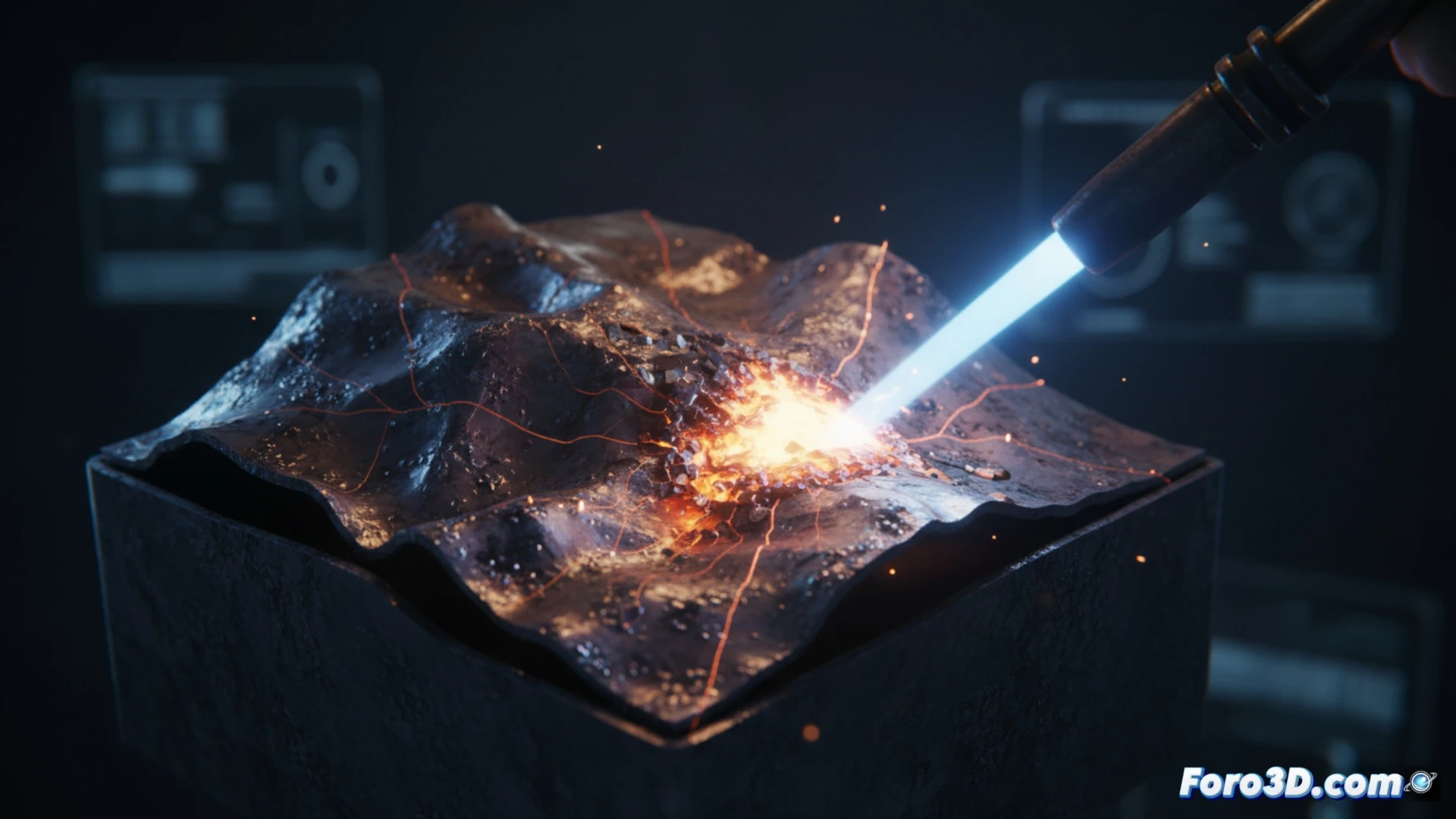
Molecular Modeling and Finite Element Simulation 🔥
At the molecular level, extreme heat accelerates the vibration of the atomic lattice, exceeding the bond energy and causing dislocation slip in metals, or chain scission in polymers. In a 3D environment, software such as Abaqus or Ansys allows simulating this process through thermal-transient analysis coupled with structural mechanics. Temperature-dependent properties, such as Young's modulus and the expansion coefficient, are defined. To model localized melting, particle simulations (SPH) are used to capture the flow of molten material and its subsequent solidification, recreating typical deformations such as sheet warping or crater formation in plastics.
Prevention and Forensic Analysis of Sabotage 🛡️
Accurate simulation of this vandalism allows forensic engineers to reconstruct the sequence of the thermal attack and assess the residual integrity of the component. By identifying characteristic deformation patterns, such as asymmetric buckling or radial microcracking, thermal barriers or early warning systems can be designed. This knowledge serves not only for incident investigation but also to harden designs against intentional attacks, integrating extreme thermal fatigue into industrial safety protocols.
In the 3D simulation of extreme fatigue due to thermal vandalism, how are localized phase transitions and residual stresses generated by abrupt cooling after applying a blowtorch to a metallic structure modeled?
(PS: Material fatigue is like yours after 10 hours of simulation.)