Organic dust, accumulated in silos or processing plants, is a lethal trigger. A single spark can unleash a violent deflagration, an explosion that propagates at subsonic speed but with devastating pressure. This phenomenon, underestimated by many, is responsible for industrial catastrophes with severe structural damage and loss of life. Modeling its dynamics in 3D is key to understanding its behavior and preventing future disasters.
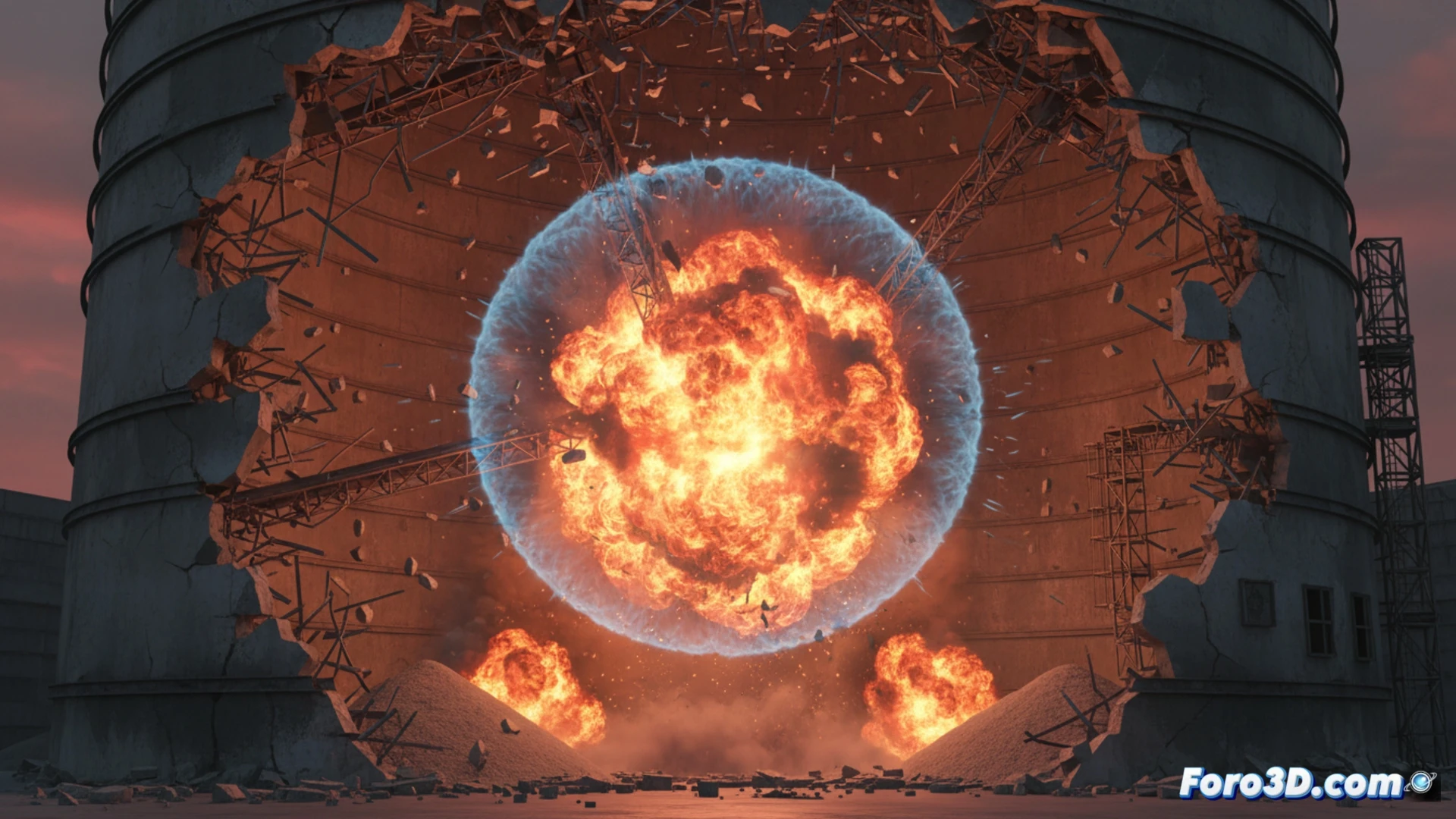
CFD modeling and particle dynamics in the blast wave 💥
To recreate a deflagration in a virtual environment, Computational Fluid Dynamics (CFD) software coupled with discrete particle simulations is used. The process begins with the exact geometry of the industrial facility, identifying areas of high dust concentration. The simulation calculates the combustion velocity of the cloud, the expansion of the shock wave, and the overpressure generated. Using adaptive meshes, it visualizes how the deflagration accelerates when passing through ducts or reflects off walls, identifying points of structural failure. The result is a dynamic risk map that allows for the redesign of ventilation and suppression systems.
Virtual lessons for real industrial safety 🛡️
3D simulation not only reconstructs the disaster but also acts as a testing laboratory. By modifying variables such as dust concentration or sensor location, pressure relief systems and isolation dampers can be validated. These tools allow engineers to anticipate failures before they occur, transforming a catastrophic event into a learning opportunity. Prevention, supported by visual models, saves lives and prevents the paralysis of industrial production.
What physical and environmental parameters (such as dust concentration, relative humidity, or silo geometry) are critical for accurately modeling the pressure wave and combustion velocity in a 3D simulation of organic dust deflagration?
(PS: Simulating catastrophes is fun until the computer melts down and you are the catastrophe.)