The coffee industry not only harbors aromas and flavors, but also a latent risk of explosion. A simple bean, when processed, generates combustible dust. Under specific conditions of concentration, oxygen, and an ignition source, this dust can trigger a deflagration. This article analyzes, through 3D simulation, how such an everyday event can lead to a catastrophe, from the initial ignition to the structural collapse of a roasting plant. 💥
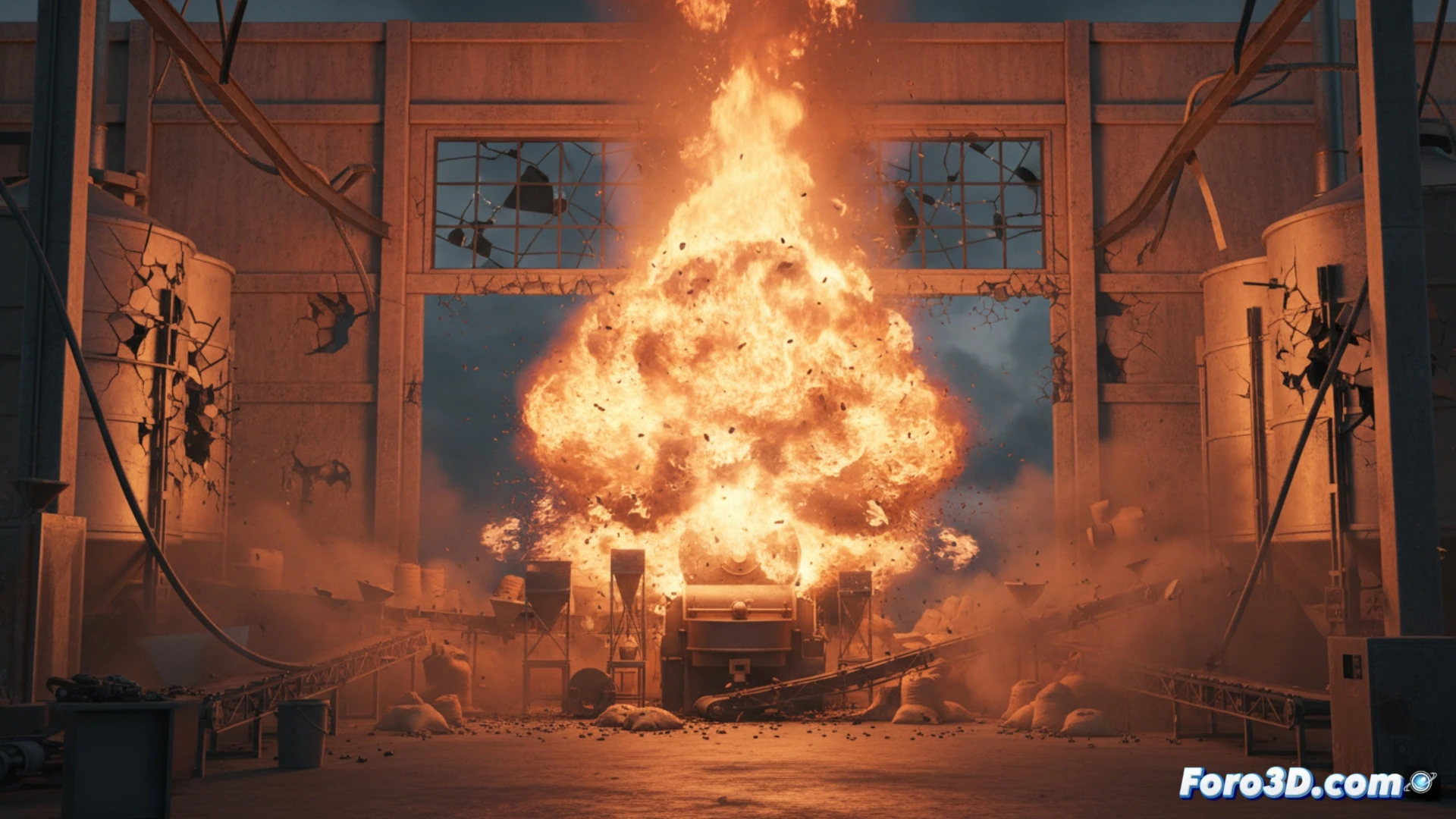
CFD Simulation: Shockwave Propagation in Storage Silos 🔥
To model the phenomenon, we use computational fluid dynamics (CFD). The 3D simulation begins with a cloud of coffee dust suspended inside a silo. The ignition source, modeled as a hot spot at 500 degrees Celsius, generates rapid combustion. In milliseconds, the internal pressure skyrockets to over 8 bars. The model results show a spherical shockwave impacting the silo walls. The 3D animation reveals how structural stress exceeds the steel's elastic limit, causing brittle fracture and the violent release of debris and incandescent material.
Prevention: The Cost of Ignoring the Invisible Particle ⚠️
The simulated catastrophe is not fiction. Real statistics indicate that 70% of organic dusts are explosive. The lesson from the 3D model is clear: an investment in ventilation systems, spark detectors, and cleaning protocols is not an expense, but a life insurance policy. Visualizing the collapse of a structure in a simulation reminds us that prevention begins by respecting the latent power within every coffee bean.
How would you model in 3D the dynamics of a deflagration from coffee particles to visualize the shockwave propagation and the critical ignition point in an industrial hopper?
(PS: Simulating catastrophes is fun until the computer melts down and you are the catastrophe.)