The glazed deflagration represents one of the most complex scenarios in urban safety engineering. This phenomenon combines a high-speed blast wave with the massive fragmentation of tempered glass, generating lethal projectiles. 3D technology today allows reconstructing these events with millimeter precision, analyzing the interaction between dynamic pressure and the facades of modern buildings.
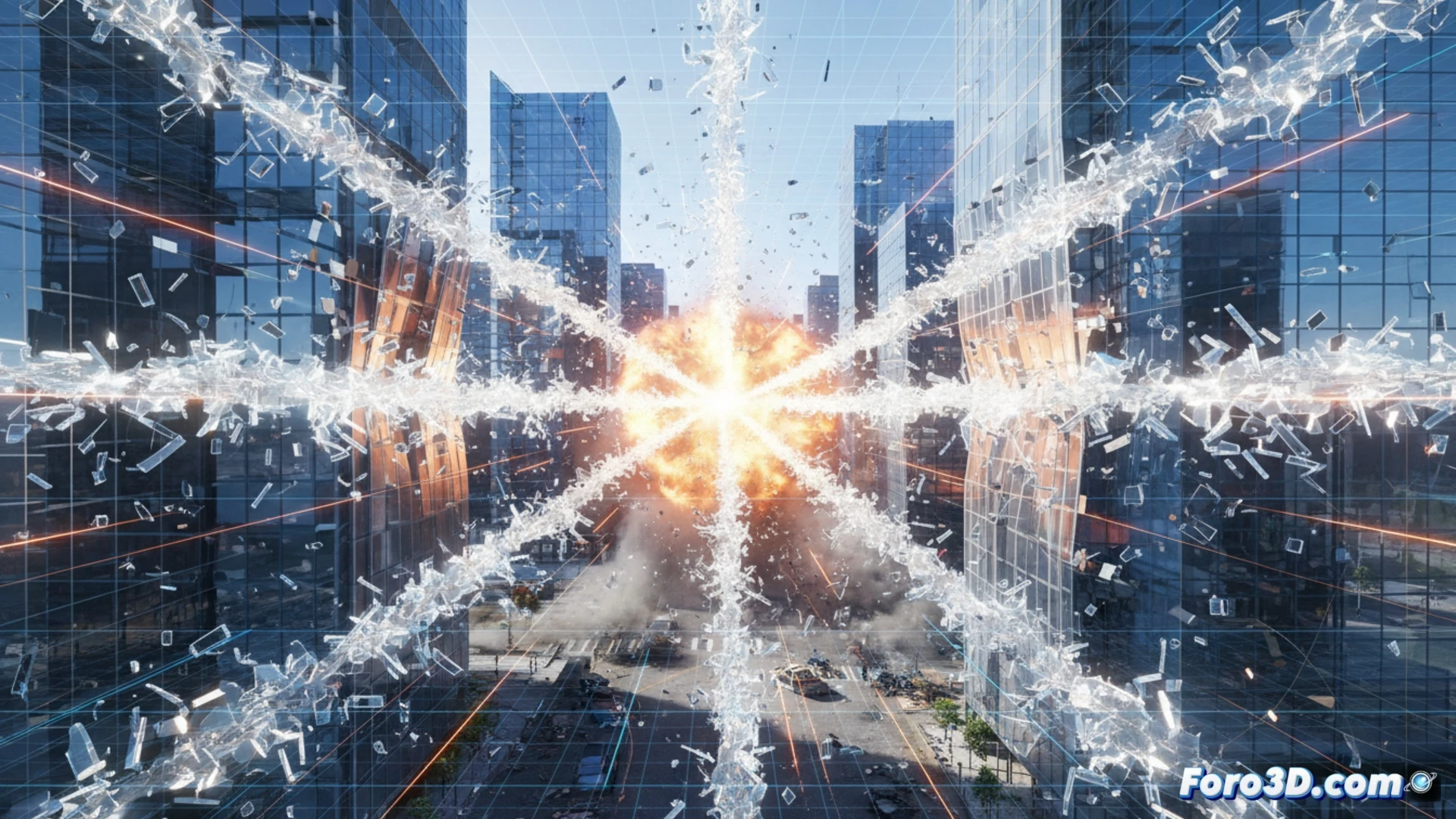
Modeling the blast wave and fragmentation 💥
The simulation process begins with the discretization of the air volume using unstructured meshes and finite volume methods. CFD (Computational Fluid Dynamics) software calculates the propagation of the shock wave, while finite element modules (FEM) evaluate the stress on the glass panels. Upon exceeding the fracture threshold, the Mott-Linfoot fragmentation model distributes thousands of shards with specific velocity vectors and mass. The results allow predicting the lethal impact zone and the load on the load-bearing structure, validating designs for laminated glass or ventilated facades.
Lessons for urban safety 🏙️
Cases like the Beirut explosion in 2020 or the deflagration in the Tianjin Zero Zone demonstrate that the main risk is not the blast wave, but the rain of glass. 3D simulations have led to regulations requiring safety films on skyscrapers and setback distances in glazing. Today, any architect can integrate these analyses into BIM to design buildings that, in the event of a deflagration, contain damage and save lives.
How does the orientation and thickness of glass panels influence the accuracy of a 3D simulation of glazed deflagration in urban environments?
(PS: Simulating disasters is fun until the computer crashes and you are the disaster.)