The resolution of a robbery at a silver shop often depends on the reliability of witnesses. However, human memory is fallible and individual perspectives can distort the facts. Comparing testimonies through virtual 3D reconstruction allows investigators to visually contrast each person's statements. By integrating photogrammetry data and laser scanning of the scene, a digital twin is generated where the trajectories and positions of witnesses are simulated with millimeter precision, revealing inconsistencies that would go unnoticed in a traditional interrogation.
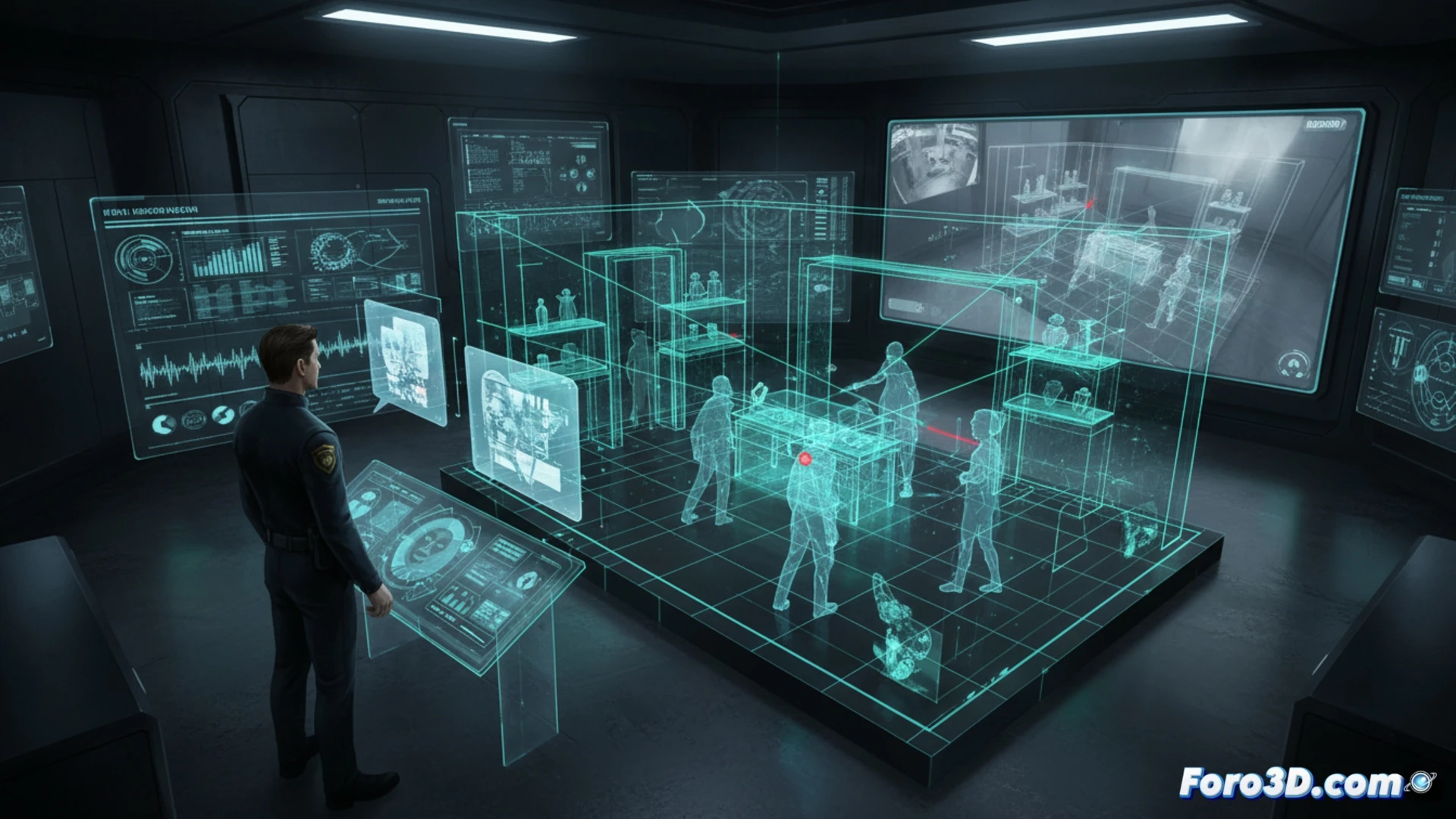
Technical Workflow for Trajectory Simulation 🛠️
The process begins with the forensic survey of the silver shop using laser scanning and high-resolution photogrammetry to capture every detail of the space, including display cases, counters, and potential obstacles. With this data, a textured 3D mesh is generated in software like RealityCapture or Agisoft Metashape. Subsequently, the model is imported into a simulation engine such as Blender or Unreal Engine. Each testimony is translated into spatial data: virtual avatars are placed in the stated positions and their movement trajectories are animated. The key tool is temporal overlay, where the accounts are synchronized to visualize what each witness saw from their exact angle at the time of the robbery, allowing for the detection of contradictions in the suspect's location or the sequence of events.
Beyond the Pixel: Validation of Human Perception 🧠
3D technology not only documents the scene but also exposes the limits of human perception. By confronting witnesses with their own visualized version in the model, a more rigorous forensic dialogue is generated. This methodology does not seek to replace testimony but to contextualize it. The true value of the forensic pipeline lies in its ability to transform the subjectivity of a narrative into quantifiable data, offering investigators a solid foundation to validate or refute statements about the silver shop robbery.
How can we determine the acceptable degree of discrepancy between witness testimonies and the 3D reconstruction of the silver shop robbery scene so that it remains considered valid forensic evidence?
(PS: don't forget to calibrate the laser scanner before documenting the scene... or you might be modeling a ghost)