Corsair has revealed at Computex 2026 a new line of hardware that directly impacts the performance of workstations for 3D modeling. The WARTHOG case, with its optimized airflow design, promises to maintain stable temperatures under sustained rendering loads. The AX1600i SHIFT 1600W power supply, for its part, offers the necessary capacity to power multi-GPU configurations and extreme overclocking in complex simulations, marking a before and after for industry professionals. 🖥️
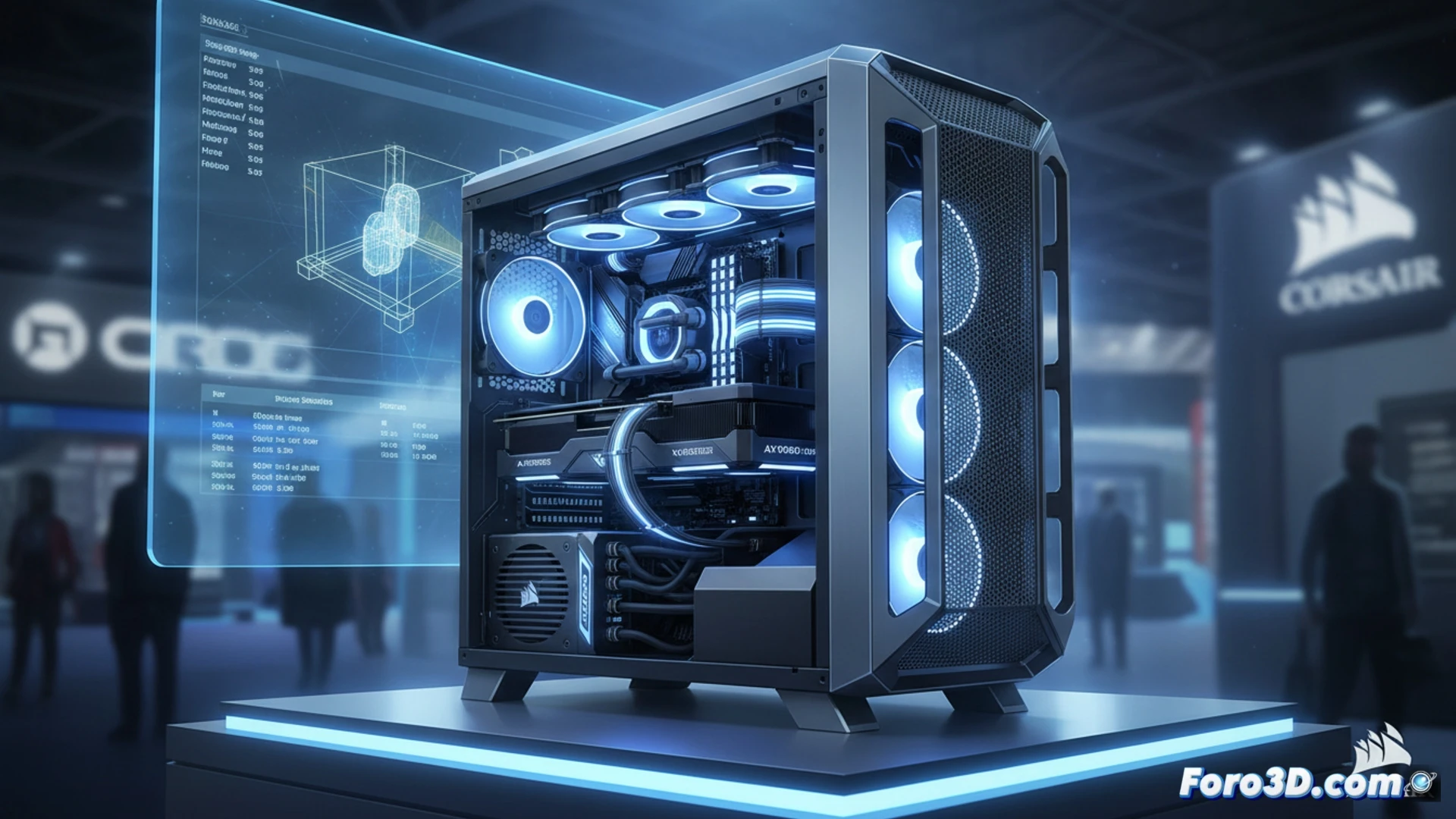
Technical analysis of the WARTHOG case and the AX1600i SHIFT power supply 🔧
The WARTHOG is not just a chassis with a military aesthetic; its interior design prioritizes direct airflow to the GPU, a critical factor for cards like the RTX 6000 or upcoming Radeon Pro. It includes native support for 420 mm radiators at the front, ideal for liquid cooling systems that prevent thermal throttling in rendering sessions of 12 hours or more. The AX1600i SHIFT, with its side connector, facilitates cabling in deep cases and offers Titanium efficiency, guaranteeing a stable and clean power supply, essential to avoid crashes during physical or fluid simulations in Blender or Houdini.
Implications for the professional 3D workflow 🎯
For the Foro3D user, these novelties represent a tangible solution to thermal and power bottlenecks. The WARTHOG and AX1600i combination allows maintaining stable overclocking on high-end CPUs and dual GPUs, reducing rendering times per frame. In an environment where every minute counts, having a system that does not degrade thermally and with a power supply that supports consumption spikes without fluctuations is a direct competitive advantage. Corsair has listened to the creator community.
Considering the new Warthog connector design and the AX1600i's focus on voltage stability under extreme rendering loads, as a 3D engineer, how does this specific hardware combination affect thermal management and sustained overclocking of a dual-chip GPU in applications like Blender or Unreal Engine?
(PS: remember that a powerful GPU won't make you a better modeler, but at least you'll render your mistakes faster)