3D food printing promises nutritional customization, but it hides a silent danger: cross-contamination. When the same printer alternates between PLA filaments and edible pastes, residues from non-food-grade materials can migrate into the food. This article analyzes the critical points of microbiological and chemical contamination in nozzles, extruders, and surfaces, offering a technical protocol to ensure food safety in domestic and professional environments.
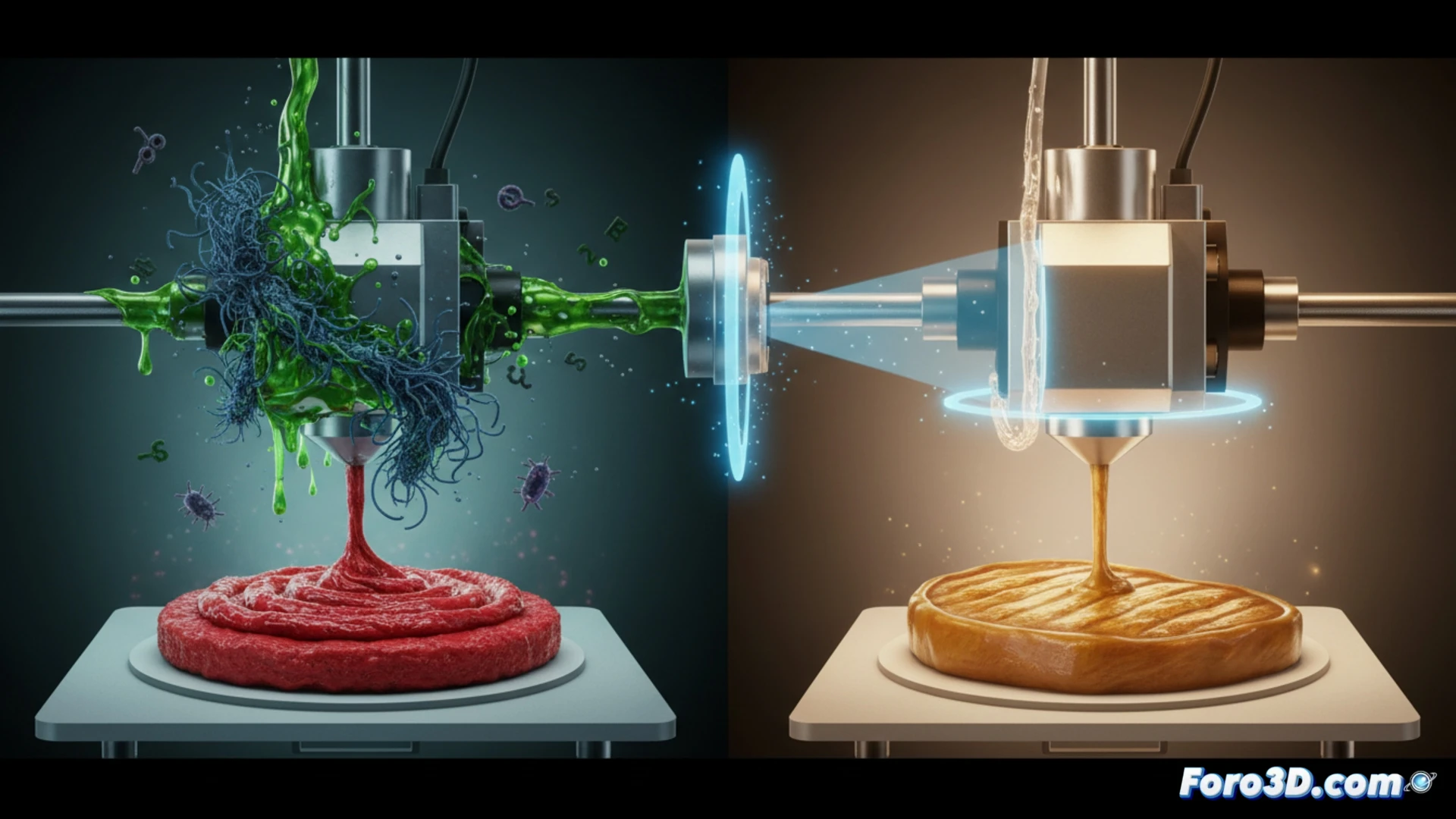
Critical contamination points in the food extruder 🍽️
The main risk focus is located in the nozzle and the feeding system. Fruit pastes, chocolates, or vegetable purées, being rich in water and nutrients, create an ideal biofilm for bacteria like Salmonella or E. coli if not cleaned immediately after use. Additionally, the prior use of technical filaments such as PLA or ABS leaves microparticles that become embedded in the hotend joints. In dual-extruder printers, cross-contamination is inevitable if the system is not purged with a certified cleaning material. 3D visualizations of cross-sections show how these residues accumulate on the internal walls of the nozzle and in the PTFE joints, creating dead zones where contamination thrives.
Towards a hygiene certification for culinary printers 🧼
The industry needs clear standards. I propose a three-phase cleaning protocol: disassembly and mechanical washing of nozzles with soft-bristle brushes, followed by a thermal purge with cleaning filament at 200 degrees, and finally chemical disinfection with peracetic acid solutions suitable for food contact. Manufacturers should certify their printers under ISO 22000 standards, clearly indicating whether the equipment is single-use (edible only) or hybrid. For the home user, I recommend physically labeling printers according to their use and changing nozzles every 50 hours of food printing. Education in 3D food safety is as crucial as recipe design.
As a food safety expert, what cleaning and disinfection protocol would you recommend to eliminate the risk of cross-contamination between vegetable protein and dairy filaments in a shared-use 3D extruder?
(PS: at Foro3D our diet is based on pixels and coffee, but at least we render vegetables)