The growing congestion of satellites and space debris in low Earth orbit has made collision prediction a critical priority. 3D simulation technologies allow for modeling orbital trajectories with millimeter precision, visualizing encounter points, and calculating impact probabilities in real time, transforming complex data into interactive representations.
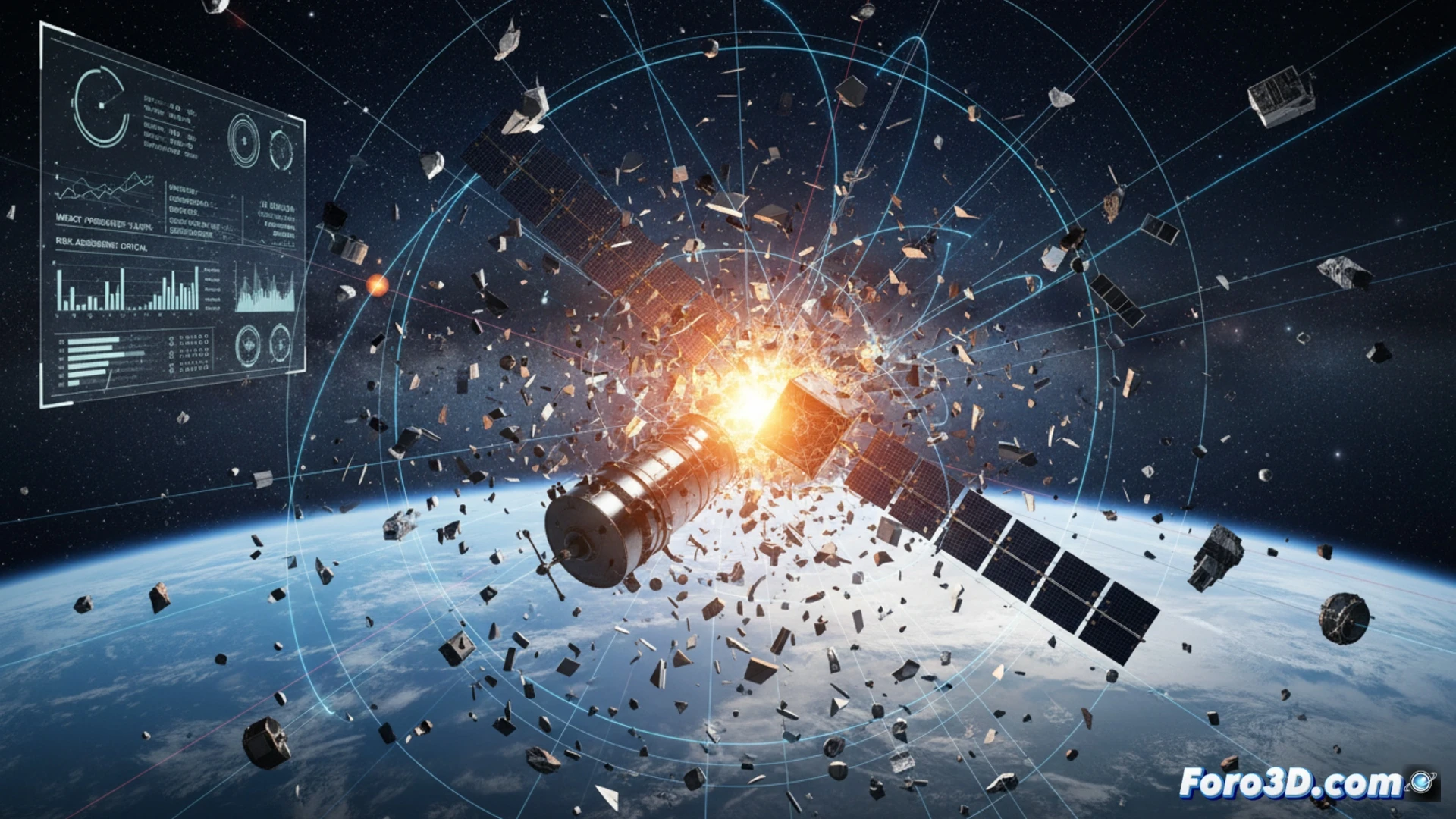
Trajectory Modeling and Impact Risk Calculation 🛰️
To simulate an orbital collision, 3D engines integrate precise ephemerides and atmospheric perturbation models. Velocity vectors and position error cones, known as covariances, are represented, defining the uncertainty zone for each object. The software calculates the minimum approach distance and generates visual alerts when this distance falls below critical thresholds. Digital twins, virtual replicas of real satellites, allow for executing simulated evasive maneuvers before applying them, validating their effectiveness without risking the physical hardware.
Lessons from Space Debris for Virtual Worlds 🌍
Cases like the Iridium 33 satellite or the ISS maneuver to dodge a Chinese fragment demonstrate that prevention is the only viable defense. In the niche of Virtual Trajectories, these simulations not only educate about real risks but also teach how to design autonomous evasion systems. The precision of 3D models turns orbital chaos into a predictive laboratory.
Which 3D simulation parameters do you consider most critical for accurately predicting the risk of collision between active satellites and space debris in low Earth orbit.
(PS: Simulating trajectories is like playing billiards, but without having to clean the table afterwards.)