The recent incident where two delivery robots collided in the middle of a public road has opened a crucial technical debate in the mobile robotics sector. Beyond the crash, the event exposes vulnerabilities in autonomous perception and navigation systems. We analyze the accident from an engineering perspective, using 3D simulation tools to replicate the scene and diagnose failures in obstacle avoidance algorithms and sensor coverage.
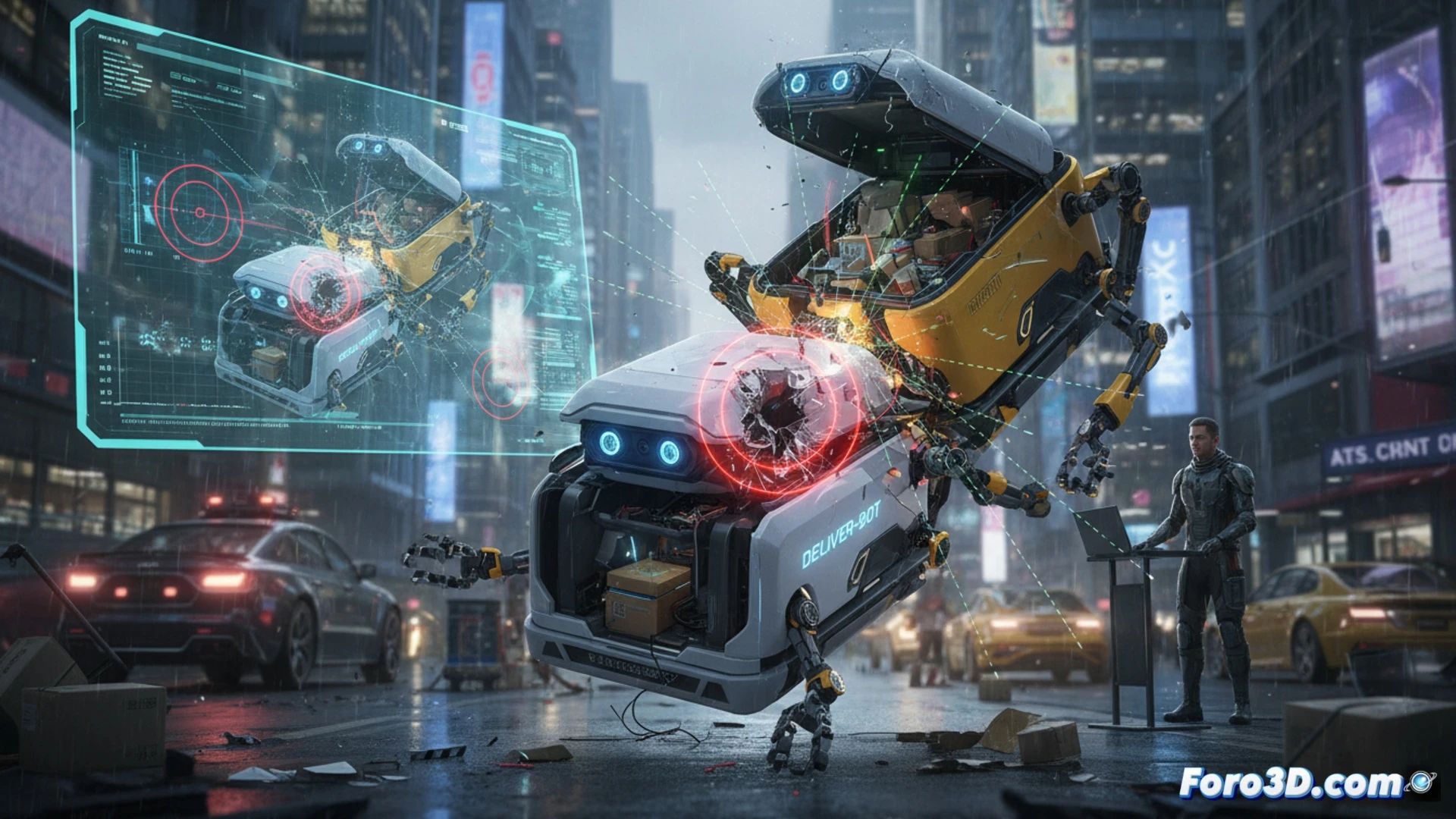
Technical recreation: fields of view and avoidance algorithms 🤖
Using a digital twin of the scenario, we can visualize each robot's fields of view. In the simulation, it is observed that the LiDAR sensors of both devices had a blind spot in the impact zone, likely due to mounting height or the reflectivity of the other robot's material. Additionally, the route planning algorithms failed by not prioritizing the braking trajectory over the optimal route. The simulation reveals that Robot A detected Robot B with a delay of 0.8 seconds, insufficient time to activate the collision protocol. The lack of sensor redundancy and the absence of a V2V (Vehicle-to-Vehicle) communication system between the units aggravated the incident.
Towards safer and more redundant navigation 🛠️
To prevent future incidents, it is imperative to implement a multimodal approach to detection. I propose integrating stereo depth cameras alongside LiDAR to cover blind spots, and adding short-range ultrasonic sensors on the sides. 3D simulation allows testing these configurations without risk. Furthermore, standardizing a communication protocol between delivery robots could synchronize their movements at intersections, transforming the collision from a failure into a design lesson for urban automation.
What specific limitations of LiDAR sensors in direct or reflected sunlight conditions could explain the lack of mutual detection between delivery robots in a simulated environment, and how could 3D simulation be improved to anticipate these failures?
(PS: Simulating robots is fun, until they decide not to follow your orders.)