The term Pollinator Collision describes a critical phenomenon where insects like bees and butterflies collide with urban obstacles or compete for limited resources. Thanks to 3D technology, scientists can model these interactions with millimeter precision. This article explores how volumetric simulations and heat maps allow for the analysis of flight paths, impact rates, and flight biomechanics, offering a powerful tool for species conservation and the design of ecological infrastructure.
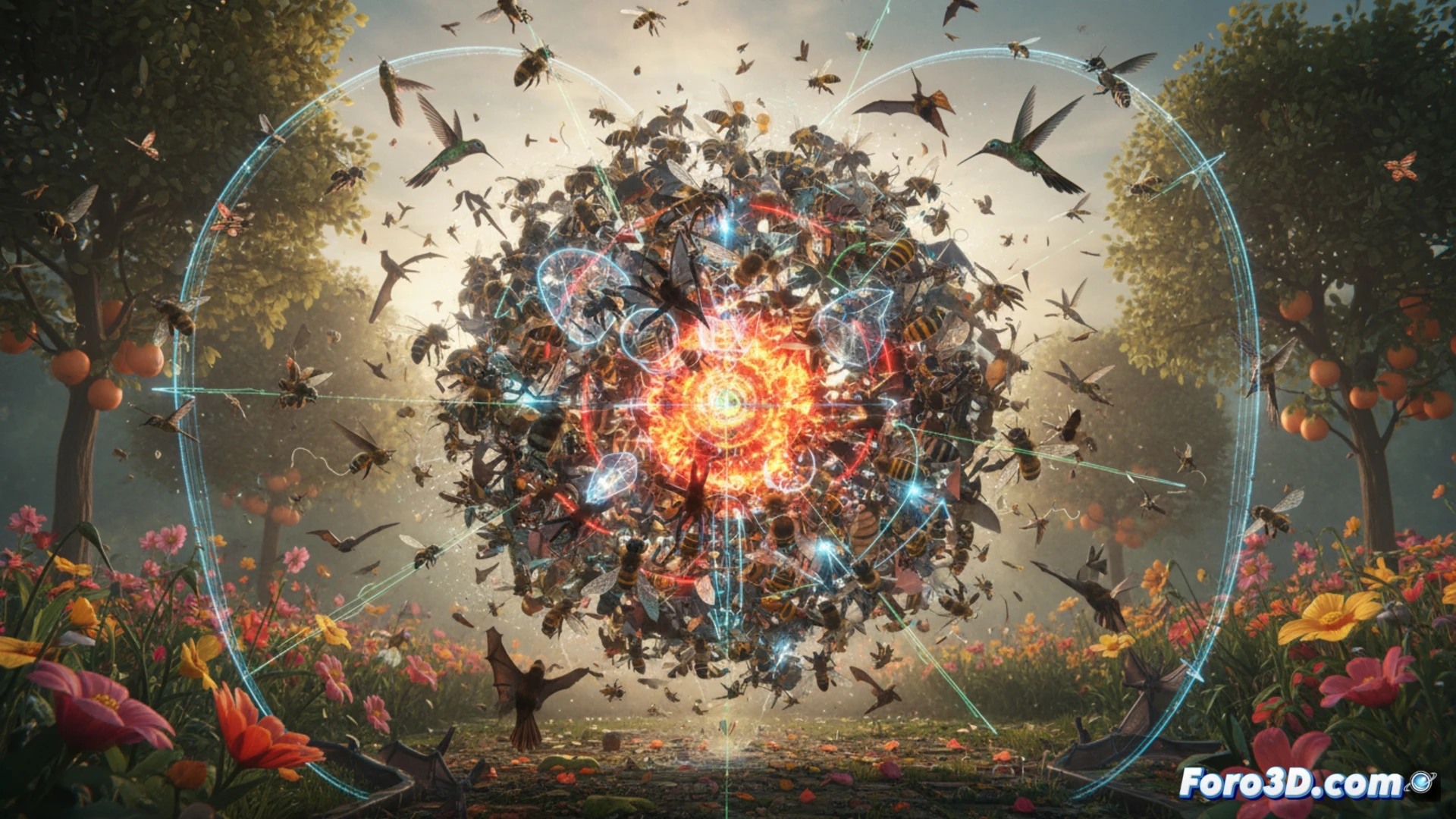
3D Modeling of Trajectories and Flight Biomechanics 🐝
To study collisions, researchers use computational fluid dynamics (CFD) software integrated with real-time rendering engines. First, flight data is captured using high-speed cameras and LiDAR sensors. Then, detailed anatomical models of the pollinators are reconstructed, including wing structure and exoskeleton. Simulations reveal turbulence patterns and structural stress points during impact. Tools like Blender or Houdini allow for the visualization of population density maps, where warm colors indicate areas of high collision probability with windows, vehicles, or pesticides. This analysis is vital for predicting colony decline and redesigning safer urban environments.
Ecological Awareness Through Simulation 🌿
Beyond pure science, these visualizations have a profound emotional impact. By observing a 3D simulation of a bee deforming against a reflective surface, the viewer understands the fragility of the ecosystem. Interactive representations allow urban planners and biologists to modify variables such as flower density or hive location, seeing in real-time how collisions are reduced. This approach transforms abstract data into an immersive visual narrative, turning technology into a bridge between research and public awareness about the pollinator crisis.
How 3D simulation tools and particle systems can help model and visualize the chaotic trajectories of pollinators when colliding with urban obstacles to predict critical impact points in the ecosystem
(PS: fluid physics for simulating the ocean is like the sea: unpredictable and you always run out of RAM)