The recent news about a drone impacting a power line reminds us of the fragility of our critical infrastructure in the face of emerging threats. Although the incident did not escalate into a major catastrophe, the potential for damage is real. We analyze this scenario using 3D simulation to model the collision, evaluate the structural integrity of towers and cables, and visualize the power supply interruption, offering a basis for prevention and rapid response protocols.
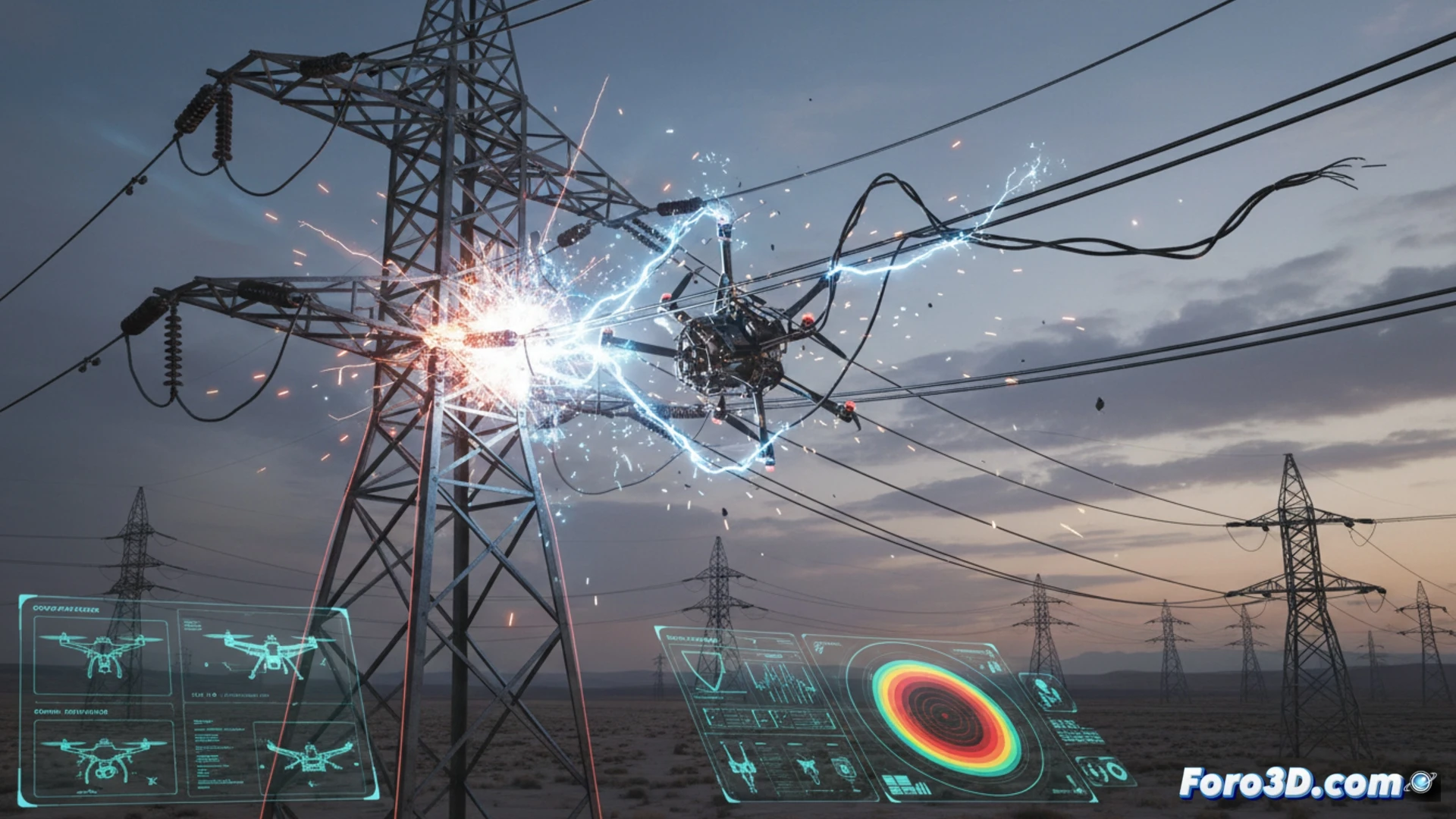
3D modeling of the collision and structural damage assessment ⚡
To simulate the impact, a detailed 3D model of a high-voltage tower and its power line is built, assigning physical properties to the materials (steel, aluminum, and drone composite). Computational fluid dynamics (CFD) and finite element analysis (FEA) simulation allow recreating the collision at speeds of up to 80 km/h. The results show that a direct impact on the main cable can cause significant plastic deformation, reducing its working tension by 30% and generating micro-arcs. On the tower, a strike on a crossarm can propagate fatigue cracks, compromising stability. The 3D visualization of the event allows identifying critical failure points and predicting the cascade of blackouts in the grid.
Lessons for critical infrastructure protection 🛡️
The simulation reveals that prevention is key. Installing impact sensors and drone detection systems (radar or acoustic) in substations and strategic lines reduces response time. Additionally, designing power lines with vibration dampers and reinforced shield wires mitigates damage. 3D visualization also serves to train emergency teams, simulating supply cuts and load relocation. This proactive approach transforms an isolated incident into an opportunity to strengthen the grid's resilience against accidents or intentional acts.
Which simulation parameters are critical for predicting structural damage to a power line after the impact of a commercial drone, and how do they influence the prevention of cascading short circuits?
(PS: Simulating catastrophes is fun until your computer melts down and you are the catastrophe.)