The failure of an anchor in a wind turbine is not just a mechanical accident; it is a catastrophe foretold by material fatigue. This article analyzes the collapse from the perspective of 3D simulation, breaking down the stress sequence that leads to catastrophic rupture. We will model the behavior of steel under extreme load cycles to visualize the exact point of failure and propose structural solutions using digital twins.
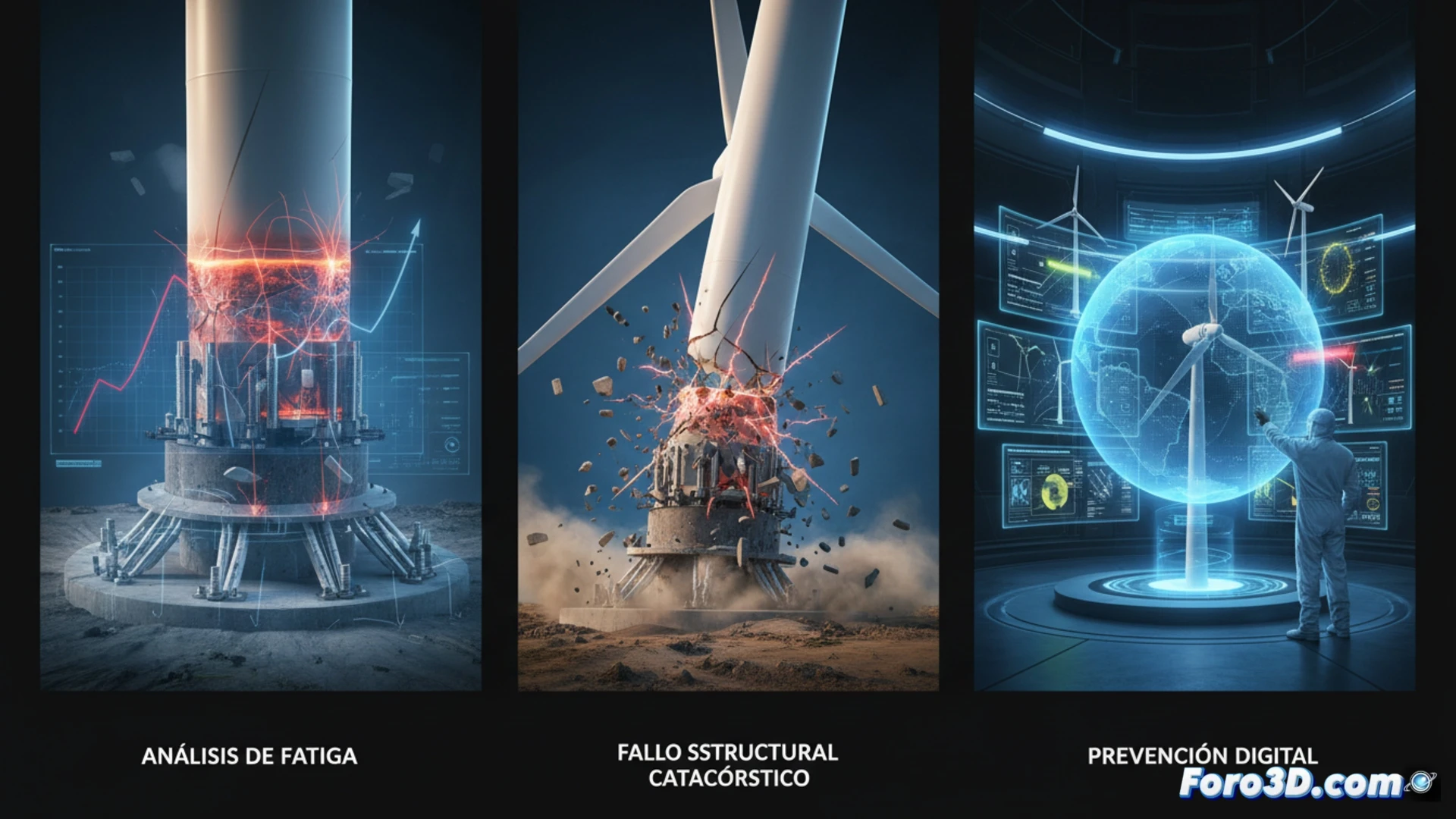
Technical Simulation of the Tensile Rupture Mode 🔧
The 3D simulation begins with a finite element model of the anchor subjected to cyclic wind and torque loads. The software reveals that stress concentration accumulates at the welded joint between the base plate and the anchor bolt. After 10,000 simulated cycles, a microcrack is observed progressing in a ductile rupture mode, accelerated by stress corrosion cracking. The 3D visualization shows how localized plastic deformation causes the sudden detachment of the tower, an event that in reality generates a cascade of damage to the nacelle and blades. The digital twin allows modifying material and geometry parameters in real time to identify the critical design point.
Lessons from the Collapse for Structural Design ⚙️
The catastrophe underscores the need to redesign anchors with dynamic safety factors. The 3D model suggests that incorporating a second redundant anchor point, visible in the simulation, distributes loads and delays fatigue. Furthermore, the use of virtual sensors in the digital twin allows predicting the remaining service life of the steel, transforming disaster prevention into a data visualization science. This lesson is vital for any critical infrastructure exposed to extreme conditions.
Is it possible to predict, through parametric simulations in real time, the exact point of fatigue failure in a wind turbine anchor before structural collapse occurs?
(PS: Simulating catastrophes is fun until the computer crashes and you are the catastrophe.)