Gravitational energy collapse is not just a concept in astrophysics; it is a real mechanism of destruction in human infrastructure. When gravitational force exceeds the structural resistance or energy dissipation capacity of a system, a cascading failure is triggered. In this article, we explore how 3D simulations allow us to model this phenomenon, from material fatigue to progressive deformation, visualizing the exact moment when gravity turns a stable structure into an uncontrolled source of kinetic energy.
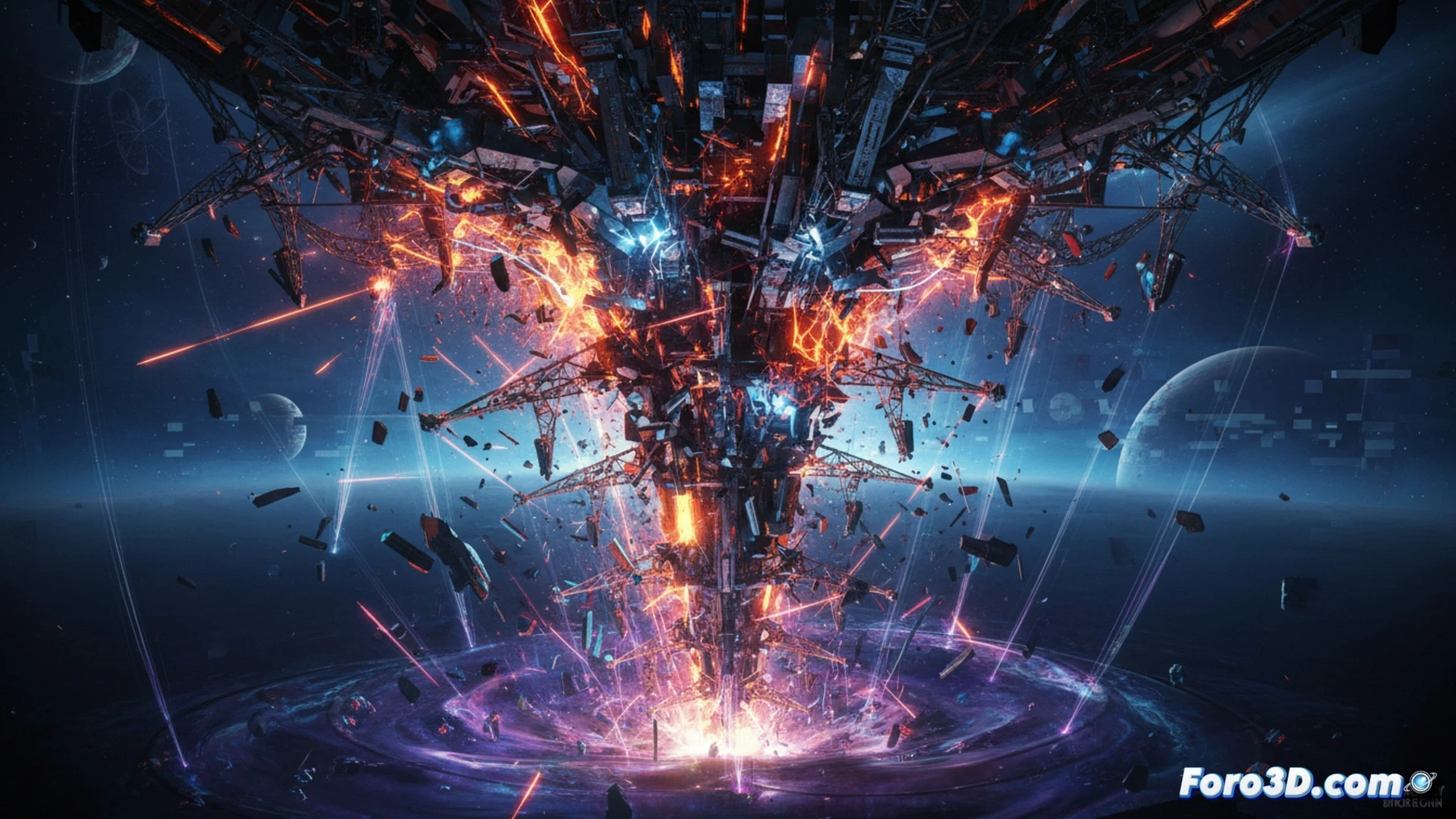
Technical Modeling: Material Fatigue and Progressive Deformation 💥
To simulate a gravitational collapse, finite element models are used to calculate the stress at each point of the structure. The process begins with a static load, where gravity acts as a constant force. By introducing microcracks or cyclic fatigue, 3D animation software (such as Blender or Houdini with physics engines) can show how a localized failure point propagates. The key lies in potential energy: when a support gives way, the mass releases gravitational energy that is converted into plastic deformation and fracture. Parametric simulations allow adjusting material density, Young's modulus, and gravitational acceleration to predict the exact collapse pattern, whether in a suspension bridge or a concrete dam.
Lessons from the Void: When Gravity Shows No Mercy ⚠️
Observing these simulations confronts us with an uncomfortable truth: gravity is an unrelenting force that only waits for the moment of material weakness. In the realm of disasters, energy collapse reminds us that any energy system (power plants, cooling towers) must be designed not only to withstand loads but also to dissipate the energy of a failure. Modeling these events in 3D not only prevents tragedies but also teaches us to respect the boundary between stability and chaos.
Would you export the results to GIS format?