The term Tennis Collapse immediately evokes the image of a failed sports infrastructure, whether it be an indoor court, a grandstand, or an annex building. For a specialist in ruin reconstruction, this event is not just news, but a forensic case study. Our goal is to go beyond simply visualizing the disaster; we seek to model in 3D the pre-collapse state and contrast it with the current remains to dissect the mechanics of the failure.
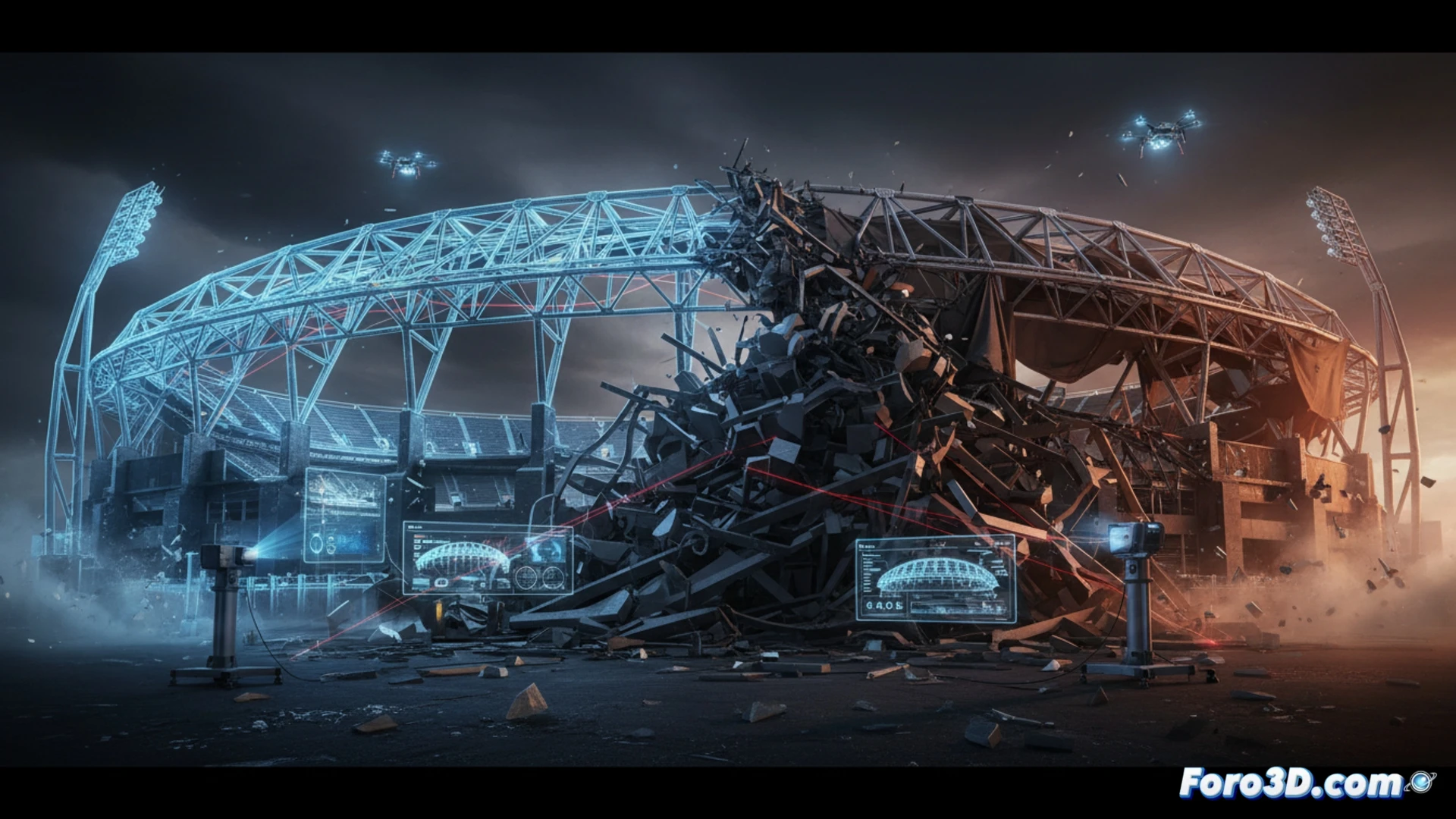
Technical Workflow: Modeling Against Fatigue Points 🏗️
The initial phase consists of digitizing the remains through photogrammetry or terrestrial laser scanning (LIDAR), generating a point cloud of the post-collapse state. In parallel, the ideal 3D model of the original structure is reconstructed, based on construction plans, building permits, and archival photographs. The critical analysis arises when superimposing both models. Using solid dynamics simulation software, such as Blender with Physics or ANSYS, we can recreate the collapse sequence. This allows identifying areas of stress concentration, possible foundation errors, or material fatigue in key joints and beams that may have initiated the catastrophe. The metric comparison between the theoretical model and the debris reveals dimensional discrepancies that point to construction defects.
Virtual Preservation of Sports Memory 🎾
Beyond failure analysis, this reconstruction has heritage value. A collapsed tennis court is not just a pile of concrete; it is a place of competition and memories. By generating a 3D model that documents both the original structure and its ruin state, we create a perpetual virtual archive. This model will serve as technical evidence for litigation, as educational material for structural engineers, and above all, as a digital testimony that preserves the form and history of a lost sports space.
What specific photogrammetry and laser scanning methodologies are used in the 3D reconstruction of sports infrastructure ruins to accurately determine failure sequences and collapse patterns in forensic structural analysis?
(PS: Reconstructing ruins is like doing a puzzle without knowing how many pieces are missing. But at least you can make up the missing ones.)