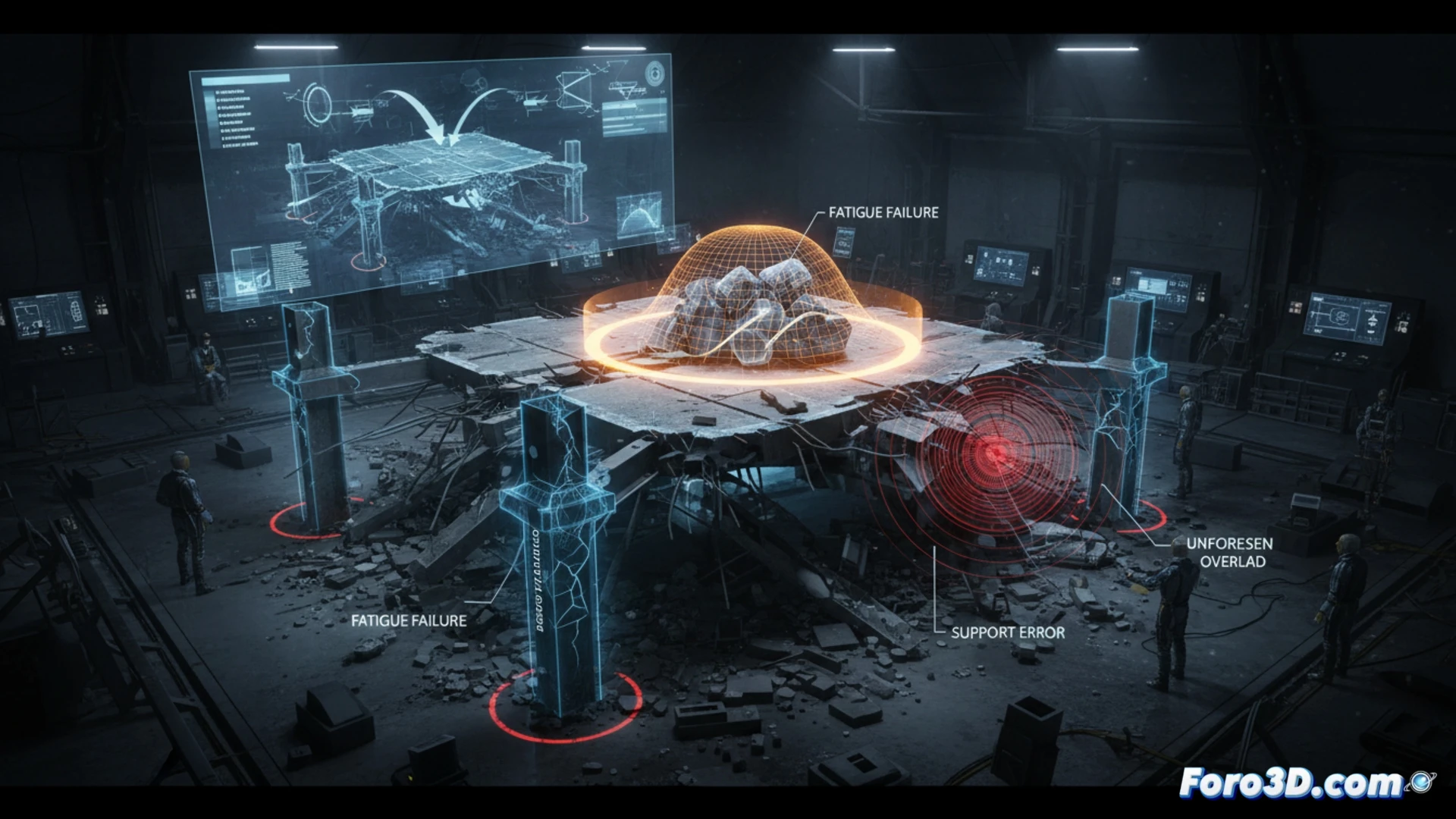
The collapse of a base platform is not a random event, but the result of a chain of failures that can be predicted through numerical simulation. In this article, we will address the 3D modeling of a collapsed structure to apply forensic engineering techniques, identifying fracture points due to material fatigue, calculation errors in supports, and overloads not considered in the original design.
Virtual Reconstruction and Stress Simulation 🏗️
Virtual reconstruction begins with capturing data from the incident, such as metric photographs and sequence testimonies. In the modeling software, we recreate the platform with its nodes and main beams, assigning real mechanical properties to the materials (structural steel or reinforced concrete). We apply static and dynamic loads using finite element analysis (FEM) to replicate the pre-collapse conditions. The results reveal stress concentrations at welded joints and anchor points, where the modulus of elasticity was exceeded, initiating crack propagation. Temporal simulation allows visualizing the exact order in which the supports yielded, confirming whether the cause was an accidental overload or a manufacturing defect.
Lessons from the Collapse for Structural Design 🔍
This forensic analysis demonstrates that most base platform collapses originate at the interface between components, not in the solid body of the beam. Common design errors include underestimating wind loads or cyclic fatigue from machinery vibrations. By modeling these variables in 3D, engineers can validate safety margins and propose localized reinforcements. Digital reconstruction not only explains the past but prevents future structural failures.
What critical factors in the numerical simulation of a base platform allow identifying failure points prior to structural collapse?
(PS: Simulating a collapse is easy. The hard part is keeping the program from crashing.)