The recent collapse of a floating solar panel has brought the vulnerability of floating renewable infrastructure into focus. This incident, far from being an isolated event, reveals critical failures in the interaction between composite materials and hydrodynamic loads. Using 3D finite element simulation, we analyze the fatigue and collapse process, breaking down the stresses that led to the catastrophe to extract applicable engineering lessons.
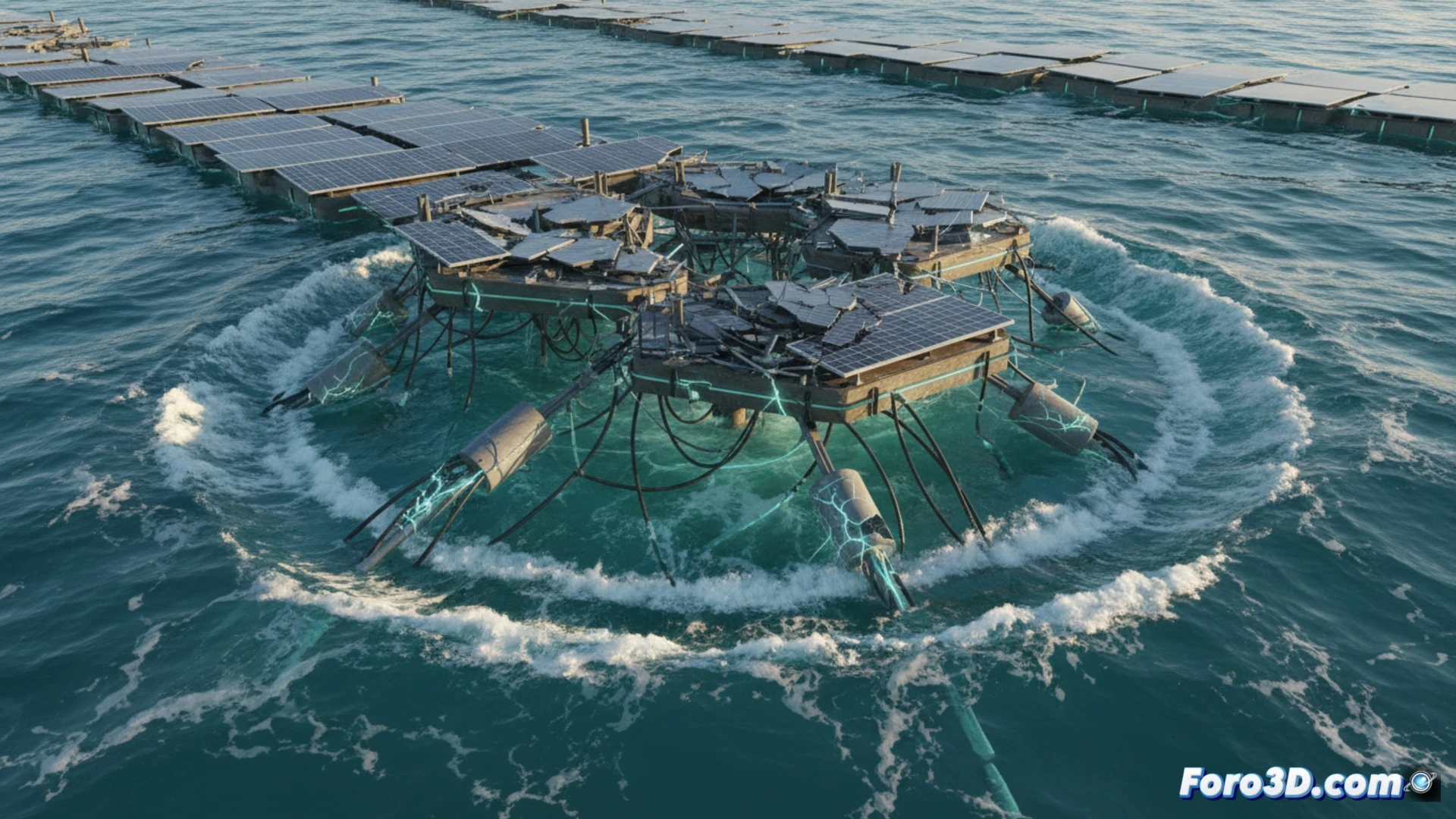
STRUCTURAL FATIGUE ANALYSIS AND HYDRODYNAMIC LOADS 🌊
The 3D simulation modeled the panel as a set of photovoltaic panels mounted on an aluminum frame and polyethylene floats. Extreme wave conditions (wave height of 3 meters and period of 8 seconds) and wind loads of 120 km/h were applied. Fatigue analysis revealed that the anchor points between floats and the structure supported cyclic stress concentrations exceeding 180 MPa. Failure initiated at the weld of the central node, with a crack propagating due to embrittlement, leading to the total collapse of the frame in less than 15 load cycles. The visualization of the collapse shows an asymmetric torsion pattern that triggered progressive sinking.
LESSONS FOR PREVENTING RENEWABLE INCIDENTS ⚠️
This incident demonstrates that safety in aquatic infrastructure cannot be based solely on static resistance. The 3D simulation highlights the need to include dynamic dampers and reinforcements at critical nodes to mitigate wave-induced fatigue. I propose implementing a real-time structural monitoring system using strain sensors, capable of alerting before a crack reaches the collapse threshold. Only then can we prevent energy progress from sinking along with its platforms.
What critical structural fatigue parameters should be modeled in a 3D simulation to predict the collapse of a floating solar panel under extreme weather events?
(PS: Simulating catastrophes is fun until the computer melts down and you are the catastrophe.)