The collapse of a suspended pool in a residential complex has reopened the debate on load limits in elevated structures. Using 3D forensic engineering, we have modeled the original structure to identify the exact point of failure. This article virtually reconstructs the incident, simulating the weight of the water, steel fatigue, and localized corrosion, offering a technical visualization of the before and after of the disaster.
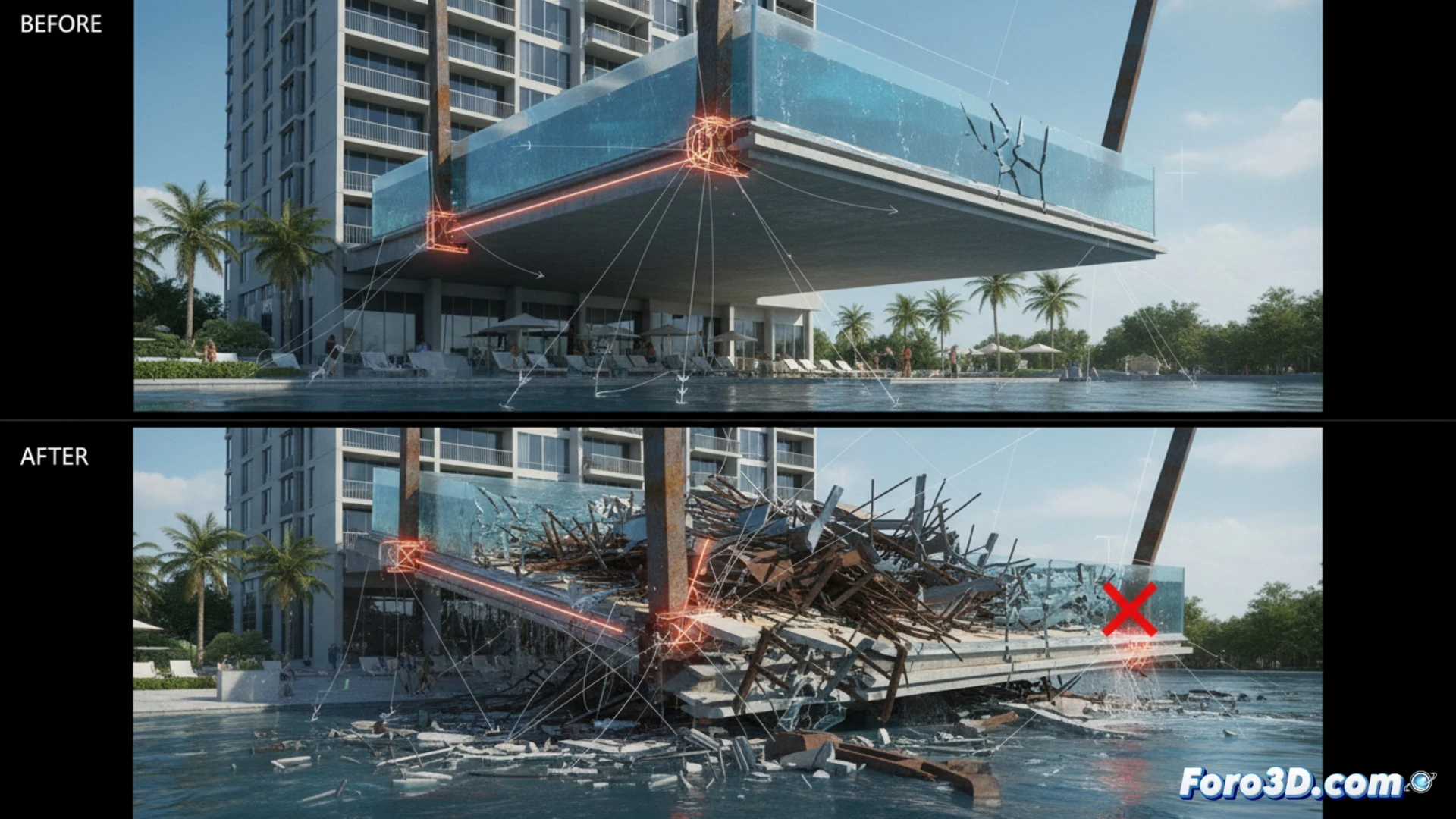
Load Modeling and Failure Point Simulation 💧
For the analysis, the pool volume (60,000 liters) was recreated, and a distributed load of 600 kN was applied to the slab. The FEM model revealed that the critical point was located at the joint between the perimeter beam and the floor slab. The simulation showed that, after 12 years of service, chloride corrosion reduced the effective cross-section of the reinforcing steel by 35%. When the wave impact factor was added, the stress exceeded the yield limit, generating a progressive crack that led to total collapse. The shear stress diagrams showed a concentration of 4.2 MPa in the failed area, well above the allowable limit of 2.8 MPa.
Lessons for the Design of Elevated Hydraulic Structures 🏗️
This incident demonstrates that 3D modeling is not only useful for visualizing the disaster but also for anticipating failures during the design phase. The combination of dynamic loads (moving water) and chemical degradation (chlorides) is lethal if not considered in the calculations. As technical writers, we must insist that every suspended pool requires a digital twin that simulates its entire life cycle, including delayed corrosion. Safety is not a render; it is a rigorous simulation.
Which structural and 3D simulation parameters should be prioritized in forensic analysis to prevent the collapse of a suspended pool?
(PS: Simulating a collapse is easy. The hard part is not crashing the program.)