Biomass collapse represents the terminal phase of an ecosystem, where biodiversity loss and desertification advance irreversibly. At Foro3D.com, we have developed a three-dimensional model that visualizes this catastrophic process, starting from a healthy temperate forest to its transformation into a barren wasteland. The simulation allows year-by-year observation of how deforestation and climate change accelerate the mass death of species, offering a visual tool for disaster prevention.
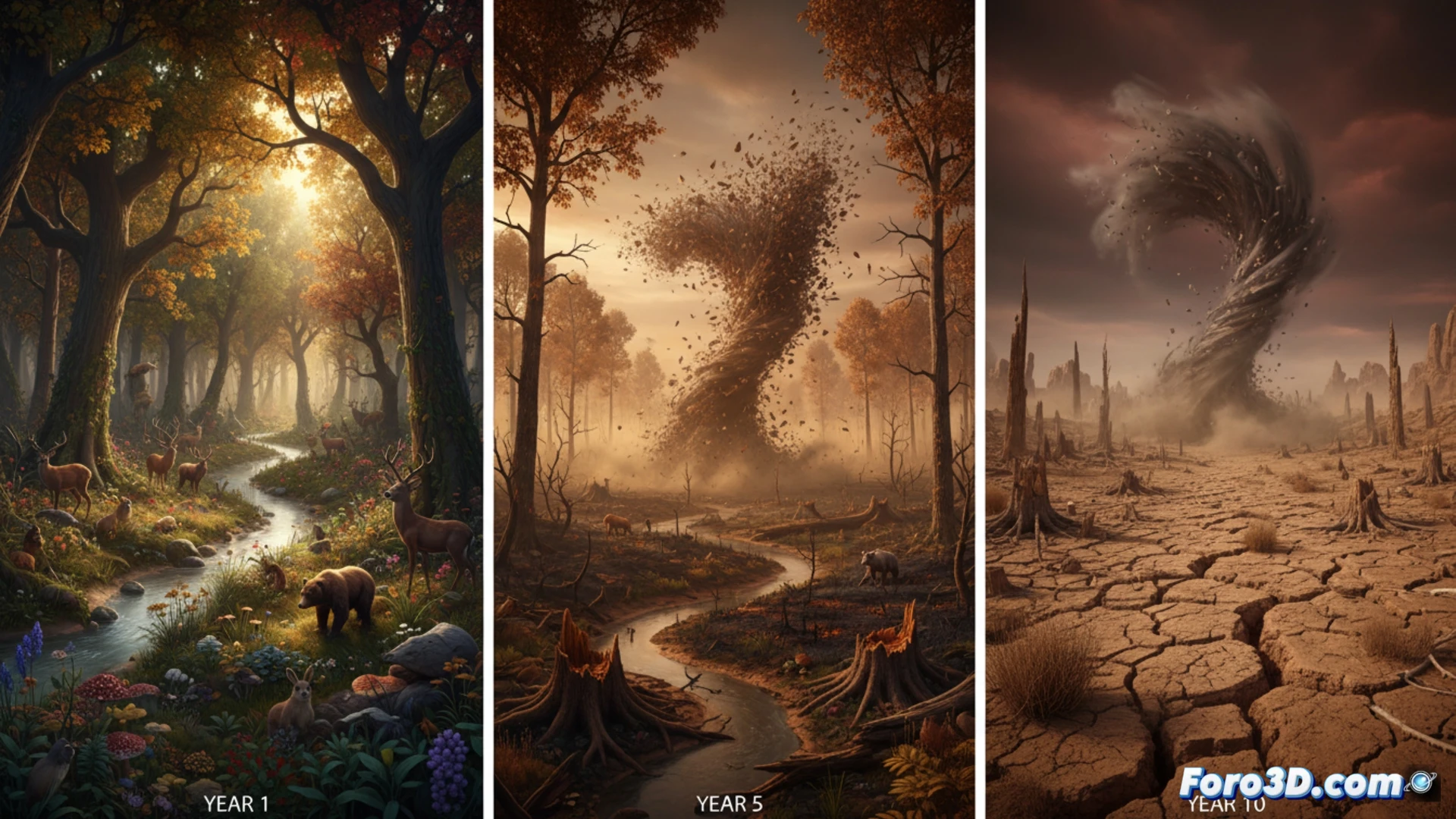
Three-Dimensional Modeling and Desertification Data 🌍
Our model uses satellite data from NASA and the FAO to recreate a 10-square-kilometer biome. The temporal simulation employs a particle engine to represent fauna and flora, adjusting parameters such as photosynthesis rate, soil moisture, and average temperature. In the healthy phase, the tree canopy shows a density of 800 trees per hectare and 120 animal species. After 15 years of simulated climate stress, density drops to 40 trees per hectare and only 5 species survive. The 3D infographic includes heat maps showing the expansion of the arid zone and habitat fragmentation, allowing analysts to identify critical tipping points.
When Green Turns Gray: Visual Lessons ⚠️
The question that arises when observing the animation is whether we have time to reverse the trend. The model reveals that once the soil loses 70% of its organic matter, natural regeneration is almost impossible in less than a century. Seeing the forest collapse in 3D not only has a visual impact but also translates scientific data into a tangible warning. For disaster response teams, this simulation is a reminder that collapse is not a sudden event but a spiral from which it is difficult to escape without immediate intervention.
How the feedback between biodiversity loss and desertification can be modeled in 3D to visualize the tipping points of a collapsing ecosystem
(PS: Simulating catastrophes is fun until the computer crashes and you are the catastrophe.)