Space debris is no longer a theoretical threat. In this technical article, we analyze the 3D modeling of an impact between two orbital spacecraft. Using trajectory data, relative velocity, and angle of incidence, we simulated the catastrophic fragmentation of the satellites. The result is an expanding debris cloud that redefines the risk for the International Space Station and other assets in low Earth orbit.
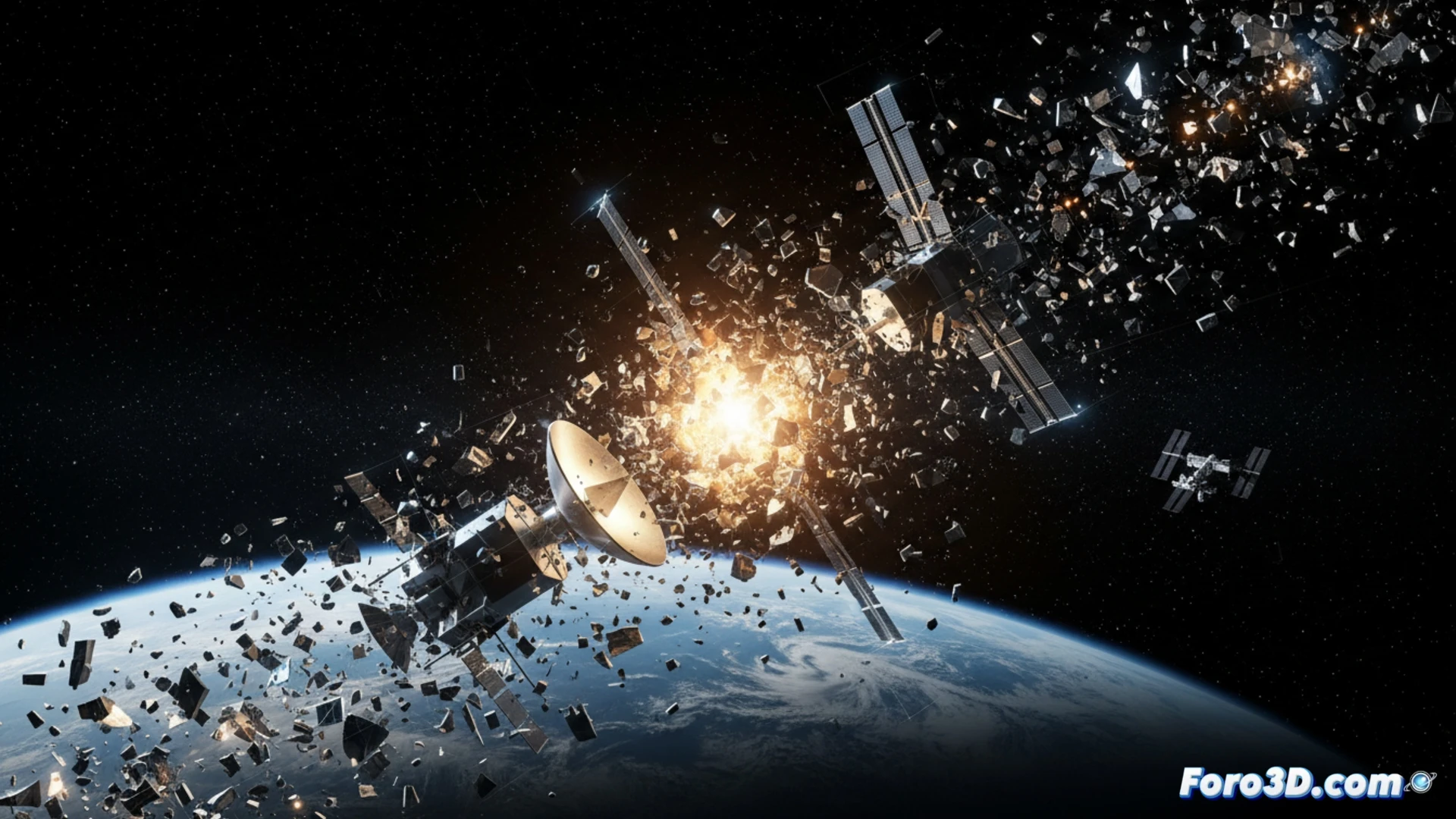
Kinetic Modeling and Fragment Dispersion 🛰️
For the simulation, we set a closing velocity of 10 km/s with an impact angle of 45 degrees. The computational fluid dynamics software applied hexahedral meshing to the solar panel structures and the satellite bus. After the collision, the finite element analysis calculated the transferred kinetic energy, generating over 1,200 traceable fragments. The 3D visualization showed a conical dispersion of debris, with velocity vectors increasing the risk of secondary impact by 340% within a radius of 200 orbital kilometers.
Prevention as the Only Defense 🚀
The simulation confirms that once the impact occurs, mitigation is nearly impossible. The fragment cloud travels at hypersonic speeds, penetrating any standard shielding. The lesson is clear: orbital catastrophe is not repaired, it is prevented. Modeling these scenarios in 3D allows space agencies to plan evasive maneuvers and design satellites with passive deorbiting systems, reducing the debris legacy that future generations will inherit.
How 3D modeling of fragment dispersion after a satellite impact is performed and which physical parameters are critical for accurately simulating the evolution of the resulting space debris cloud
(PS: Simulating catastrophes is fun until your computer crashes and you become the catastrophe.)