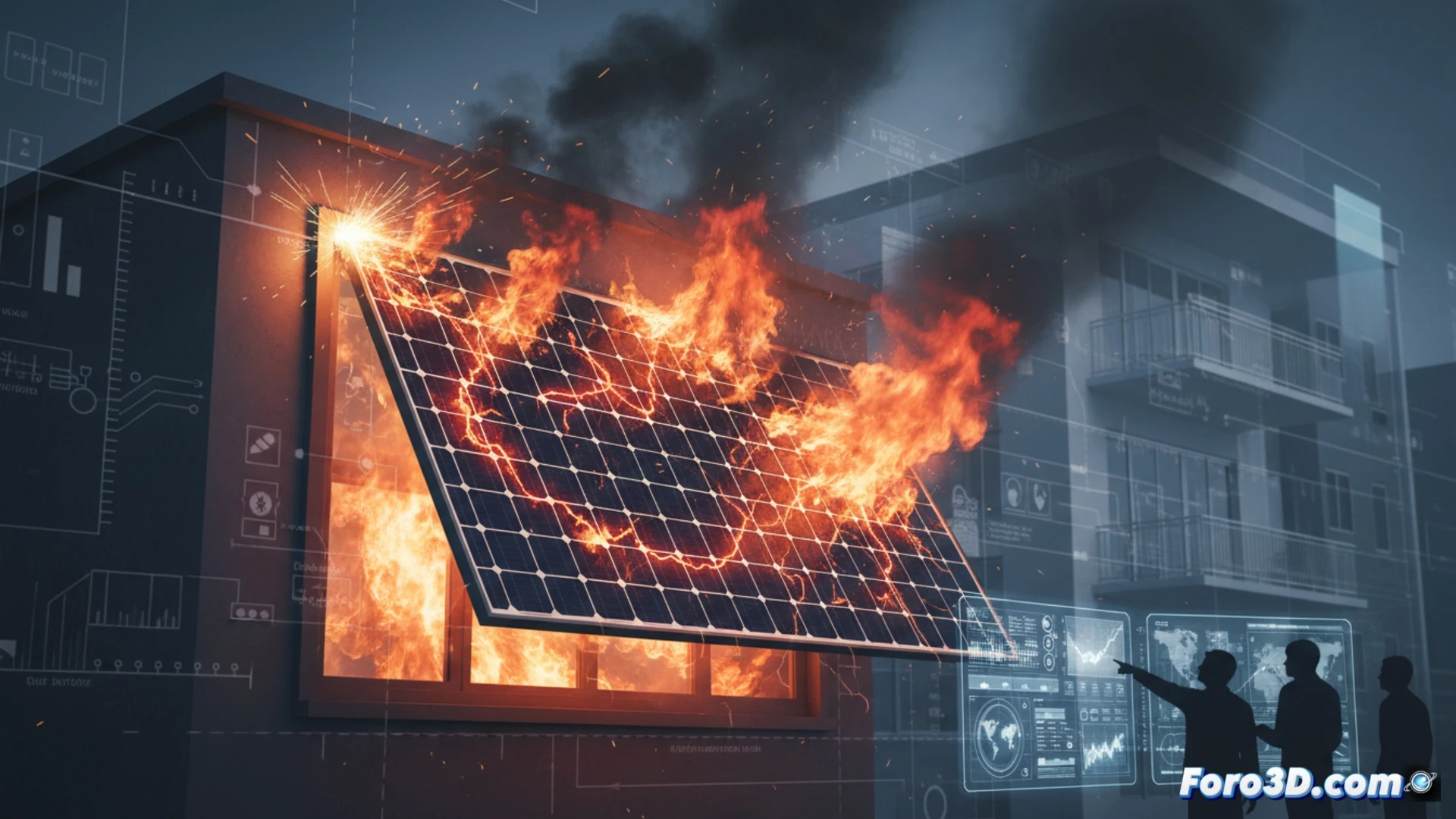
A small electrical fault in a photovoltaic panel can turn into a catastrophe in seconds. The news about the spark in a solar window forces us to rethink the safety of these installations. To understand the risk, we have used 3D modeling to recreate the incident. The goal is to visualize the dynamics of the incident, from the ignition point to the fire spread, allowing engineers and firefighters to anticipate critical failure points in solar energy systems.
Technical Analysis: Fire Spread in Photovoltaic Systems 🔥
In our simulation, the 3D model shows how a spark caused by a faulty connector or a micro-crack in the tempered glass can ignite the combustible materials of the encapsulant (EVA). The localized temperature exceeds 300 degrees Celsius. The virtual recreation reveals that the airflow under the panels, designed for cooling, acts as a conduit that accelerates the spread of flames towards the roof. The modeling allows modifying variables such as the distance between modules or the type of support to observe how these changes contain or worsen the fire.
Virtual Lessons for Safer Energy ⚡
The spark in the solar window is a reminder that renewable technology requires rigorous prevention protocols. Thanks to 3D simulation, we can visualize the risk before it occurs in reality. This analysis proposes concrete design improvements: from installing fireproof insulators to optimizing ventilation so as not to fuel the fire. Prevention is not just theoretical; we can now see and correct it in a virtual environment.
What electrical and environmental parameters should be modeled in a 3D simulation to accurately predict the spread of a fire from a spark in a photovoltaic panel?
(PS: Simulating catastrophes is fun until your computer melts down and you are the catastrophe.)