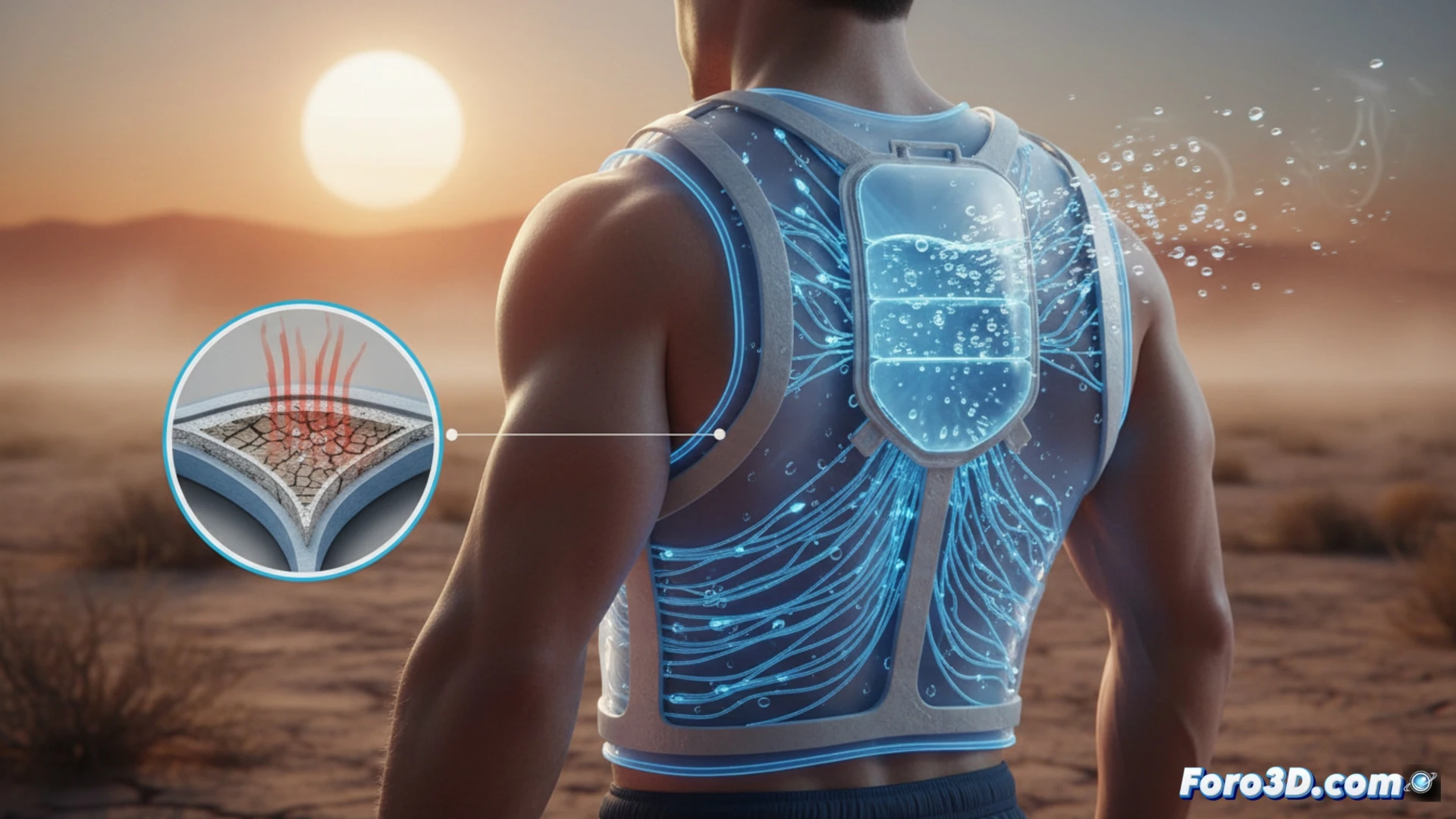
Summer brings with it the need for innovative textile solutions for thermal comfort. This tutorial details the creation of a cooling vest through 3D printing, whose core is a back panel with capillary microchannels. The garment functions as a continuous evaporation system: water stored in a reservoir is distributed through the channels, and as it evaporates with body heat, it generates a direct and prolonged cooling sensation, ideal for outdoor activities or extreme heat days.
Parametric modeling and flexible materials for evaporation 🌊
The design of the back panel is based on parametric modeling that optimizes the geometry of the microchannels. The key is to create a network of fine capillary ducts that maintain a constant water flow without dripping, leveraging surface tension. For printing, flexible and waterproof filaments such as high Shore A hardness TPU (thermoplastic polyurethane) are recommended, allowing the necessary bending to adapt to the torso without breaking. The reservoir, integrated into the lower part of the panel, must be hermetically sealed. The process includes generating a support mesh for the internal channels and fine-tuning the layer height (0.12 mm) to ensure watertightness and a smooth texture against the skin.
Technical clothing that responds to the climate: from prototype to real-world use 🧊
This vest is not just an accessory; it is an example of how 3D printing democratizes the creation of functional garments. By combining parametric design with real needs, an evaporative cooling solution is achieved that surpasses conventional fabrics in efficiency. The ability to customize channel density according to body area or reservoir capacity opens the door to adaptations for sports, industrial work, or simply coping better with urban heat. It is a firm step towards technical, sustainable, and made-to-measure fashion.
What 3D microchannel design strategies maximize water evaporation in a cooling vest without compromising fabric flexibility?
(PS: Designing fashion in 3D has the advantage that you never have to sew a button.)