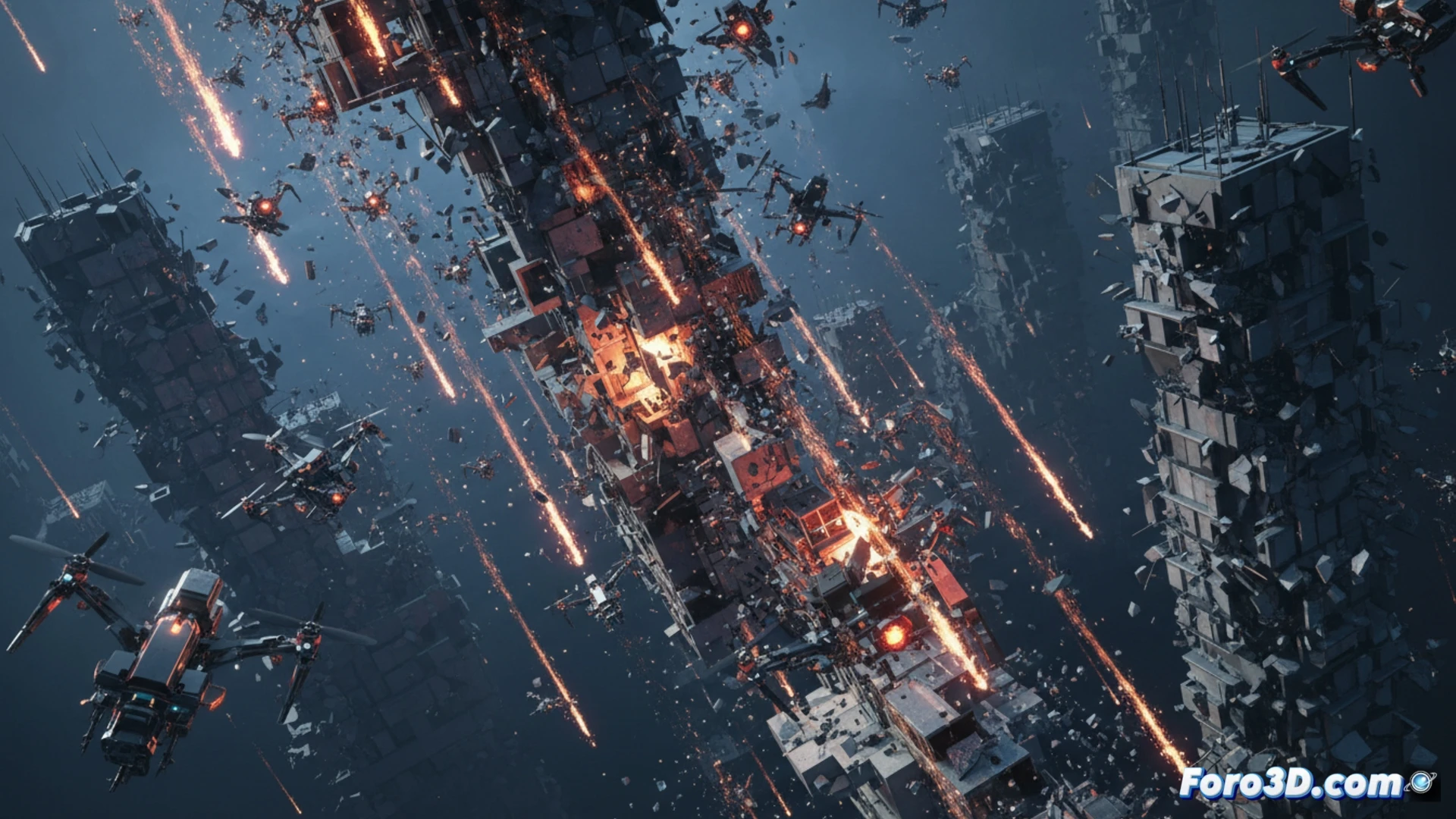
The term Swarm Fall evokes an image of synchronized and massive destruction, where multiple elements fail in a cascade. Whether it's a swarm of military drones losing control, a cluster of meteorites impacting an urban area, or the structural collapse of a building complex, this phenomenon represents an extreme modeling challenge. 3D tools allow us to break down the physics of chaos to understand how failure propagates.
Dynamic modeling of cascading failures 💥
To simulate a Swarm Fall, we must abandon the physics of individual bodies and embrace the dynamics of coupled systems. In a structural collapse, each building does not fall on its own; its collapse transfers kinetic energy and debris to adjacent ones, creating a chain reaction. In software like Houdini or Blender, we can use rigid body simulations with progressive fracture constraints. The critical parameter is the propagation threshold: the minimum force an element must receive to initiate its own failure. By adjusting this value, we move from a localized collapse to a total extinction of the swarm.
Chaos as a prevention tool 🛡️
Visualizing the Swarm Fall in 3D is not just an aesthetic exercise, but a logistical necessity. By rendering the trajectory of debris or the dispersion of a failed drone swarm, planners can identify safety zones and intervention points. The simulation reveals that the fall pattern is not random, but follows a fractal logic of self-similarity. Understanding this pattern allows for designing response protocols that interrupt the cascade before the entire system collapses.
What physical parameters and collective behavior algorithms are essential for realistically modeling the propagation of a cascading failure in a 3D Swarm Fall simulation?
(PS: Simulating catastrophes is fun until your computer melts down and you are the catastrophe.)