Fashion and technology merge to combat extreme heat with an innovative 3D-printed textile accessory: the Negative Thermal Gusset. This tutorial breaks down the parametric design of a rhomboid geometry structure integrated into shorts, capable of generating an upward airflow. The goal is to create a passive ventilation system that improves thermal comfort during the summer months, using flexible materials and additive manufacturing techniques.
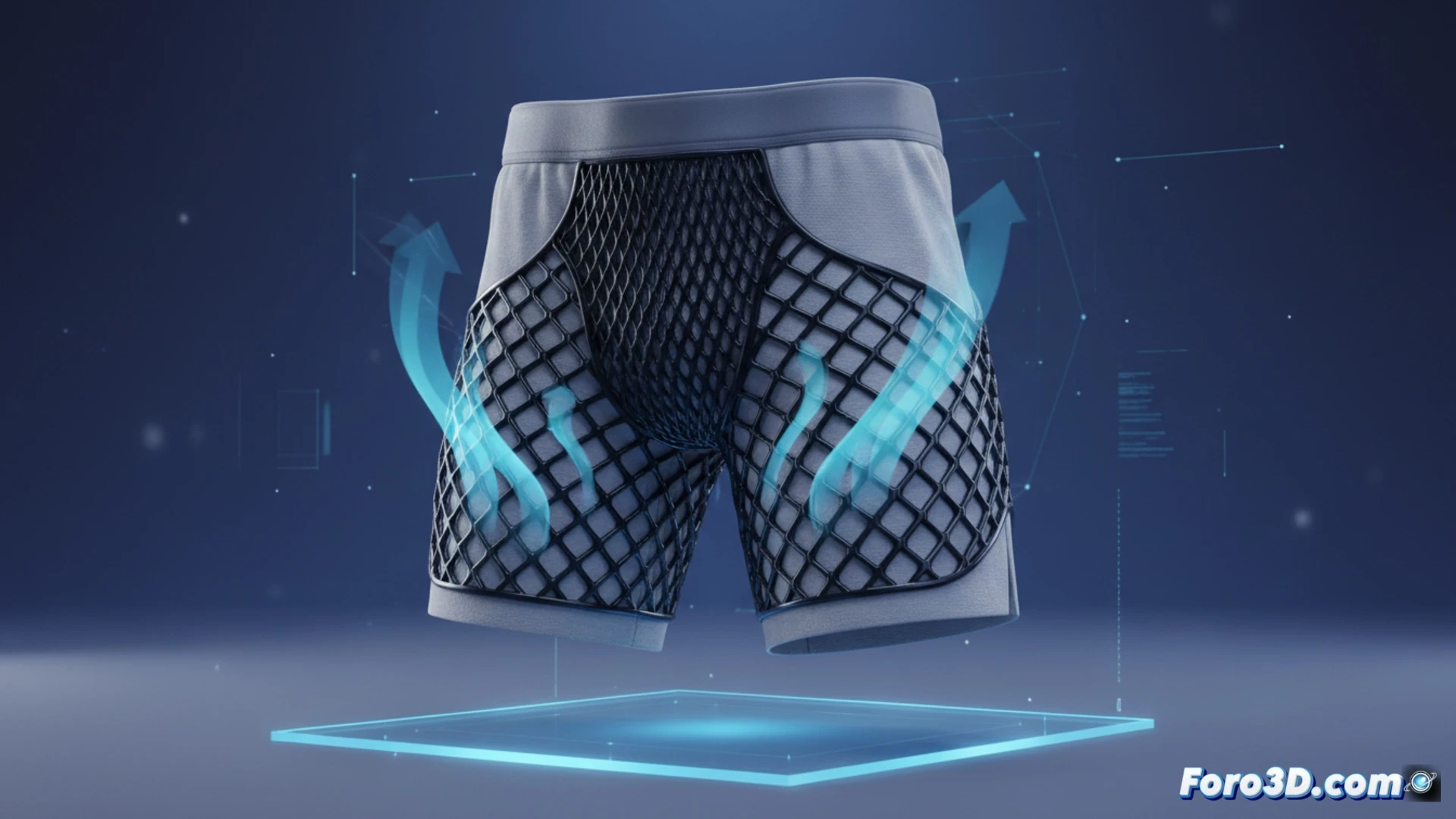
Parametric Design and Upward Airflow 🌬️
The core of the design lies in a matrix of hollow rhomboids that act as micro-ventilation channels. When modeling in parametric CAD software (such as Fusion 360 or Rhino with Grasshopper), the inclination angle of the rhomboid walls (ideally between 30 and 45 degrees) and the aspect ratio of the holes are defined. This geometry, when integrated into the inner area of the shorts, leverages the user's natural movement. While walking, the compression and decompression of the structure pumps trapped hot air upward, while the rhomboid shape channels cool air from the bottom of the garment, creating a chimney effect that dissipates body heat without the need for fans.
Flexible Materials and Textile Post-Processing 🧵
For the gusset to be wearable and breathable, the material is critical. A TPU filament with a Shore hardness of 85A to 95A is recommended, offering the necessary flexibility to adapt to movement without breaking. Alternatives like thermoplastic elastomer (TPE) filaments also work, though with lower abrasion resistance. In slicing, it is key to use a gyroid infill pattern at 15-20% to maintain elasticity, and a layer height of 0.12 mm to preserve the rhomboid details. Post-processing is limited to a gentle wash with soapy water to remove support residue; sanding is not recommended, as it would compromise the breathable texture. For seamless integration, the printed piece can be sewn to the inside of the shorts using nylon thread.
How does the rhomboid geometry design in the 3D negative thermal gusset optimize body heat dissipation for use in shorts during extreme heat conditions?
(PS: Designing fashion in 3D has the advantage that you never have to sew a button.)