Bleacher blocking represents one of the most feared scenarios in temporary and permanent structural engineering. When a crowd converges at an exit point or a sudden failure occurs, mass dynamics turn a leisure space into a death trap. Virtual reconstruction using 3D modeling software allows forensic engineers to dissect the event, identifying the exact moment of overload and the sequence of the break, providing critical data to prevent future tragedies.
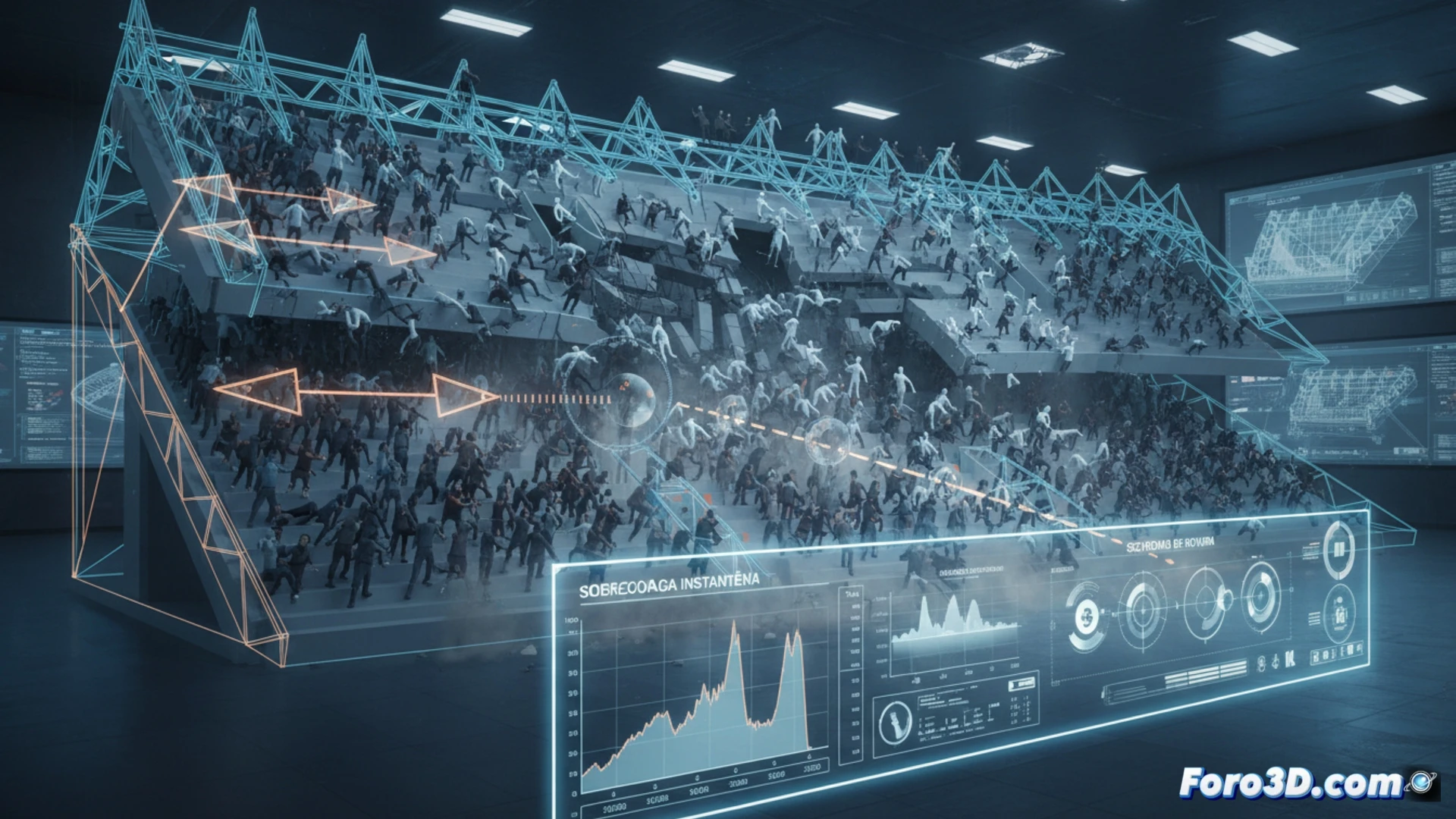
Simulation of Mass Dynamics and Failure Point 🏟️
To recreate the blocking, we model the original geometry of the bleacher in a parametric environment, assigning physical properties to the concrete and steel of the structure. The next step is agent simulation: hundreds of digital avatars with herd behavior, evacuation speeds, and weight distribution. By applying dynamic loads at the bottleneck point of the aisle, the software reveals the critical moment of buckling. Material fatigue is visualized as a heat map on the support joints, showing that the failure was not explosive, but progressive, initiated by a resonant vibration from the crowd.
Lessons from the Virtual Model for Real Prevention 🛡️
Comparing our simulation with real collapses, such as the Hillsborough stadium disaster or the collapse of a bleacher in Kenya, we find common patterns: insufficient exits and poorly anchored movable barriers. The 3D model allows testing solutions without human risk, such as redistributing pillars or installing energy dissipation systems. The true catastrophe is not the blocking itself, but the lack of foresight; technology gives us the tools to see the disaster before it happens.
How can the 3D reconstruction of a structural collapse due to bleacher blocking improve safety protocols at mass events and prevent similar failures in the future?
(PS: Simulating catastrophes is fun until the computer crashes and you are the catastrophe.)