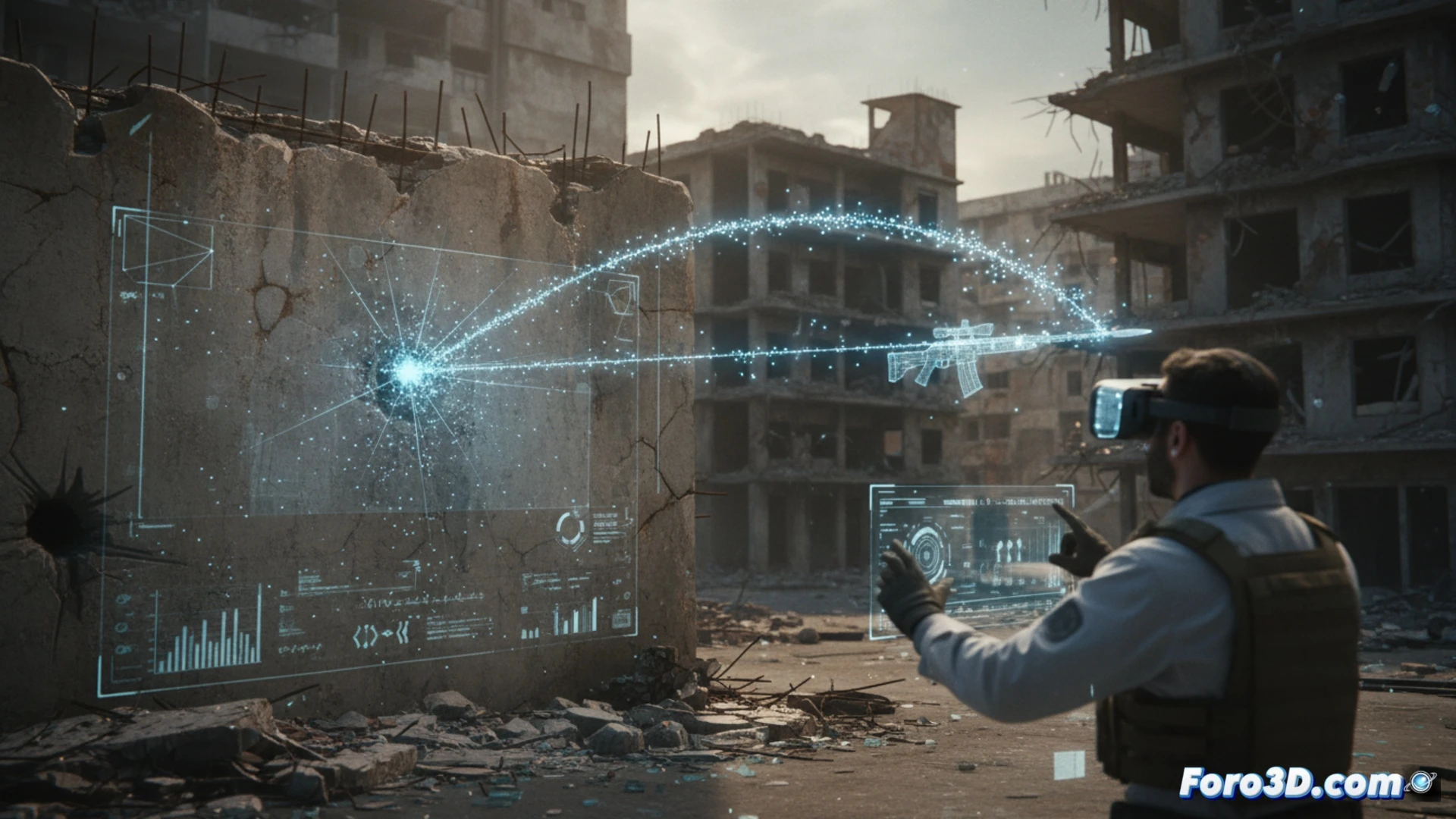
Locating a sniper from a distance is a challenge that combines physics, geometry, and technology. The key lies in the projectile: its trajectory, impact, and deformation contain enough data to trace the reverse path back to the point of origin. In the analysis of war conflicts, 3D reconstruction of this trajectory allows for precise determination of the shooter's position, even when there are no direct witnesses.
Trajectory Reconstruction Techniques and Scene Modeling 🎯
The forensic process begins with capturing data from the impact site: entry angle, material damage, and GPS coordinates. With this information, 3D modeling software such as Blender or ballistic simulation tools is used to create a digital terrain scenario. Variables like wind speed, gravity, and aerodynamic drag are introduced. The system then calculates all possible flight parabolas, filtering those that match the actual trajectory. The result is a projection line that, when intersecting with virtual obstacles (buildings, walls, vegetation), reveals the exact sniper point, often hidden from plain sight.
Tactical Implications and Evidence Verification 🔍
This methodology not only serves criminal investigation but also transforms the planning of military operations. By simulating multiple shooting scenarios, analysts can predict ambush positions and validate alibis. However, accuracy depends on the quality of initial data; a millimeter error in impact measurement can shift the location by several meters. Therefore, the combination of 3D laser scanning and inverse ballistic analysis consolidates as the definitive tool to unmask the shooter from the shadows.
Is it possible to determine the exact three-dimensional position of a sniper by analyzing solely the deformation patterns of a bullet's impact crater on a solid obstacle, without needing to know the projectile's complete trajectory?
(PS: reconstructing virtually is the first step to reconstructing in reality)