The collapse of a historic bell is not just a cultural loss; it is a mechanical failure that demands a detailed forensic analysis. When the metal or support structure gives way, fatigue forces accumulated over decades or centuries manifest catastrophically. In this article, we will apply 3D modeling and finite element simulation techniques to break down the stresses that led to the breaking point, offering a technical perspective that goes beyond a simple chronicle of the event.
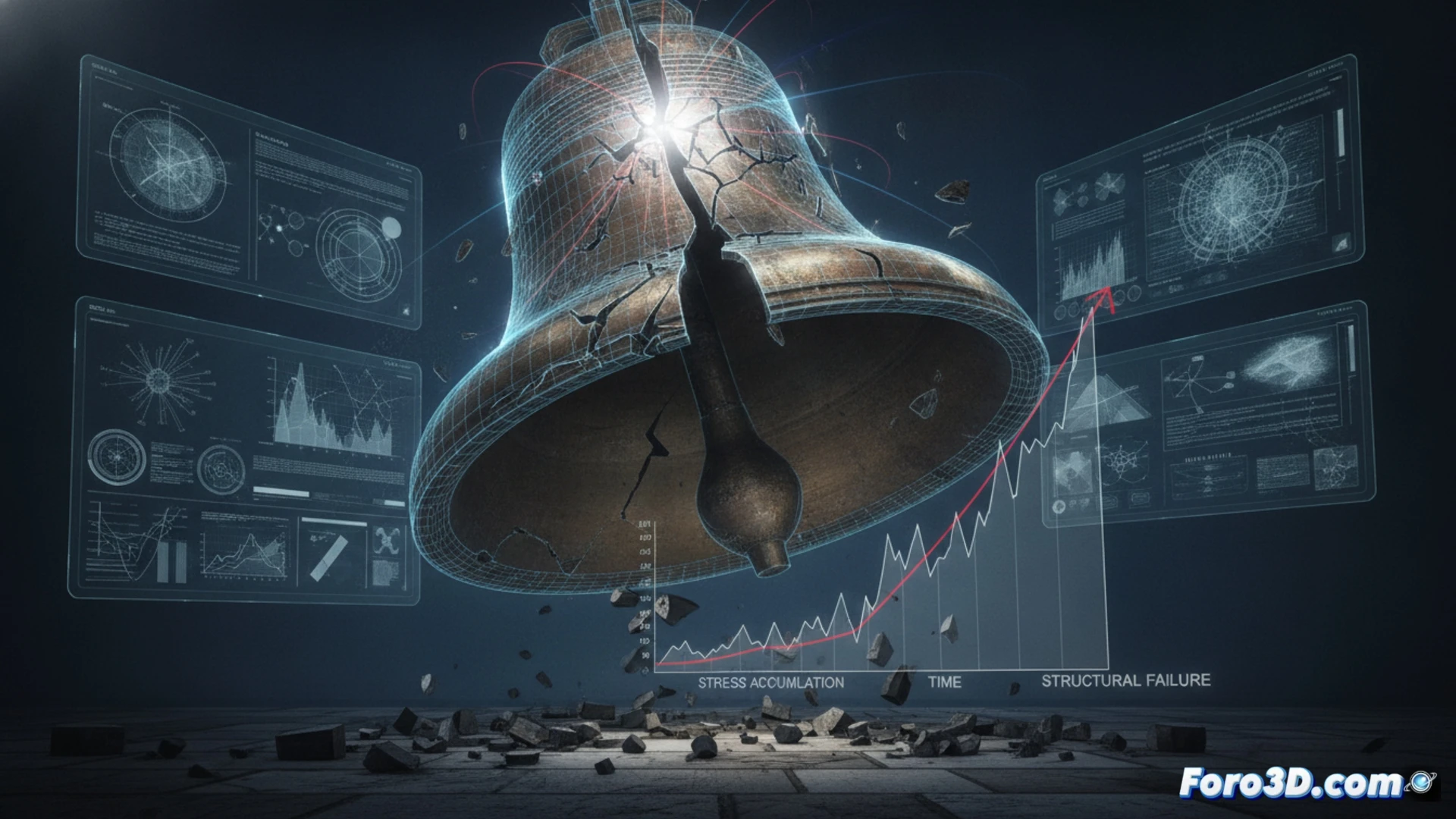
Virtual reconstruction and material fatigue analysis 🔧
To understand the collapse, the exact geometry of the bell and its support yoke is first recreated in parametric CAD software. Historical mechanical properties are assigned to the bronze, considering corrosion and internal microcracks. The simulation applies dynamic loads that mimic the clapper's swing and the vibrations of the chime. The model reveals that the failure point is usually concentrated in the joint area between the crown and the body, where cyclic stress exceeds the material's fatigue limit after years of use. Visualizing this stress concentration allows engineers to determine whether the collapse was due to accidental overload, progressive deterioration, or an original casting defect.
Structural lessons for heritage conservation 🏛️
Beyond assigning responsibility, 3D modeling becomes a prevention tool. By simulating reinforcement scenarios, such as installing dampers on the yoke or redistributing the clapper's impact point, minimally invasive interventions can be designed. This technical approach demonstrates that forensic digitization not only explains the past but also protects the future of historic structures, allowing the sonic heritage to endure without repeating the structural errors that led to its silence.
Which finite element simulation methodology is most effective for modeling crack propagation in cast bronze of a historic bell during its structural collapse?
(PS: Simulating a collapse is easy. The hard part is not crashing the program.)