Last weekend, an incident on a mechanical fair ride left a user with a severe cervical whiplash, reopening the debate on safety in these devices. Beyond the news, this event offers a perfect case study for forensic simulation. In this article, we will break down how 3D modeling and rigid body dynamics can reveal the hidden causes behind mechanical or design failure.
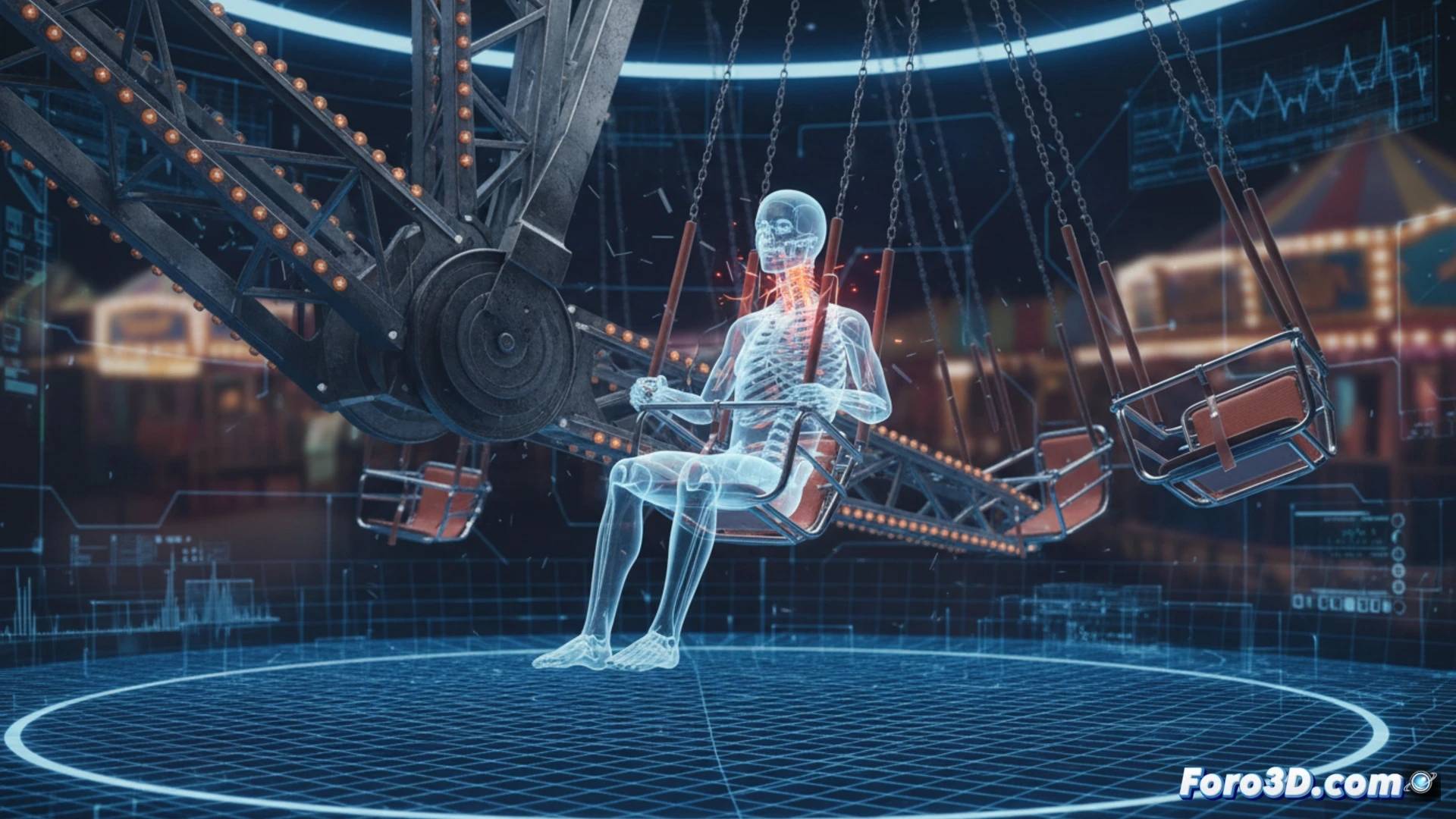
Virtual reconstruction and G-force analysis 🎢
To determine the root cause, the ride was modeled in a rigid body dynamics simulation software. The materials, connection joints, and acceleration profile of the mechanical arm were recreated. By inputting the mass data of an average passenger, the simulation calculated the instantaneous G-forces on the vertical and horizontal axes. The results showed an anomalous acceleration peak of 4.5 G on the neck during the direction change, exceeding the safe limit of 2 G for cervical structures. The passenger's trajectory indicated a direct impact against the poorly adjusted headrest, suggesting that an error in the maintenance of the hydraulic stops caused the sudden movement.
Lessons for catastrophe prevention 🛡️
This analysis demonstrates that 3D simulation serves not only for entertainment but as a critical tool in forensic engineering. By visualizing the exact point of impact and the forces involved, design flaws that would otherwise go unnoticed can be identified. For the fair industry, implementing virtual tests prior to actual operation could prevent serious injuries. Technology allows us to prevent catastrophes before they occur, as long as it is applied with technical rigor.
Is it possible to determine, through finite element simulation and 3D acceleration recording, whether the cervical injury was caused by a mechanical failure in the ride's restraint system or by a sudden movement of the user during the ride?
(PS: Simulating catastrophes is fun until the computer crashes and you are the catastrophe.)