The collapse of a large-scale 3D printed barrier represents a catastrophic failure that exposes the limitations of current structural modeling. This article breaks down the technical causes of the incident through material fatigue analysis and digital twins. We recreate the event step by step to identify the critical stress points that led to the fracture, offering a technical perspective for future additive infrastructure designs.
Digital Recreation and Structural Failure Points 🏗️
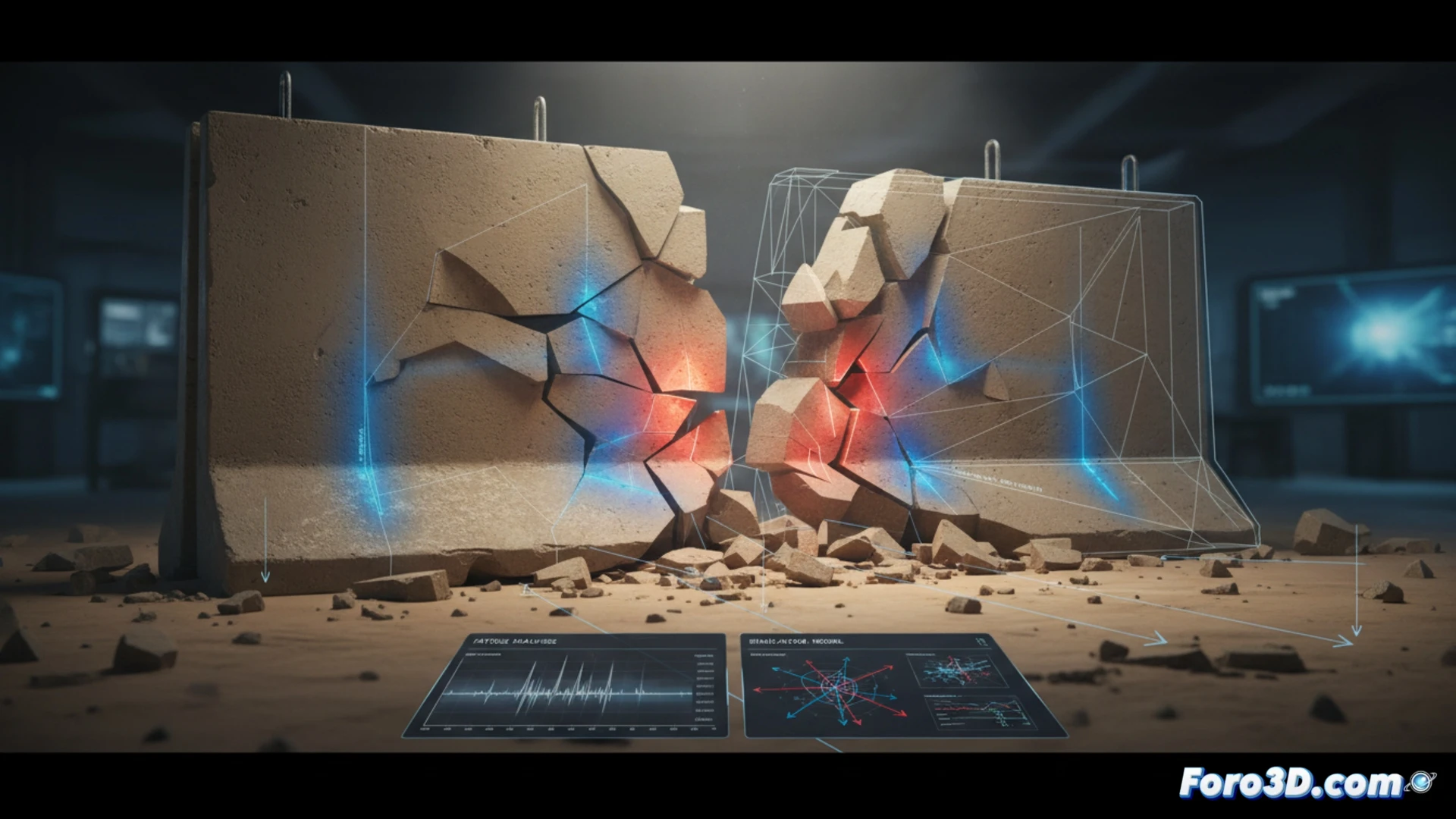
To understand the collapse, a digital twin of the original barrier was developed. Finite element simulation revealed that the failure was not instantaneous, but progressive. The critical point was located at the junction between print layers, where material anisotropy generated microcracks under load cycles. Cyclic fatigue, amplified by environmental vibrations not considered in the design, caused crack propagation that compromised the structure's integrity. The comparative visualization of the state before and after the collapse shows localized plastic deformation in the lower third of the barrier, precisely where the bending moment reached its maximum value. This modeling allows us to assert that the lack of internal reinforcements in the printed geometry was the trigger of the incident.
Lessons for Additive Infrastructure Design 📐
The collapse of this printed barrier forces us to rethink structural validation protocols. Fatigue simulation must be integrated as a prerequisite to manufacturing, not as a post-analysis. The technical proposal includes incorporating internal ribs and a redistribution of infill density to mitigate anisotropy. Comparative visualizations of the digital twin demonstrate that these modifications could have increased the structure's service life by 40%. The disaster, although tragic, becomes an invaluable case study for additive materials engineering.
Is it possible to accurately model the fatigue behavior of a large-scale 3D printed barrier to predict its catastrophic collapse point, considering the anisotropies inherent to the additive manufacturing process?
(PS: Simulating catastrophes is fun until the computer melts down and you are the catastrophe.)