Forensic biomechanics has found in motion capture (mocap) a definitive tool for solving cases where visual identity is doubtful. When a suspect denies their presence at the scene, the study of their locomotion pattern becomes key evidence. This article breaks down the technical pipeline for digitizing, modeling, and validating a defendant's gait against security footage, establishing an objective and reproducible analysis protocol. 🕵️
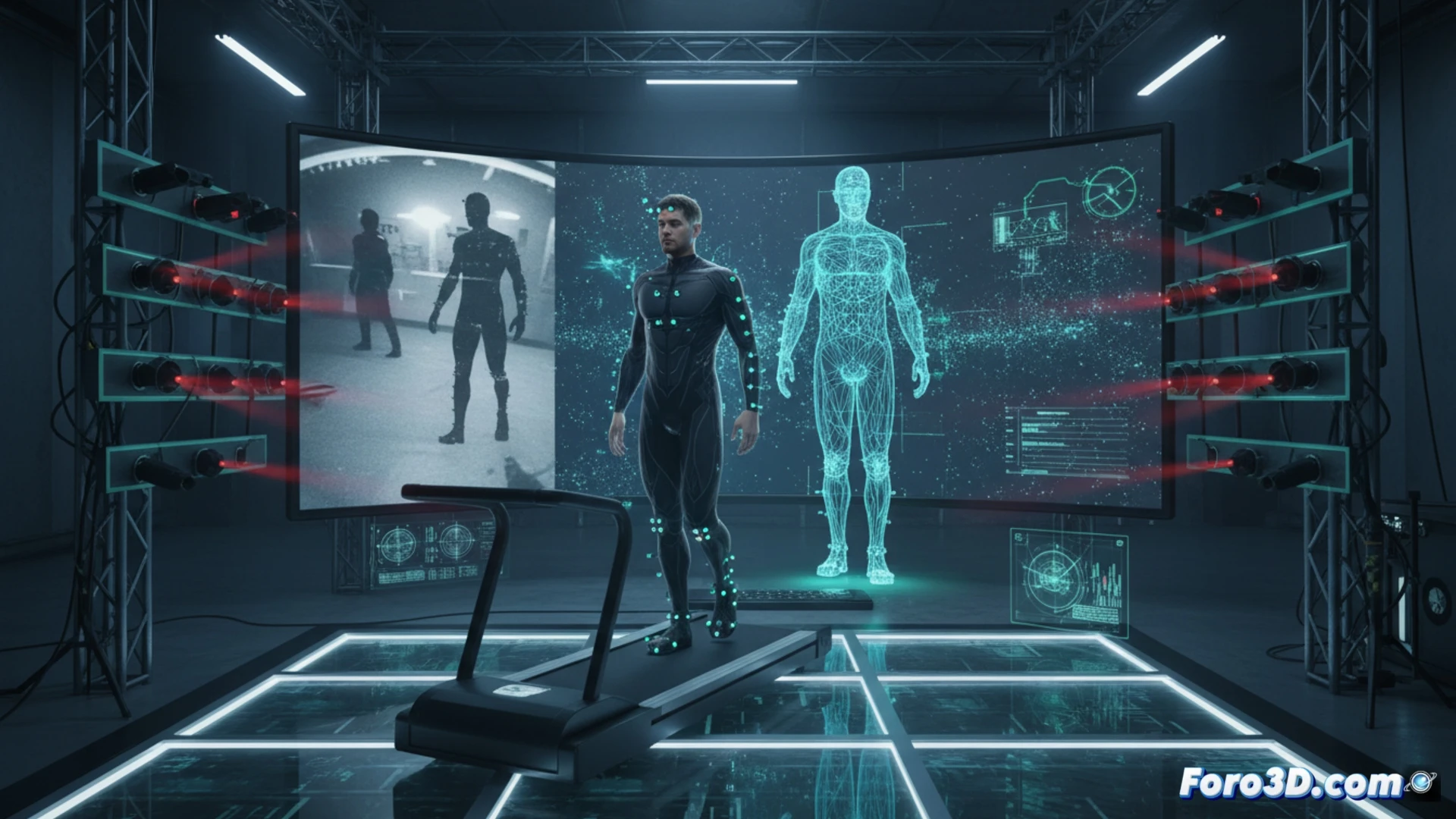
Digitization and Biomechanical Modeling Pipeline 🦿
The process begins with extracting frames from surveillance cameras and capturing the defendant in a studio using an inertial mocap suit (optical markers or IMUs). Raw data is filtered to remove noise, and a standard biomechanical rigging is applied (such as the Winter model or the ISB standard). A digital skeleton is created with 15 to 17 rigid segments (legs, hips, torso, arms), and joint angles are calculated in the sagittal and frontal planes. 3D simulation in software like Blender or Maya allows recreating the scene with lighting and perspectives identical to the original camera, overlaying the defendant's skeleton onto the suspect's silhouette for direct kinematic comparison.
Forensic Validation and Limitations of the Method ⚖️
Validation requires a statistical analysis of spatiotemporal variables (stride length, cadence, speed) and angular variables (knee flexion, pelvic tilt). A match is discarded if the deviation exceeds the system's error threshold (typically 2-3 degrees). However, the method has limitations: the quality of the original recording, the defendant's footwear, or previous injuries can alter the pattern. A solid expert report must include model uncertainty and acknowledge that gait is a behavioral trait, not a fingerprint, but its uniqueness offers a high probability of exclusion or identification.
What practical limitations do calibration protocols of optical mocap systems present when recreating a defendant's locomotion in low-visibility scenarios or on uneven surfaces within forensic 3D simulation?
(PS: In the forensic pipeline, the most important thing is not to mix the evidence with the reference models... or you'll end up with a ghost at the scene.)