We explore in three dimensions the characteristics that define Haris Rauf, the Pakistani fast bowler. His bowling action, release angle, and arm rotation are key elements that generate his speed and bounce. This analysis breaks down the biomechanics of his delivery, from the leap to the moment of releasing the ball, to understand how he generates that energy.
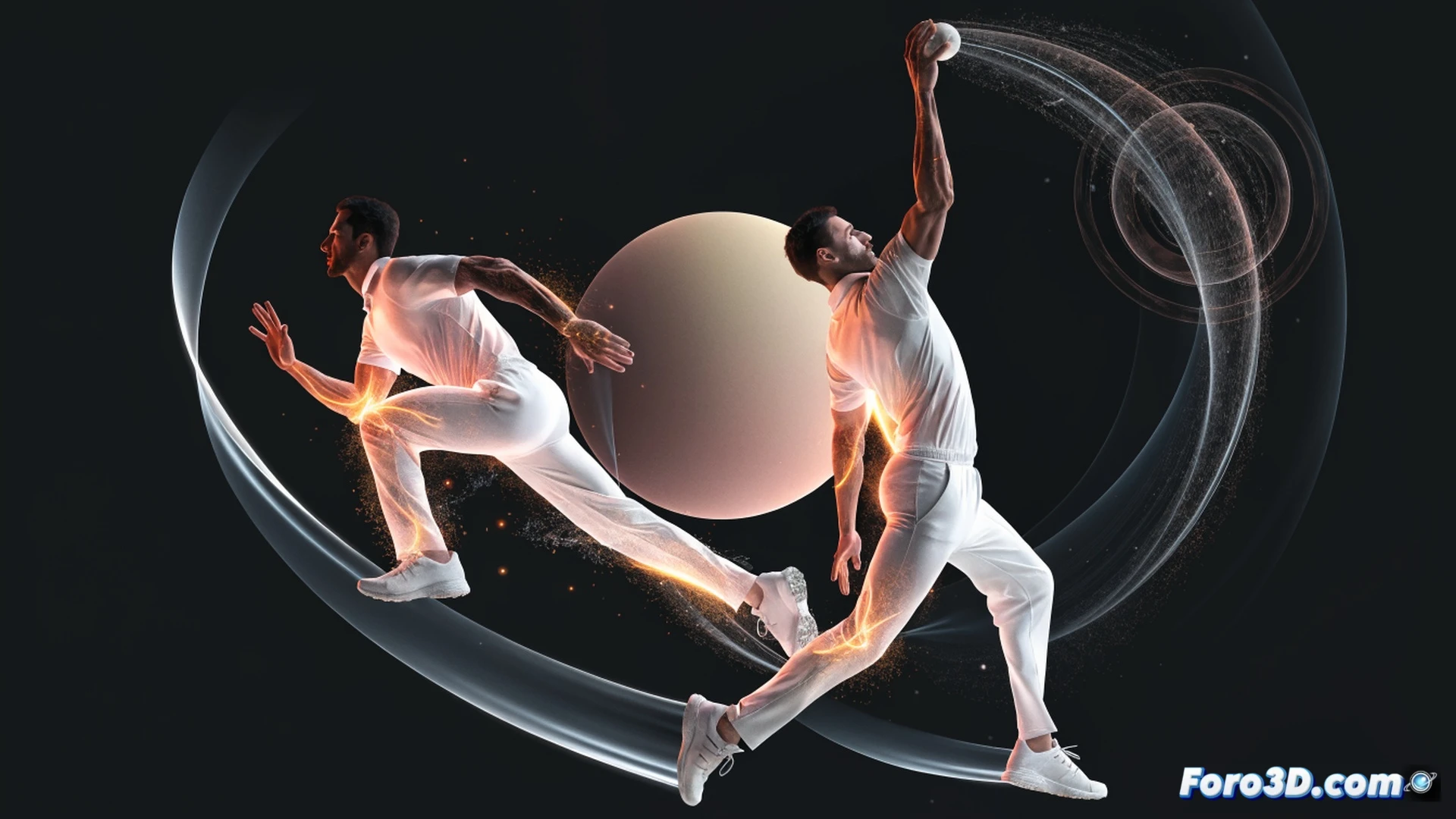
3D Biomechanics of the Arm and Energy Transfer ⚡
The three-dimensional reconstruction of his technique reveals an efficient energy transfer from the back leg to the arm. The angle of his elbow at the moment of delivery, close to 90 degrees, maximizes acceleration. His firm wrist and torso rotation generate additional snap, allowing him to reach speeds of 150 km/h. Analysis of the sagittal plane shows a spinal tilt that favors bounce on fast pitches.
The Mystery of the Yorker That Appears and Disappears 🤔
If the 3D analysis is so precise, why does it sometimes seem like he bowls with his eyes closed? The data shows his yorker is lethal one day and the next day it looks like a beach cricket delivery. Science explains his speed, but not his ability to disappear in key moments. Perhaps the 3D model should include a nervousness sensor or an airplane mode module that activates in important matches.