The detachment of a hydraulic shovel represents a catastrophic event in the field of heavy machinery, with consequences ranging from severe material damage to loss of human life. This article analyzes such a failure from the perspective of 3D simulation and modeling, employing reverse engineering tools to reconstruct the collapse sequence. The objective is to identify the root causes of the accident and propose prevention strategies based on digital twins and predictive maintenance.
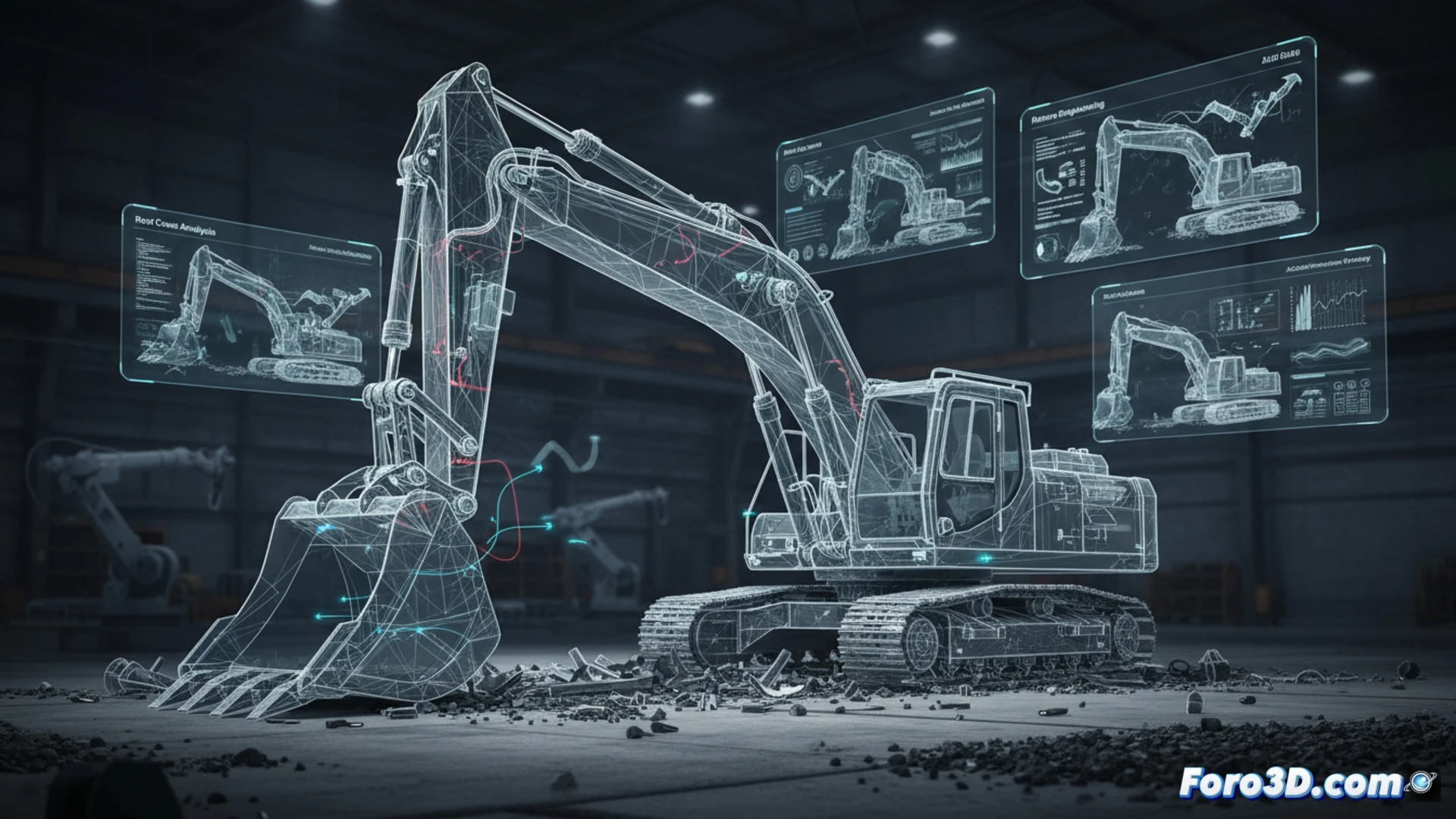
Reconstruction of structural failure through finite element simulation 💥
To understand the dynamics of the detachment, a detailed 3D model of the hydraulic shovel and its coupling system has been developed. Finite element simulation (FEM) allows visualizing the stress distribution at critical points such as the connection pin, the lift cylinder, and the bucket structure. The results show that a combination of cyclic material fatigue and a punctual overload due to impact generates a stress concentration that exceeds the steel's elastic limit. The 3D animation reveals how the fracture initiates in an undetected microcrack, propagating suddenly and causing the total detachment of the component.
Lessons for safety: from the digital twin to the emergency protocol 🛡️
The catastrophe is explained not only by the mechanical failure but also by the absence of early warning systems. The 3D analysis suggests that implementing a real-time digital twin, capable of monitoring vibration and structural deformation, would have detected the anomaly hours before the collapse. This case study underscores the need to integrate predictive simulations into industrial maintenance protocols, transforming a preventable accident into a technical lesson for safety in large-scale works.
Which design and material fatigue parameters must be modeled in 3D to accurately predict the failure point of a hydraulic shovel and prevent its catastrophic detachment
(PS: Simulating catastrophes is fun until the computer crashes and you are the catastrophe.)