The interpretation of blood patterns at a crime scene has for decades been a discipline based on two-dimensional observation and flat photographs. However, the incorporation of three-dimensional scanning technologies and photogrammetry is revolutionizing this field. By capturing each droplet as a point in space with XYZ coordinates, experts can now calculate trajectories with millimeter precision, transforming static evidence into a dynamic model of the incident's mechanics.
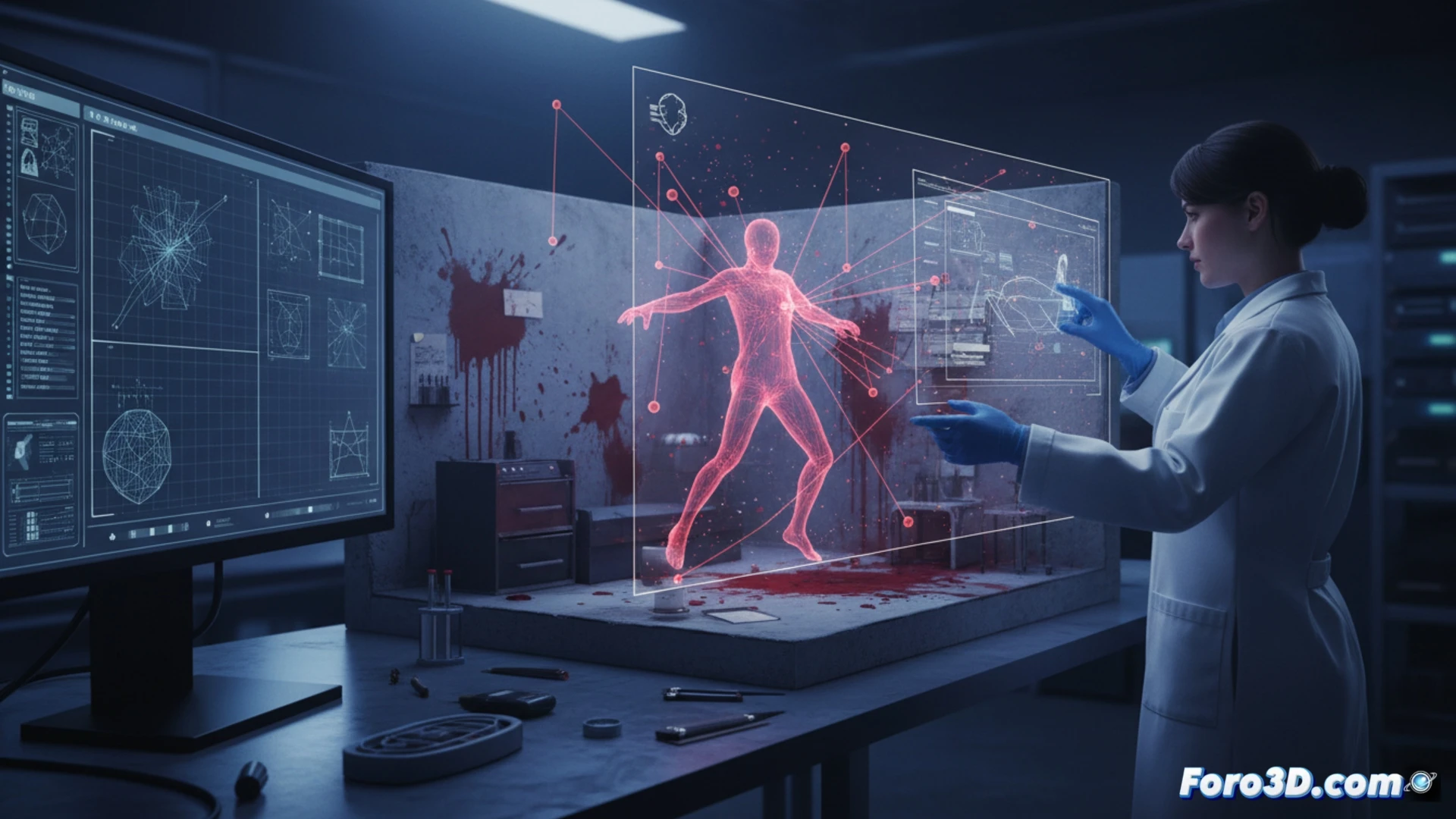
Technical workflow: capture, processing, and trajectory simulation 🧬
The process begins with the digital capture of the stained area. High-resolution cameras are used for photogrammetry, taking overlapping images from multiple angles, or terrestrial laser scanners (TLS) that generate point clouds with real color. Next, specialized software such as HemoSpat or FARO Zone 3D allows the analyst to manually mark or automatically detect elliptical stains. The program calculates the impact angle and direction of each droplet, projecting vector lines backward. The convergence point of these lines, visualized in a 3D environment, indicates the origin of the bleeding and the position of the victim or attacker at the moment of impact. This forensic digital twin is integrated with other scene data, such as the position of weapons or furniture, for a complete reconstruction that is defensible in court.
From the stain to the story: the value of volumetric precision 🔍
Beyond coordinates, the 3D model captures the volume and shape of the spatters. A droplet with an irregular edge and spines may indicate a high-velocity impact, while a smooth pool suggests passive dripping. This wealth of data allows investigators to formulate more robust hypotheses about the sequence of events. The technology does not replace the expert's clinical eye, but it provides them with a tool to measure what was previously only intuited, transforming subjective interpretation into a quantifiable and reproducible science.
How can volumetric analysis and finite element simulation of 3D blood spatter improve the accuracy in determining the point of origin and impact dynamics at a crime scene?
(PS: In the forensic pipeline, the most important thing is not to mix the evidence with the reference models... or you'll end up with a ghost at the scene.)