In the world of cricket, few bowlers command as much respect as Pat Cummins. His combination of speed, precision, and endurance makes him a key player for Australia. But beyond the statistics, his biomechanics hide fascinating details. We analyze his movements in 3D to understand what makes this player special, from the takeoff of his foot to the rotation of his hip, breaking down each phase of his action.
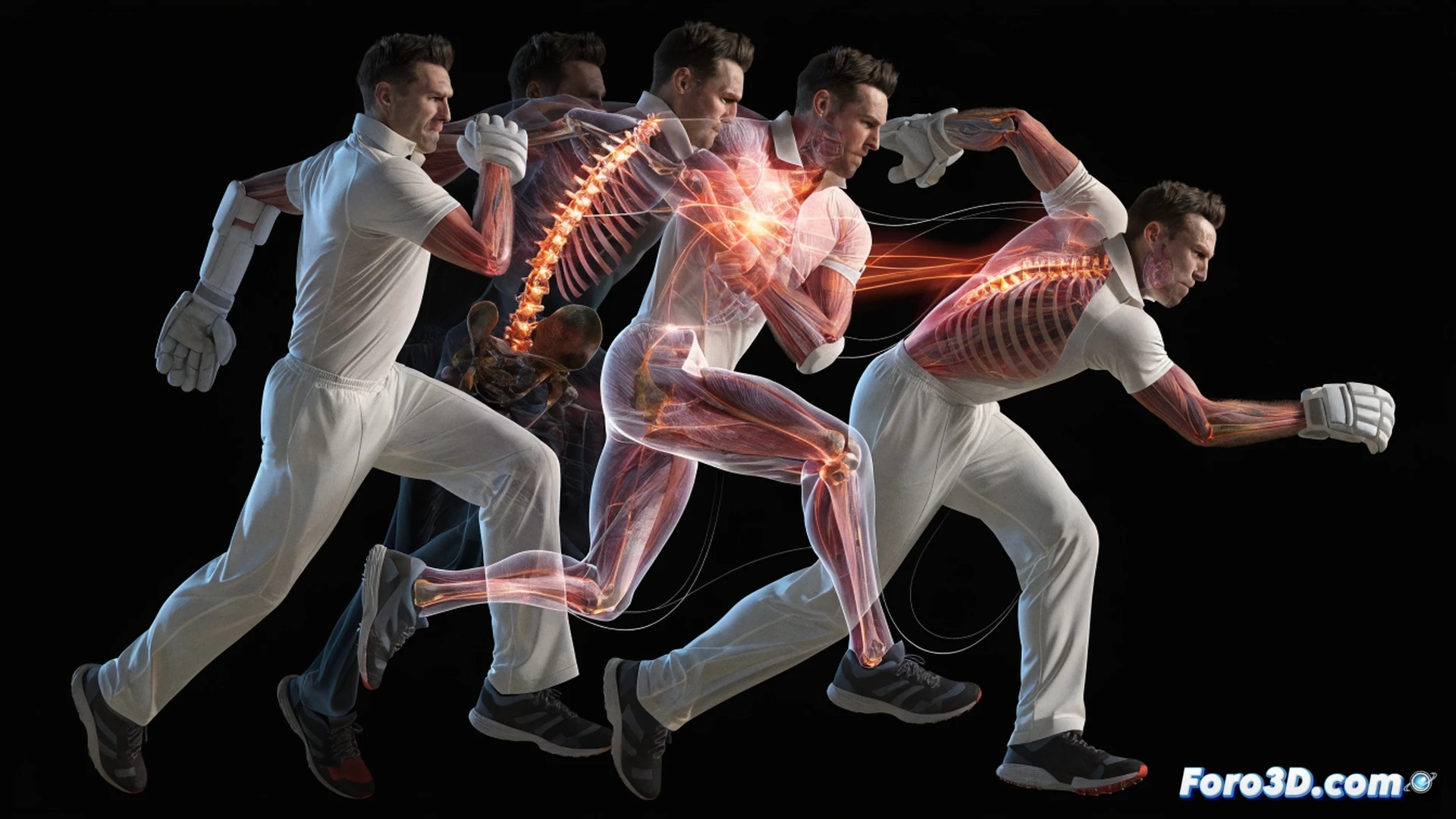
Applied Biomechanics: The 3D Technical Analysis 🏏
Three-dimensional modeling reveals that Cummins generates his power from a wide base and a controlled lowering of his center of gravity. His bowling arm describes an almost perfect arc, with an elbow angle that maximizes the whip at the release point. The shoulder rotation is asymmetrical but efficient, transferring energy from the legs to the wrist. Torque analysis shows that his spine withstands high loads, but the uniform distribution reduces the risk of injury. This data allows his technique to be replicated in virtual environments.
Cummins and the Mystery of the Seamed Boomerang 🦘
If we analyze his bowling in 3D, it seems Cummins has made a pact with a biomechanical kangaroo. The ball not only comes out at 145 km/h, but also seems to have its own GPS to find the edge of the bat. Sensors detect that his wrist rotates as if he were opening a jar of Australian jam, but with lethal results. The only unsolved mystery is why, with all this technology, they still haven't figured out how to prevent his hat from being stolen during celebrations.