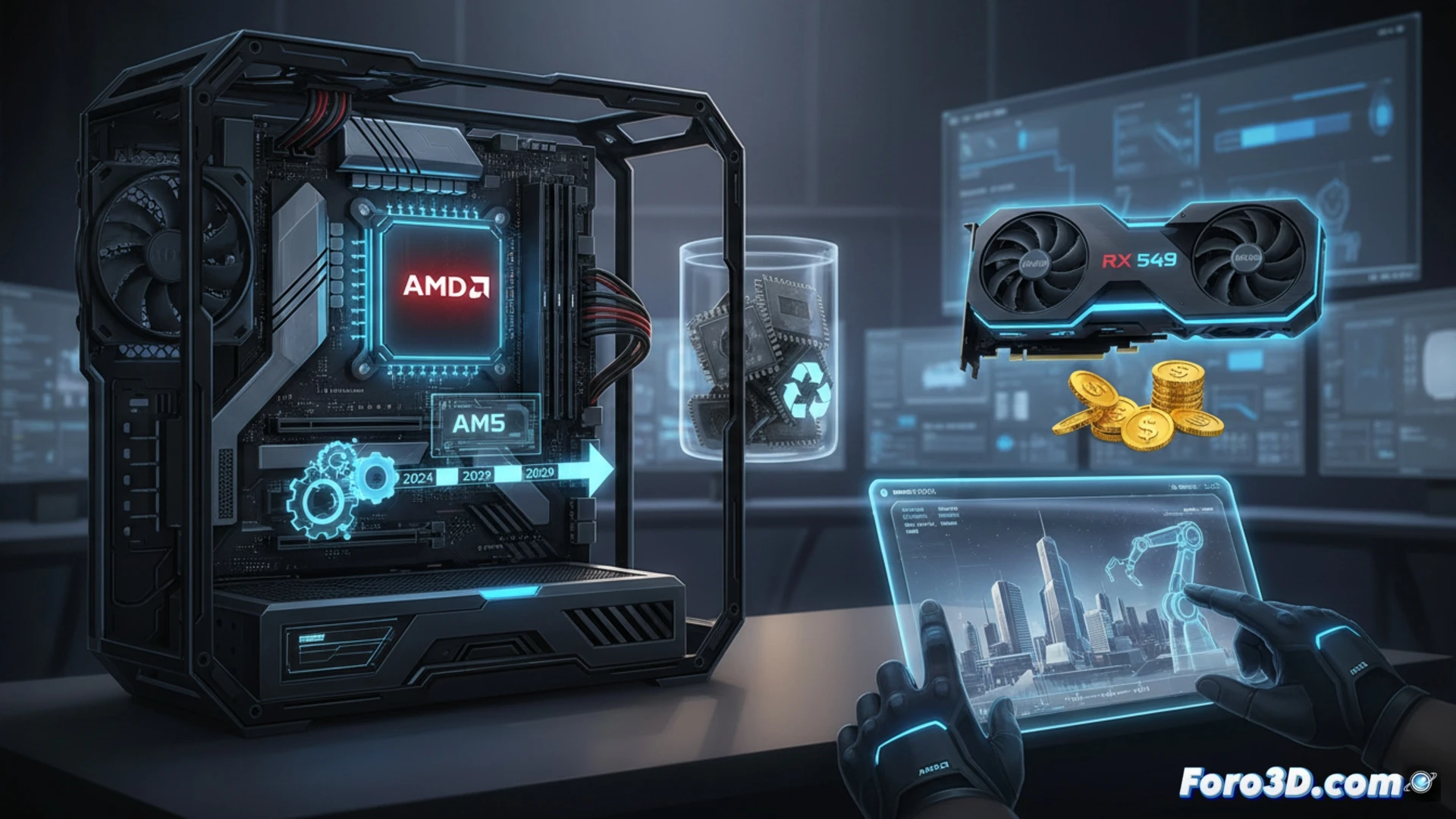
In a market where every euro counts for 3D studios, AMD has made a move with a strategy that prioritizes longevity over peak speed. The company has confirmed the extension of AM5 socket support until 2029 and has relaunched previous-generation processors at reduced prices. Added to this is a new Radeon for $549. We analyze how this move can ease the budget of the professional modeler and renderer without sacrificing workflow stability.
Radeon at $549 vs NVIDIA: the battle for the 3D budget 🎮
AMD's new GPU arrives at a critical time for digital artists who rely on render engines like Blender Cycles or Redshift. For $549, this Radeon offers an amount of VRAM that surpasses many NVIDIA options in the same price range, a key factor for handling 4K textures and complex scenes without resorting to tile rendering. However, the CUDA and OptiX ecosystem remains the de facto standard in many pipelines. The 3D professional must weigh whether the raw memory advantage compensates for the lower optimization of certain plugins and the lack of RTX in specific physics simulation applications. The decision is no longer binary, but depends on the software that dominates the studio.
The crisis as a catalyst for a smarter platform 🔧
AMD's decision to keep the AM5 socket alive until 2029 is a direct nod to the professional who cannot replace their motherboard every two years. For the 3D user, this means that an investment in a B650 or X670 board today allows jumping to future CPU generations without replacing the entire system. This saving on the workstation base allows allocating more budget to RAM or a superior GPU. In times of component crisis, the industry demonstrates that long-term profitability and platform stability are as valuable as the latest megahertz.
To what extent could the promise of AM5 support until 2029 and the reuse of CPUs change hardware upgrade planning for 3D studios with tight budgets?
(PS: RAM is never enough, like coffee on a Monday morning)