We analyze in 3D the profile of Pakistani spinner Abrar Ahmed, whose leg spin generates angles and revolutions that confuse any batsman. His flexible wrist and release point create a pronounced drift, similar to a moving diamond. This article breaks down the physics behind his technique and how technology captures those spins impossible to follow with the naked eye.
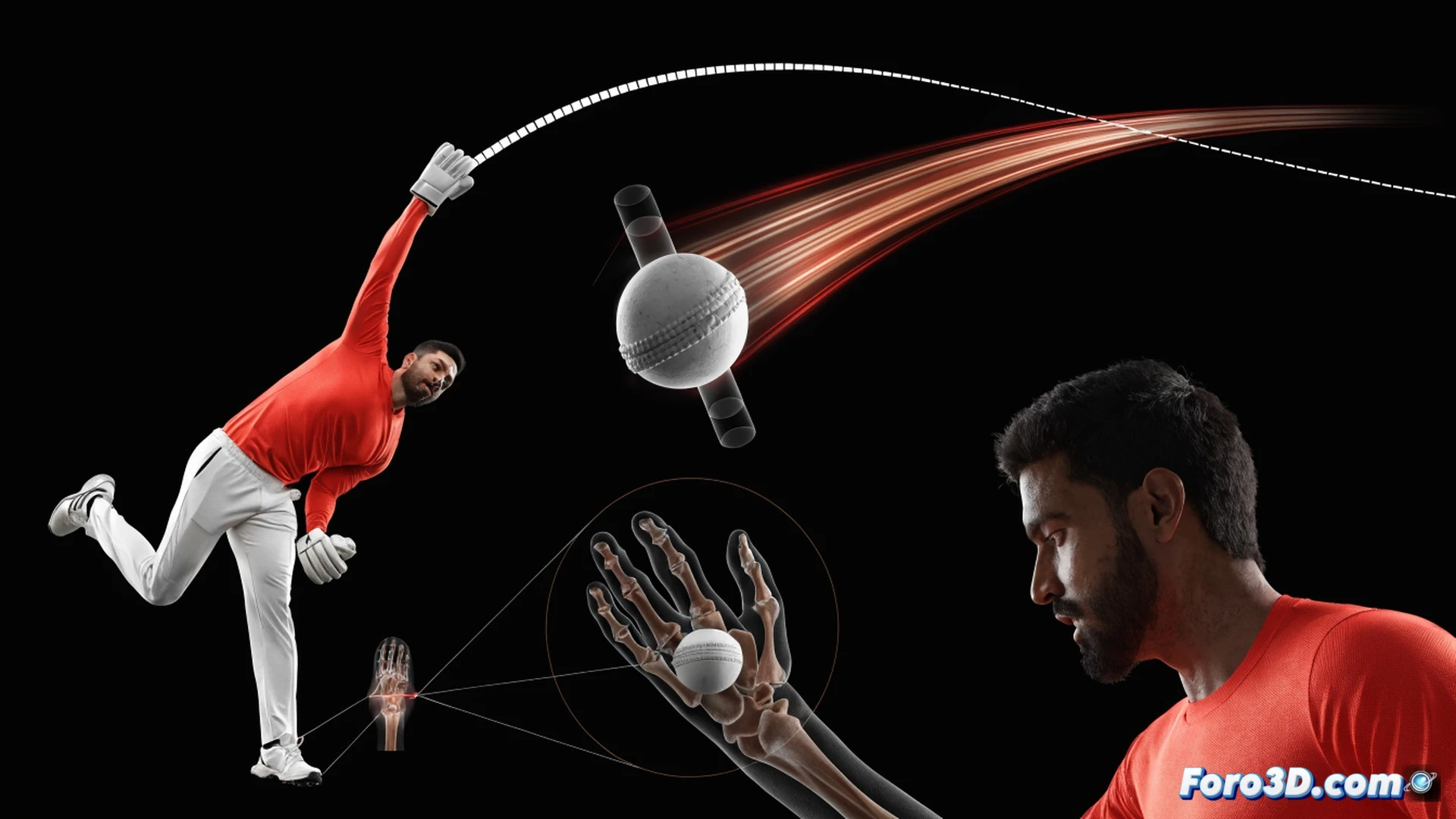
Biomechanics of the spin: the wrist angle in 3D 🌀
Volumetric reconstructions show that Abrar releases the ball with a wrist angle of 45 degrees, generating a rotation of 2,800 rpm. 3D modeling reveals that his index finger applies asymmetric pressure, causing a sudden change in trajectory at 1.5 meters from the batsman. Simulations indicate that this effect is almost unpredictable for traditional tracking systems, requiring high-frequency sensors to map its complete spiral.
The science of spinning a ball like a crazy top ⚡
If we could put a GPS on the seam of Abrar's ball, it would probably register more spins than a washing machine on a spin cycle. Engineers have calculated that his effect is so tight that even the batsman himself wonders if he is watching cricket or a magic trick. In the end, the only thing that doesn't spin is the face of the poor guy trying to hit it.