A story that shouldn't be fiction...
Santiago Abascal and Yolanda Díaz spent five days as pilgrims from Sarria to Compostela. Without bodyguards, without speeches, with blisters and under the rain. The Camino, with its egalitarian tradition and physical rhythm, forced a human encounter that no negotiation table can achieve. There were no political agreements, but there was a moment of shared humanity that left an invisible mark on subsequent debates.
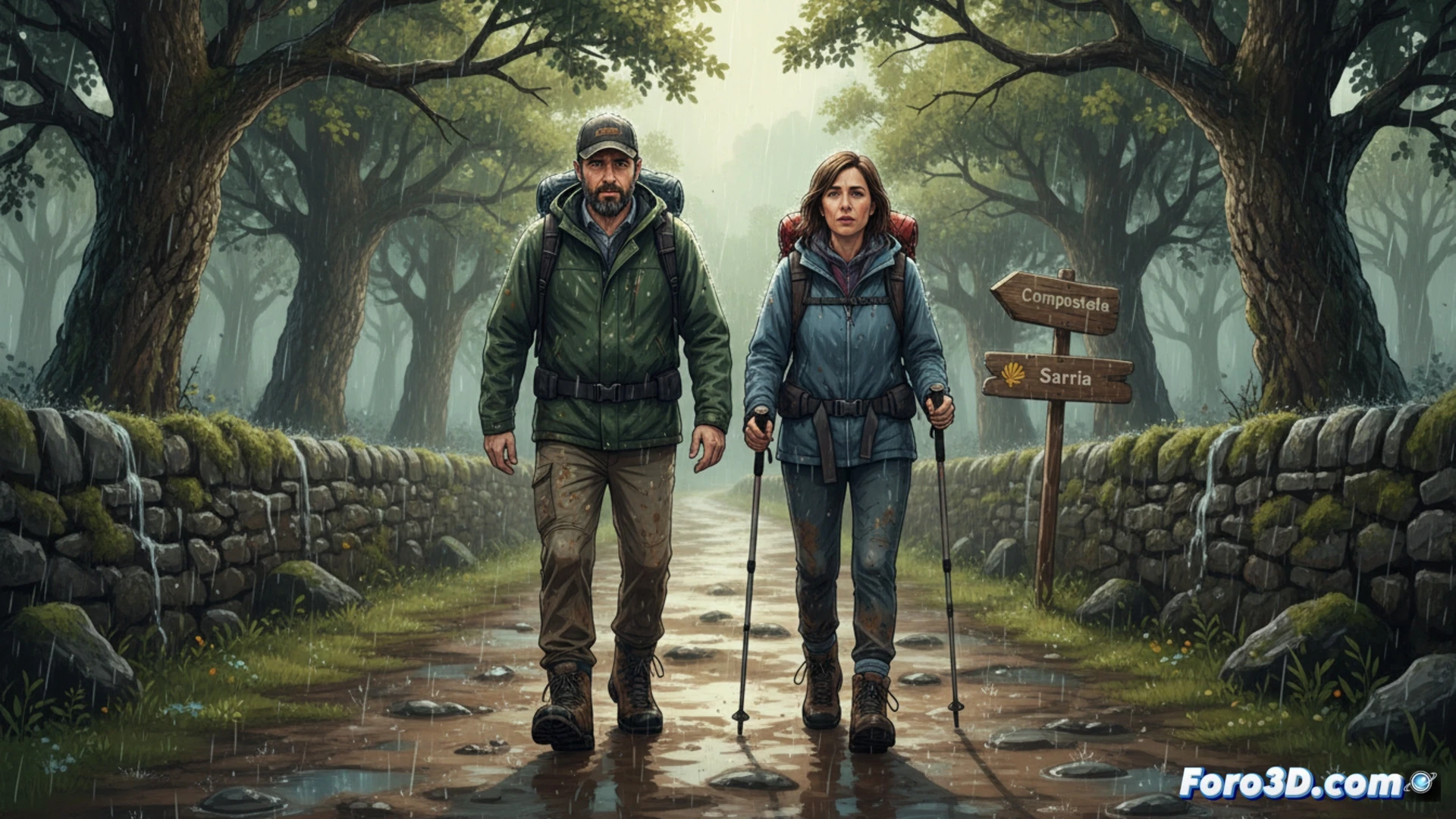
🥾 Santiago Abascal and Yolanda Díaz. Five Days on the Camino de Santiago
Santiago Abascal and Yolanda Díaz. Five days on the Camino de Santiago. From Sarria to Compostela. On foot. Like normal pilgrims. 🚶♂️🚶♀️
📖 Why This Scenario Is Especially Interesting
Because the Camino has something that no other context has: a centuries-old tradition of equalizing people. Kings and beggars have walked the same path, with the same blisters, under the same rain. The Camino makes no distinctions. And it also has something psychologically powerful: sustained physical movement facilitates honest conversation. You don't look each other in the eye; you look at the path. This lowers defenses in a way that no negotiation table can achieve. 🌧️
🎒 The First Day: Shared Embarrassment
They leave Sarria with their backpacks. Neither of them is fit for this. After two hours, both are limping. After two and a half hours, both have a blister on the same foot. In a village pharmacy, an elderly woman sells them band-aids without recognizing them and tells them, with all the naturalness in the world, to prepare better next time before coming. They look at each other. Both hold back their laughter. That is the first human moment. 😅
🚶 What the Camino Does Over the Following Days
The Camino has a strange quality: it forces you to live in the present. There is no strategy, no spin, no message. Only the next kilometer. They sleep in hostels with pilgrims from ten different countries. One night they share a table with a Brazilian family, a German retiree, and two Korean students. No one talks about Spanish politics. No one knows who they are. Yolanda talks with the Korean students about the labor market in Asia. Abascal talks with the German retiree about medieval European history. Both are genuinely interested. Both are, for a moment, just curious people. 🌍
⚡ The Moment of Real Tension
On the third day, inevitably, something erupts. They pass through a town with a political banner. One of them makes a comment. The other responds. In thirty seconds, they are in the same old debate, with the same old arguments, in the middle of a dirt path in Galicia under the rain. And then something unexpected happens: they both realize at the same time how absurd the scene is. Two soaking wet people, with blisters, arguing like in Congress in front of a cow that looks at them with disinterest. The cow breaks the moment. They both fall silent. They keep walking. That shared silence is worth more than any argument. 🐄
💬 The Conversation on the Fourth Day
It is the longest. Eight hours of walking give plenty of time when awkward silences run out. Abascal talks about his father, about a Spain he felt was being lost, about how his genuine fear is not of the other party but of fragmentation. Yolanda talks about her mother working in conditions she found unfair, about how her driving force is not ideology but a very specific anger at something she witnessed up close. Neither convinces the other. But for the first time, both understand where the other comes from. And that is completely different from understanding what the other says. 🎙️
🏛️ The Arrival in Compostela
They enter the Obradoiro square together. Like all pilgrims, they are exhausted, dirty, and feeling an emotion they didn't expect. There is a tradition on the Camino: pilgrims who arrive together hug in the square. It's almost a reflex, everyone does it. They hesitate for a second. They hug. Awkwardly. Briefly. Neither will ever mention it in public. 🤗
🔄 What Changes and What Doesn't
They return to Madrid. They become adversaries again. The ideological differences are real and don't disappear with five days of walking. But in the following weeks, in the toughest debates, Abascal doesn't use certain arguments he knows are false about her. Yolanda stops using a certain caricature she knows doesn't do him justice. They are invisible gestures. No one notices them. But in politics, an insult that is not thrown is sometimes the first step towards something better. 🕊️