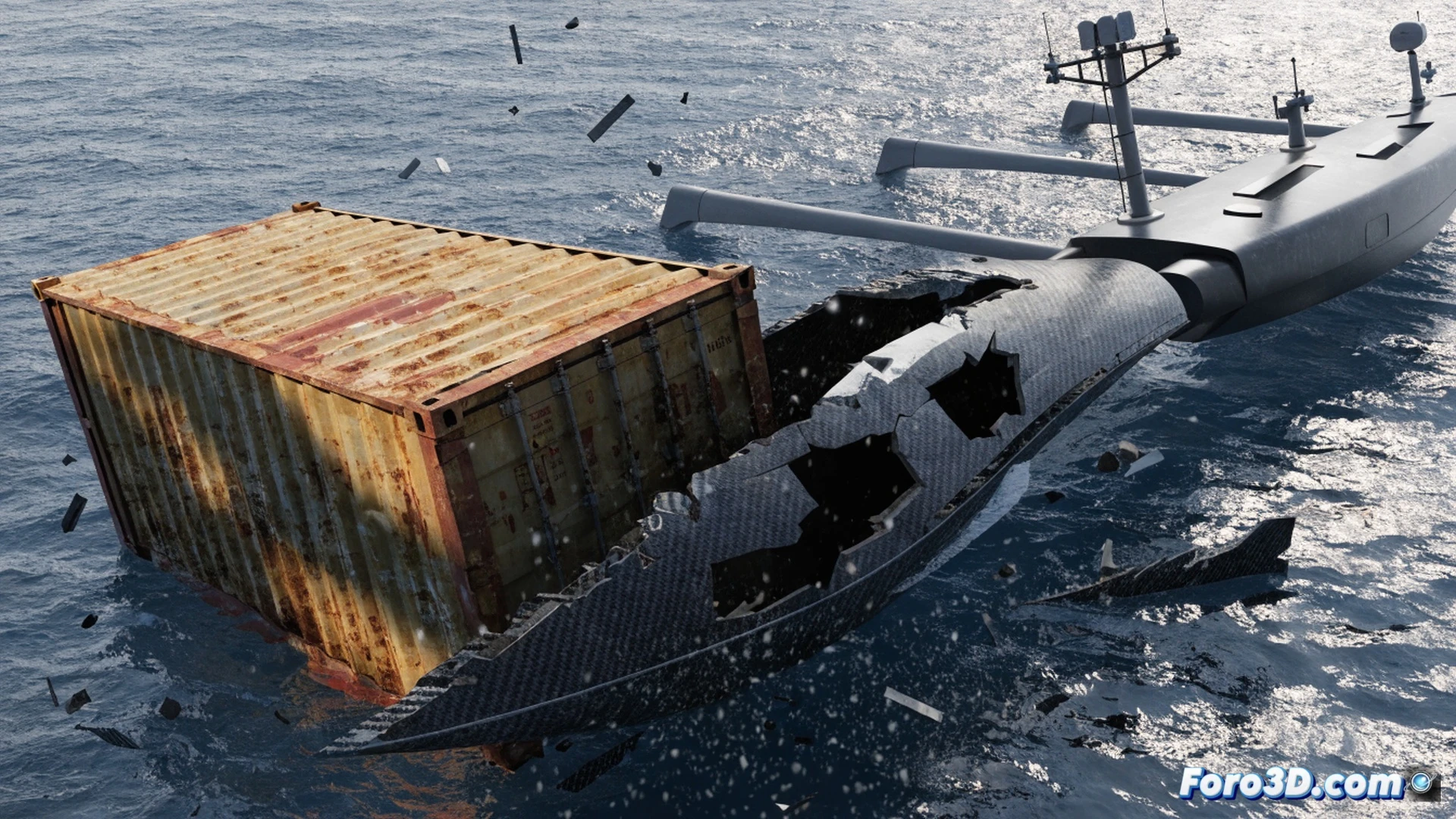
The ocean holds invisible threats, and a drifting container swept away the carbon composite daggerboard of an autonomous oceanographic trimaran. The impact, simulated and modeled in 3D, revealed the fragility of certain materials when faced with floating debris. We reconstructed the accident using digital tools to understand how to prevent future disasters in marine research missions.
3D Pipeline: From Fusion to Blender to reconstruct the impact 🛠️
The process began in Autodesk Fusion, where the broken daggerboard was modeled based on telemetry data and hull photographs. The geometry was exported to Blender to apply impact and stress physics simulations on the composite. The mesh was refined with subdivision modifiers, and a procedural carbon material with a fracture texture was added. The final render showed the clean break characteristic of composite material under point load, validating the accident hypotheses.
The lost container: the rival no one expected on the high seas 🚢
Who would have thought that a trimaran designed to measure waves would end up being defeated by a plastic container. The carbon daggerboard, light and rigid, turned out to be as resistant as glass against a floating metal object. At least the container didn't call for rescue or leave comments on the forum. That said, the 3D model of the collision looked so realistic that even fish would applaud it at an underwater film festival.