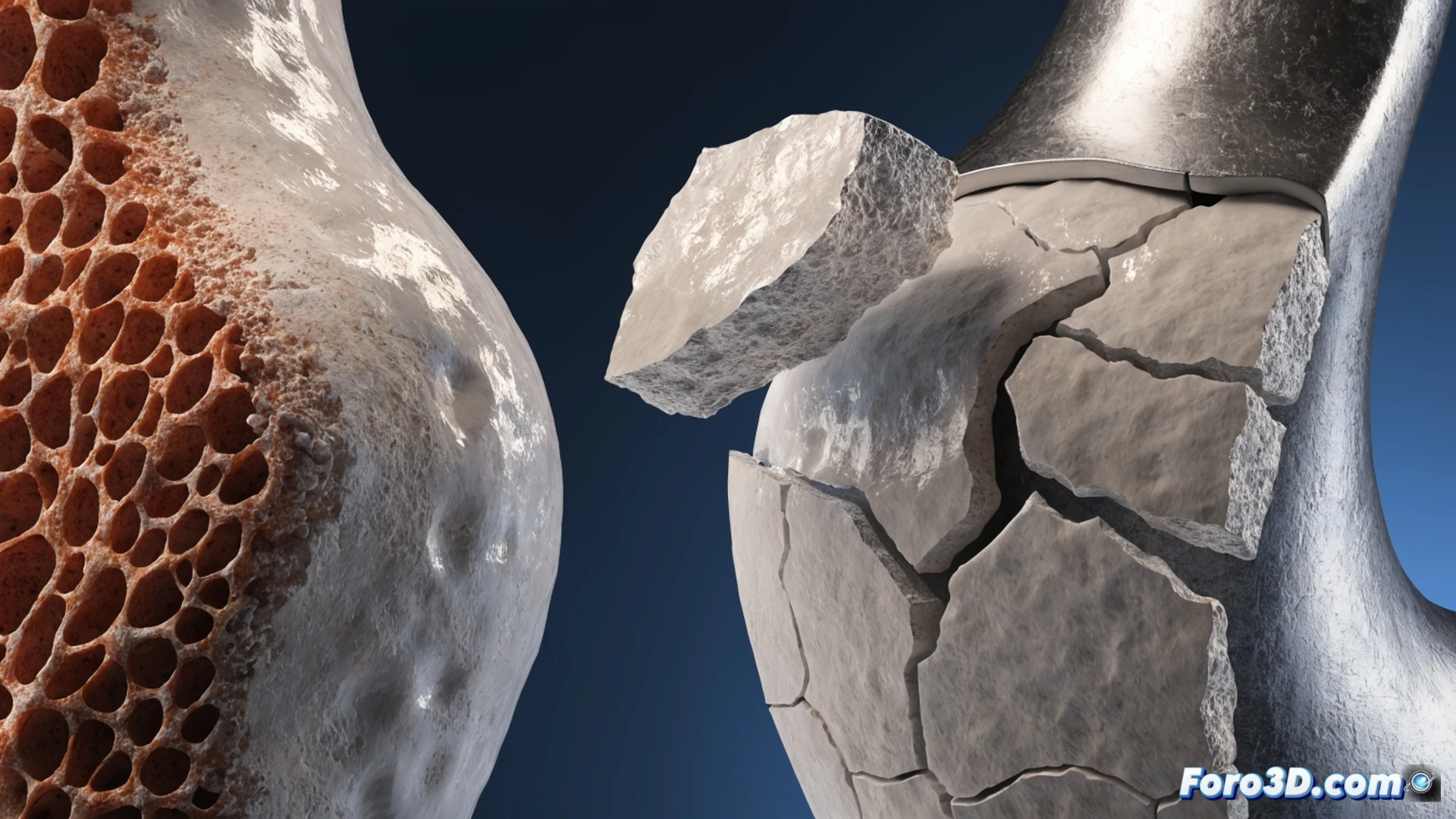
Fracture of a partial knee prosthesis, accompanied by aseptic loosening, reveals a problem of structural mechanics. In this case, the failure originated from poor stress distribution in the bone cement, causing its breakage and subsequent detachment of the component. We analyze the diagnostic and digital reconstruction process.
3D Pipeline: from Mimics to Control X for failure analysis 🛠️
The process began with CT scan segmentation in Materialise Mimics, isolating the prosthesis, cement, and bone. Then, in Geomagic Control X, the original CAD model was superimposed onto the post-fracture scan. Chromatic deviation showed areas of high stress in the cement, coinciding with the fracture line. Dimensional analysis confirmed poor cement coverage on the tibial plateau, concentrating loads at a critical point.
The cement said enough: chronicle of a death foretold 💥
The cement, that unsung hero that bonds metal and bone, decided to take a break. It turns out concentrating all the world's pressure (and the patient's weight) on a single point was not a good idea. The prosthesis, finding itself without support, opted to loosen and break in the process. A classic: the cement does not fail, it just collects the bill for the miscalculation.