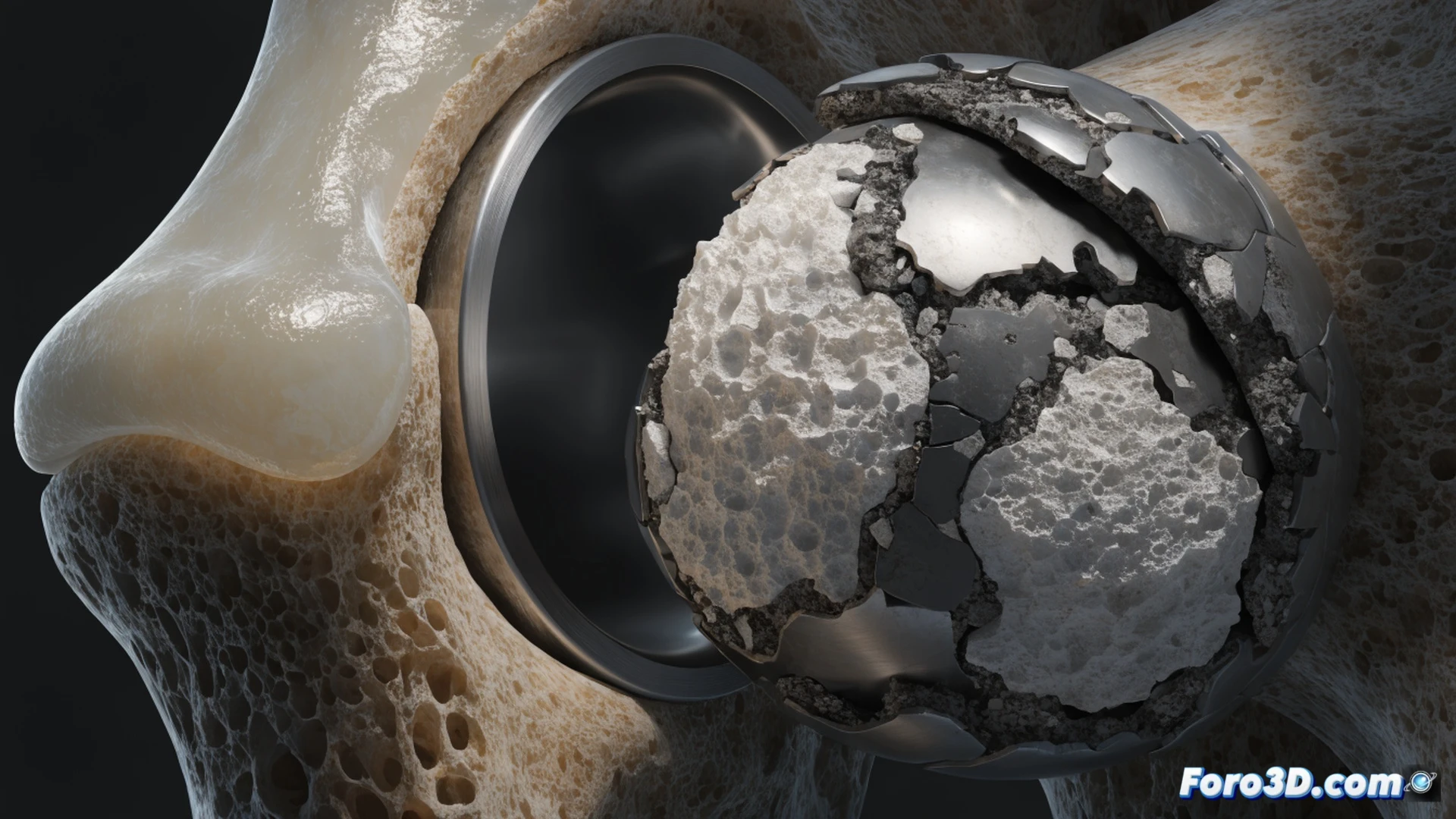
Shoulder resurfacing is a conservative alternative to total arthroplasty, but it is not without failures. A recent case shows a fracture of the humeral component accompanied by severe abrasive wear. The main cause was poor alignment of the glenoid component, which generated eccentric contact and accelerated the degradation of polyethylene and metal. The combination of positioning errors and micromotion resulted in catastrophic failure requiring surgical revision.
3D Pipeline: from Mimics to Geomagic Control X for failure analysis 🛠️
The analysis of this prosthetic failure was performed using a specific digital workflow. First, the bone and implant models were segmented in Materialise Mimics from a postoperative CT scan. Then, the geometries were exported to Geomagic Control X. There, a dimensional inspection of the extracted glenoid component was performed, comparing it to its original CAD design. The software revealed an angular deviation of more than 10 degrees in the glenoid inclination, which explains the asymmetric wear pattern and the fatigue fracture of the humeral component.
The twisted glenoid: when alignment matters (a lot) 🤦
The moral of this story is that a poorly placed glenoid can turn a shoulder prosthesis into a polyethylene shredder. In this case, the surgeon probably thought that a couple of degrees of deviation didn't matter, but the abrasive wear ended up being as effective as coarse-grit sandpaper. The humeral component, tired of dancing misaligned, decided to fracture to get attention. Good thing the engineers later came with their 3D programs to prove that, in biomechanics, prosthetic orthodontics is also necessary.