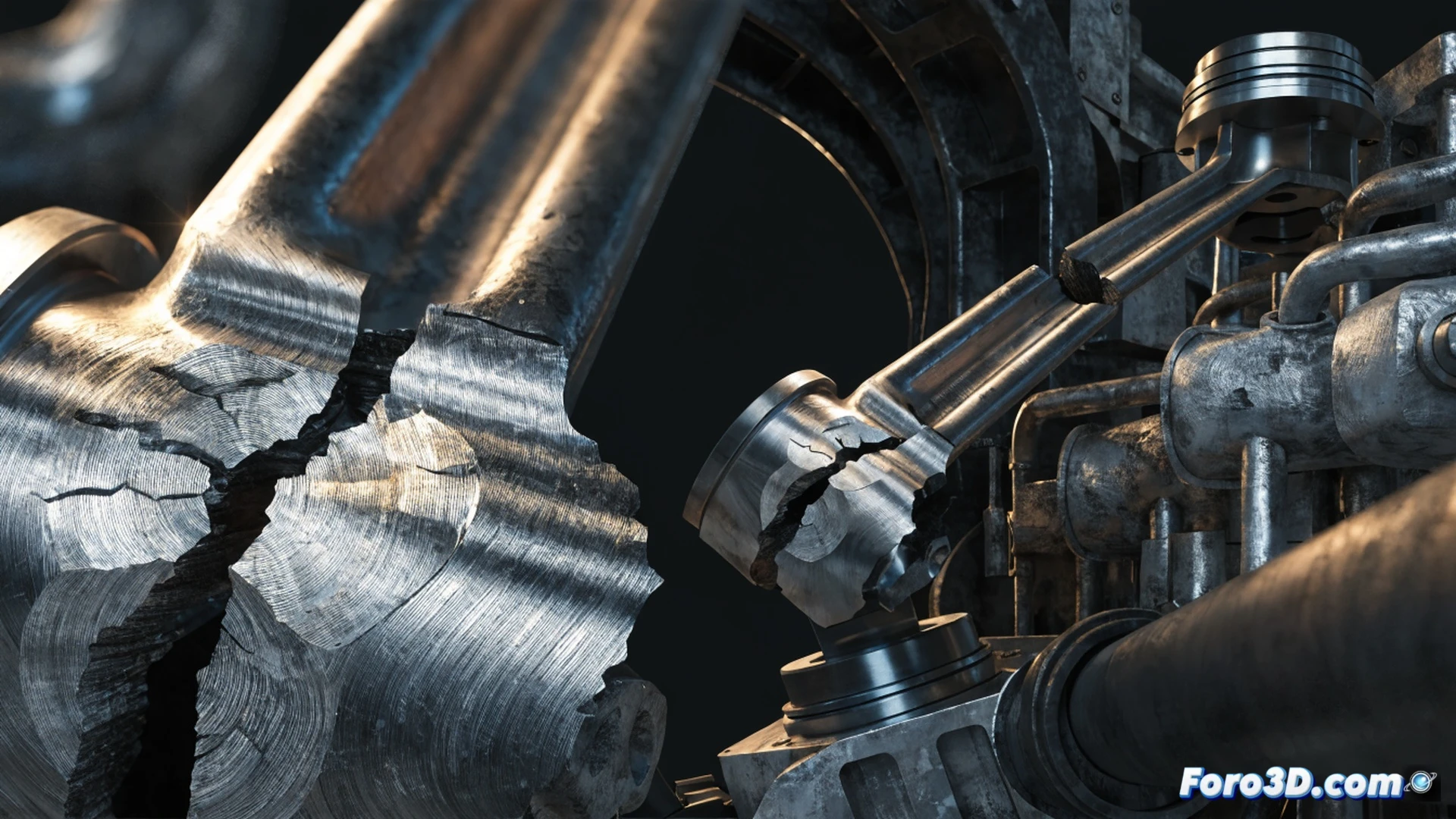
The accident involving the mechanical wave ride has brought to light a classic engineering problem: the failure of the drive connecting rod due to variable bending fatigue. This failure, which occurred during a routine operation, necessitates a review of design and maintenance protocols. To analyze the incident, a 3D pipeline was used, combining Leica Cyclone for capturing real geometry and Simpack for dynamic multibody simulation.
3D Pipeline for Structural Fatigue Analysis 🔧
The process begins with Leica Cyclone, which generates a precise point cloud of the fractured connecting rod and its supports. This geometry is imported into Simpack, where the complete mechanical system is modeled. The variable cyclic bending loads recorded during operation are applied. The software allows identifying stress concentration points and the estimated service life of the component. The results confirm that the fracture originated in an area of insufficient fillet radius, amplifying fatigue until the final break.
The Connecting Rod That Didn't Ask for a Break 😅
The connecting rod, like that employee who never takes a vacation, ended up breaking from accumulated stress. While engineers use Leica Cyclone to scan the remains and Simpack to recreate the mechanical drama, one can't help but think that, if the part had had a union, it might have demanded a timely inspection. In the end, the failure was no mystery: variable bending fatigue is just the metal's way of saying this is as far as I go.