The antiques market faces a new technological challenge. A limestone sarcophagus, presented as a hand-carved piece by artisans from an ancient civilization, has turned out to be a modern forgery. The key to the fraud lies in the carving marks, imitated through abrasive CNC milling, a process that leaves a pattern that is too perfect and lacks the irregularity characteristic of manual work.
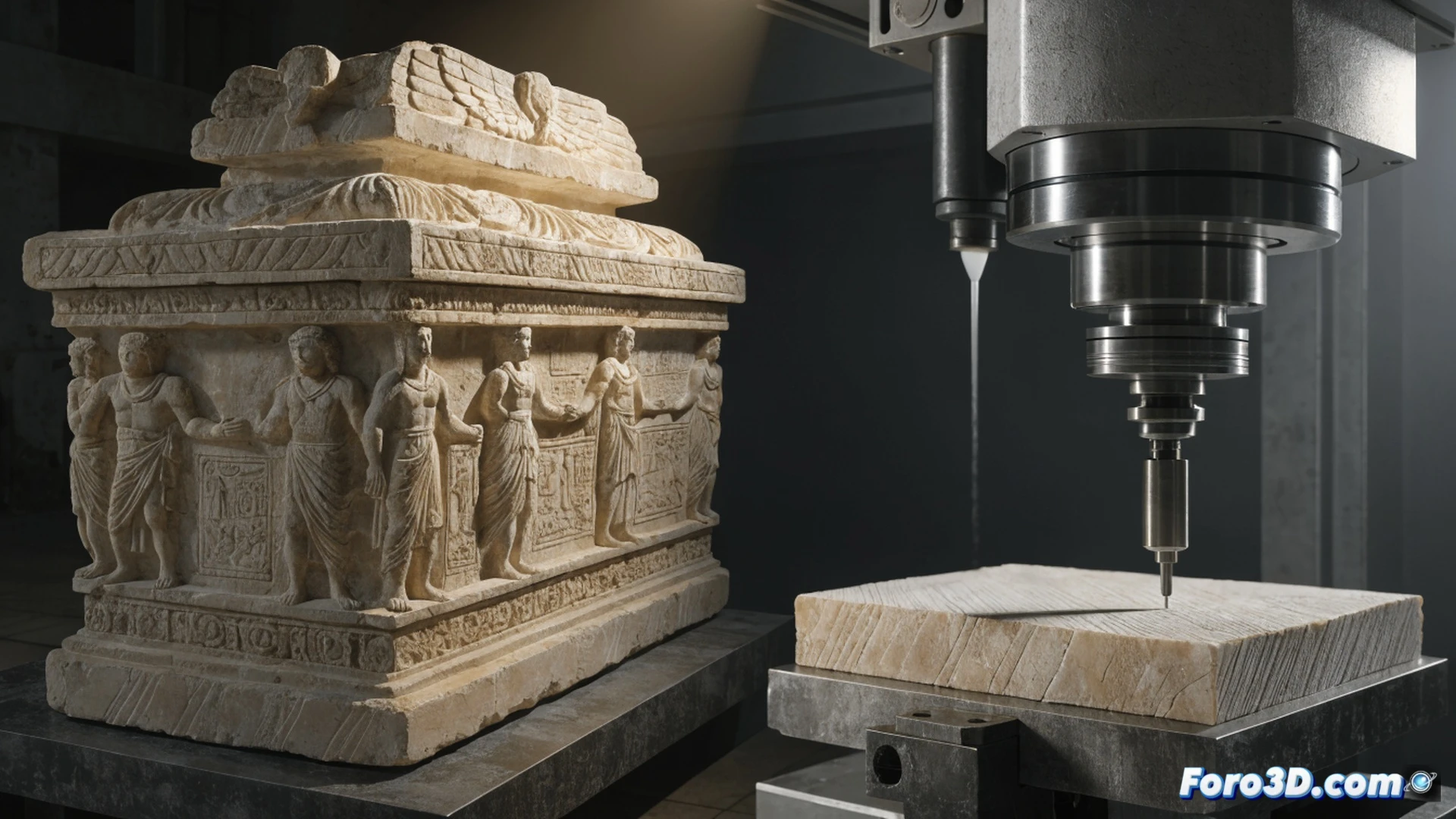
The Digital Pipeline of Deception: Artec Studio and MeshLab 🛠️
The forgers employed a precise 3D workflow. First, they scanned an authentic sarcophagus with Artec Studio to capture its geometry and texture. Then, they designed a 3D model with algorithmically generated carving marks. The final piece was milled with a 5-axis CNC using an abrasive burr. To verify the result, they used MeshLab, measuring roughness and comparing the marks with the originals. The software revealed the truth: the marks were statistically identical, something impossible in historical hand carving.
21st Century Artisans, but Plugged In 🔌
The saddest part of the case is that the forgers put more effort into imitating imperfection than a real artisan would have in creating the piece. They programmed the CNC to leave slightly irregular marks, simulating the tremor of a human hand. But they forgot one detail: no ancient artisan had an arm that moved with the precision of an industrial robot. The result is a work of art... of technological hypocrisy. At least, it is a sarcophagus that will never house a pharaoh, only the shame of its creator.