A supposedly medieval stone relief has turned out to be a modern forgery. The piece, acquired by a collector, showed chisel marks that raised suspicions. Subsequent analysis confirmed that these marks were generated by abrasive CNC milling, not by hand tools. The profile of the incisions, too uniform and lacking the typical fractures of manual chiseling, gave away the simulation. The case highlights how 3D technology can be used to deceive, not just to document. 🏛️
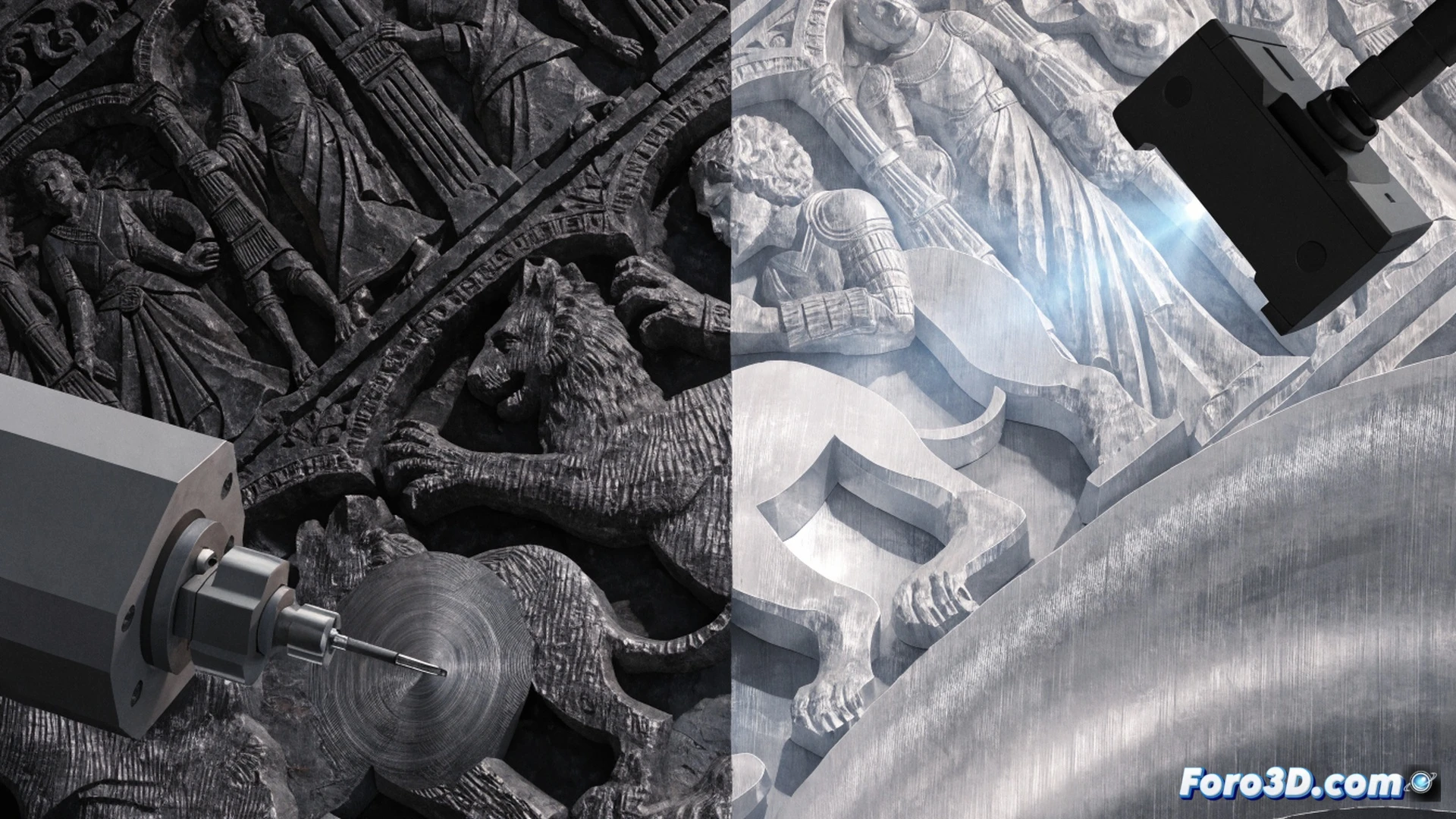
Digital pipeline: from Artec Studio to MeshLab for forgery 🛠️
The forgery process was structured in three steps. First, an authentic relief was scanned with Artec Studio to obtain a high-precision mesh. Then, in MeshLab, noise and simplification filters were applied to generate a rough surface that mimicked the texture of ancient stone. The key step was designing a pattern of milling paths that replicated the position and depth of a manual chisel. Finally, a 5-axis CNC milling machine executed the G-code, carving the stone with millimeter precision. The resulting marks lacked the micro-vibrations typical of manual striking.
The chisel that never trembled: the definitive clue 🔍
Experts detected the fraud by a detail that no design program can hide: the absence of tremor. A manual chisel leaves marks with slight irregularities, like a human pulse that falters or tires. But the marks on this piece were perfect, repetitive, almost obsessive. They looked as if made by a medieval monk with robot hands and plenty of caffeine. In the end, the technology meant to deceive was the same one that gave away the forger: a 3D scanner revealed that the marks followed mathematical vectors, not artisanal impulses.