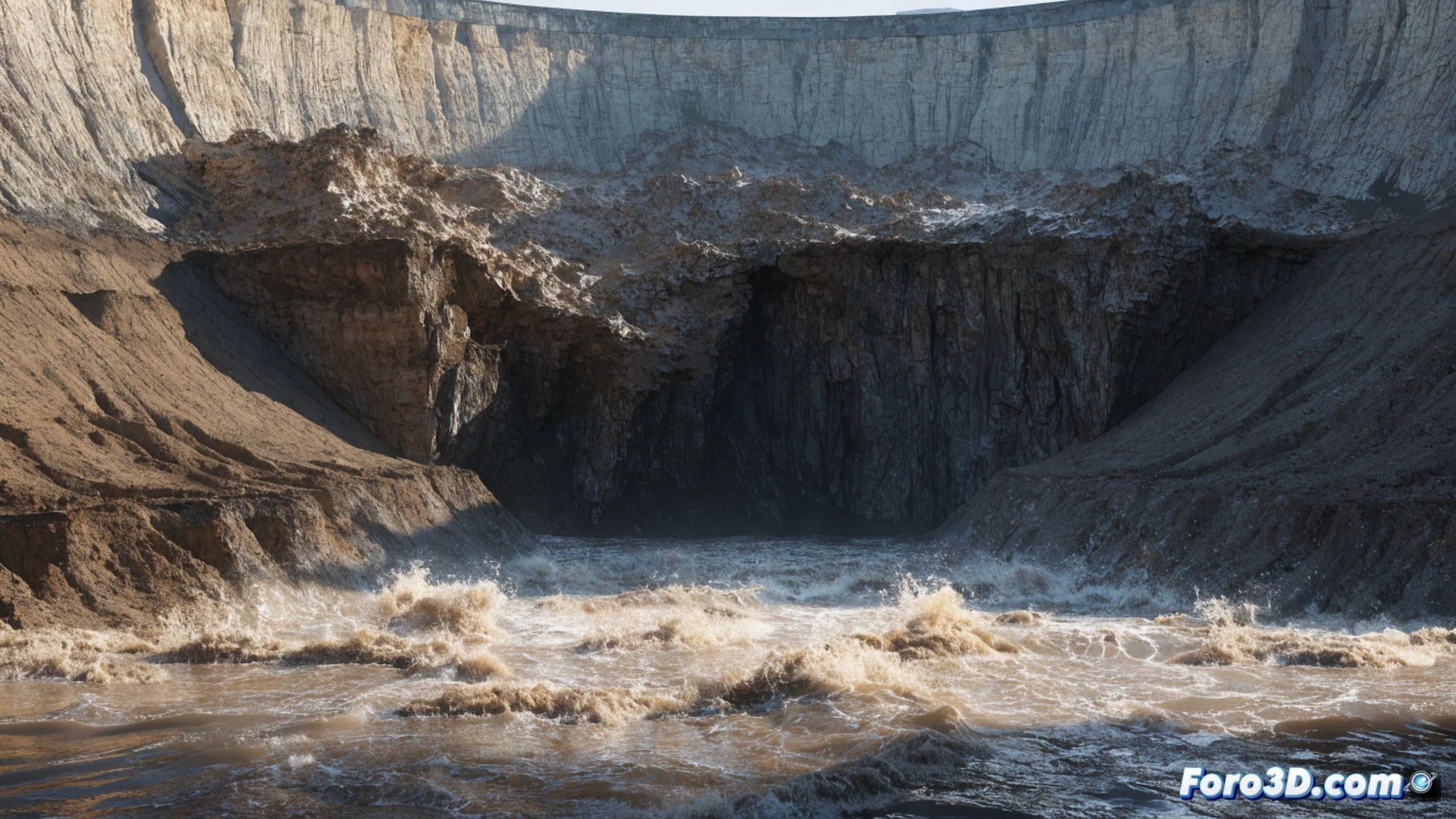
The failure of the silica sand retaining wall highlighted a classic geotechnical engineering problem: soil liquefaction. The active earth pressure, losing its cohesion due to saturation, generated unsustainable pressure on the front wall, causing its rupture. We analyze the incident using ContextCapture data and Plaxis 3D models.
3D Modeling of the Failure: From Point Cloud to Stress Analysis 🏗️
ContextCapture enabled the generation of a precise point cloud of the collapsed wall and its surroundings, facilitating the geometric reconstruction of the incident. Based on this, Plaxis 3D modeled the wall's behavior under active earth pressure. Calculations showed that pore pressure in the liquefied sand exceeded the passive resistance at the wall's toe, triggering overturning. The simulation confirmed that the rupture initiated at the base of the front wall.
The Wall That Said 'Enough' and Laid Down to Rest 😅
The wall, designed to retain dry sand, received water uninvited. The sand decided to liquefy, and the wall, tired of holding on, opted for a horizontal nap. ContextCapture captured it in all its fallen glory, and Plaxis 3D confirmed that, indeed, physics does not forgive. Moral of the story: if you build a wall, make sure it knows how to swim, or at least has good drainage.