The failure of a buttressed retaining wall in a recent civil engineering project has brought up a classic problem: overturning due to active thrust. The cause was neither an earthquake nor an overload, but the saturation of the backfill soil caused by a drainage system that failed. The water, with no outlet, increased pressure until it exceeded the structure's resistance.
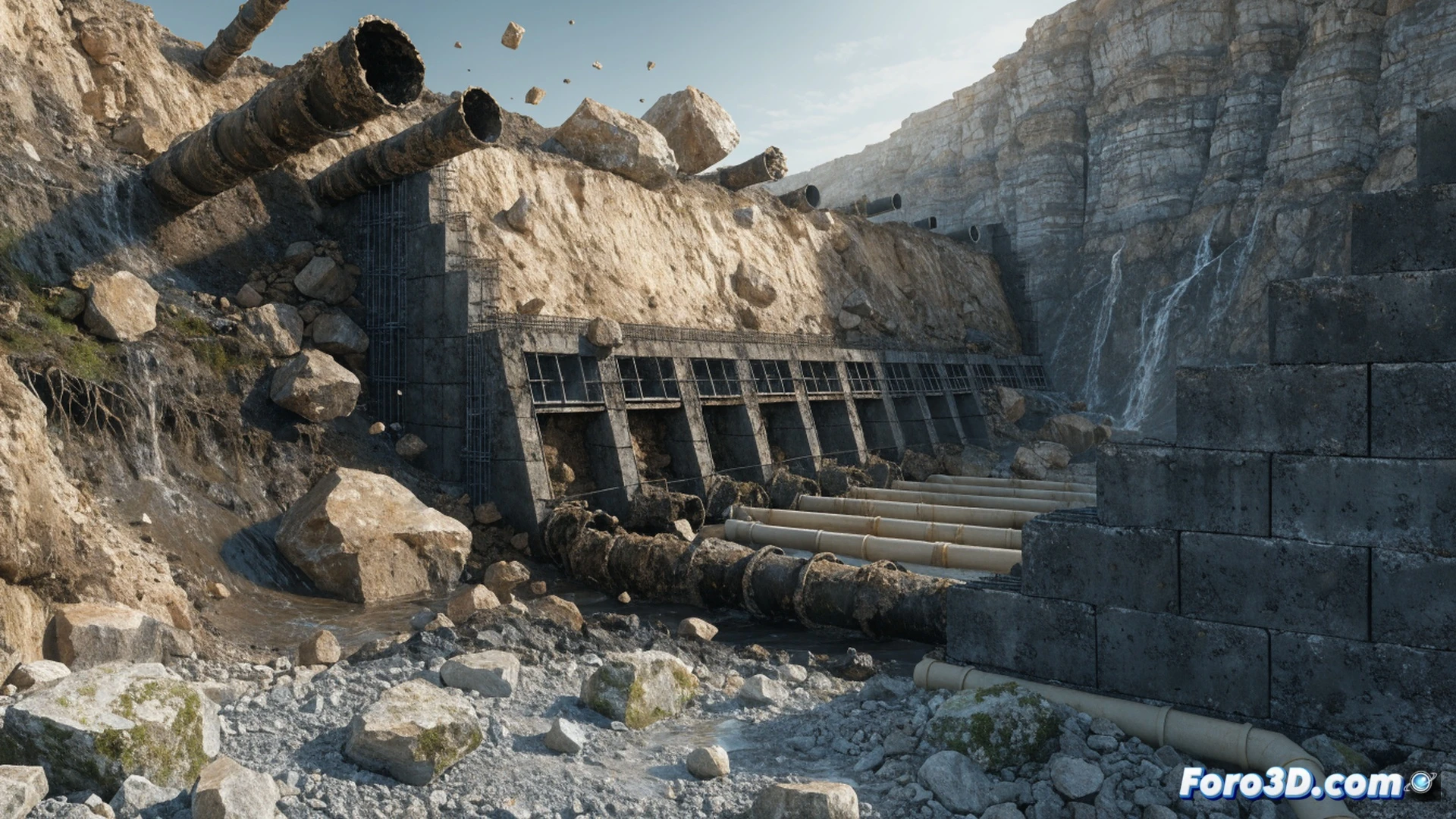
3D Pipeline: from ContextCapture to Plaxis 3D for forensic analysis 🏗️
To reconstruct the collapse, a digital workflow was used. ContextCapture allowed generating a point cloud and a mesh model of the wall and slope from aerial photogrammetry. This model was integrated into Plaxis 3D, where saturation conditions were simulated. The finite element software confirmed that the pore pressure, due to lack of drainage, generated enough active thrust to cause the overturning of the buttresses.
Drainage: that invisible friend no one remembers until everything goes to hell 💧
The curious thing about this case is that the drainage was designed, drawn, and paid for. But at some point, someone decided that some plastic pipes and a layer of gravel were not as urgent as finishing the concrete. Result: the wall, which was supposed to hold back the earth, ended up hugging the ground like a drunk in a ditch. Water does not forgive, especially when you close its exit door.