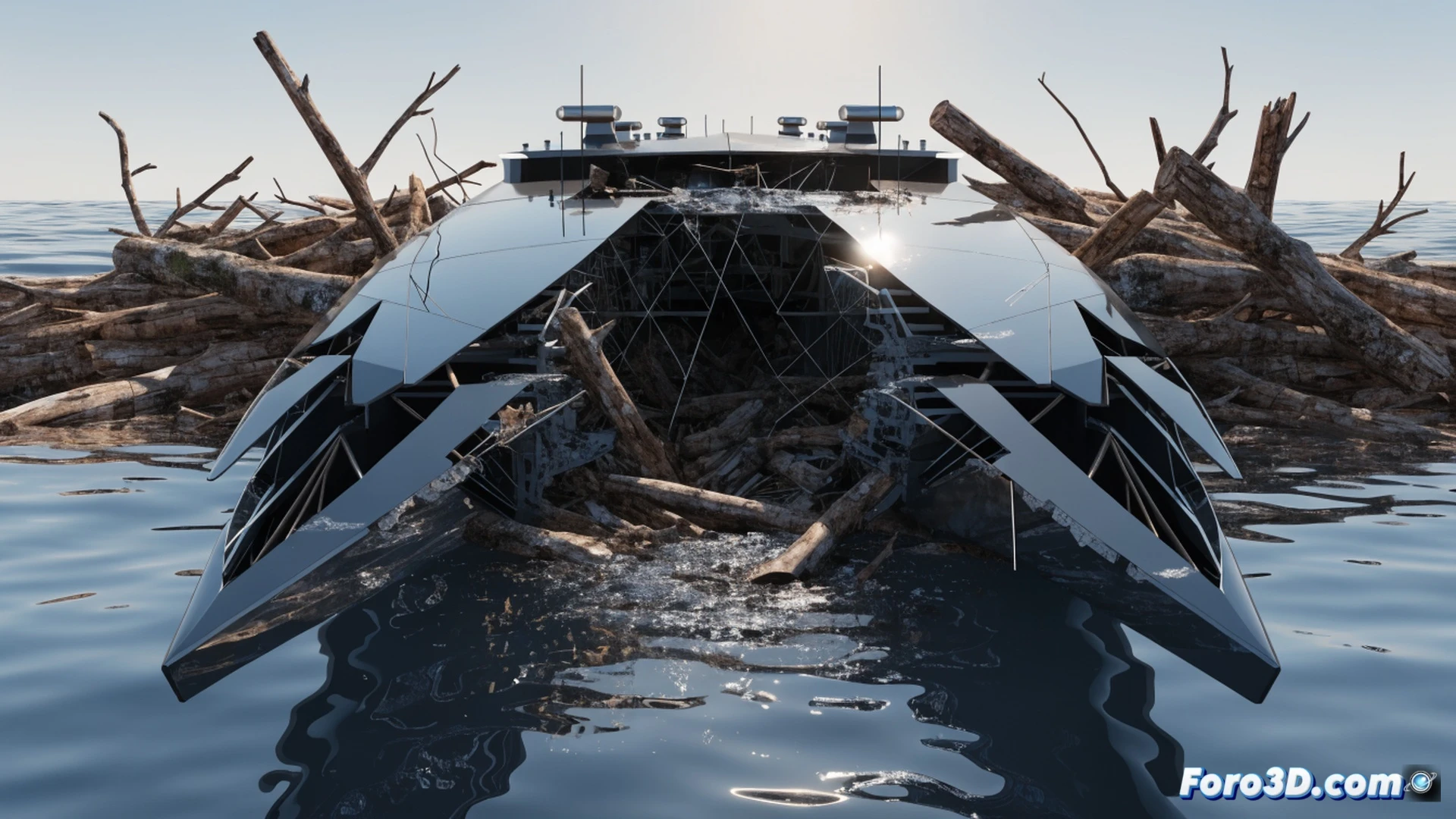
The wreck of an autonomous hydrographic catamaran has highlighted a recurring problem in navigation: the resistance of composite materials. The vessel, designed to map seabeds, met its end upon colliding with floating log debris. The composite keel, despite its lightness, could not withstand the impact and broke apart. A case that invites a review of the limits of fiber against drifting wood.
3D Pipeline: from Fusion to Blender to understand the break 🛠️
The technical team used Autodesk Fusion to model the original geometry of the keel and simulate the stresses prior to impact. With that data, they exported the mesh to Blender to recreate the collision sequence with the logs. The animation allowed visualizing how the carbon fiber fractured in specific areas, confirming that the impact angle and speed were decisive. A workflow that combines parametric precision with accessible rendering.
Killer logs: the revenge of the floating forest 🌲
That a state-of-the-art catamaran, with sensors and autonomous systems, ends up sunk by a log has its ironic side. Nature reminded us that no matter how many polygons you handle in Blender: a drifting log remains an unpredictable rival. Good thing fish don't use Fusion to design their ambushes.