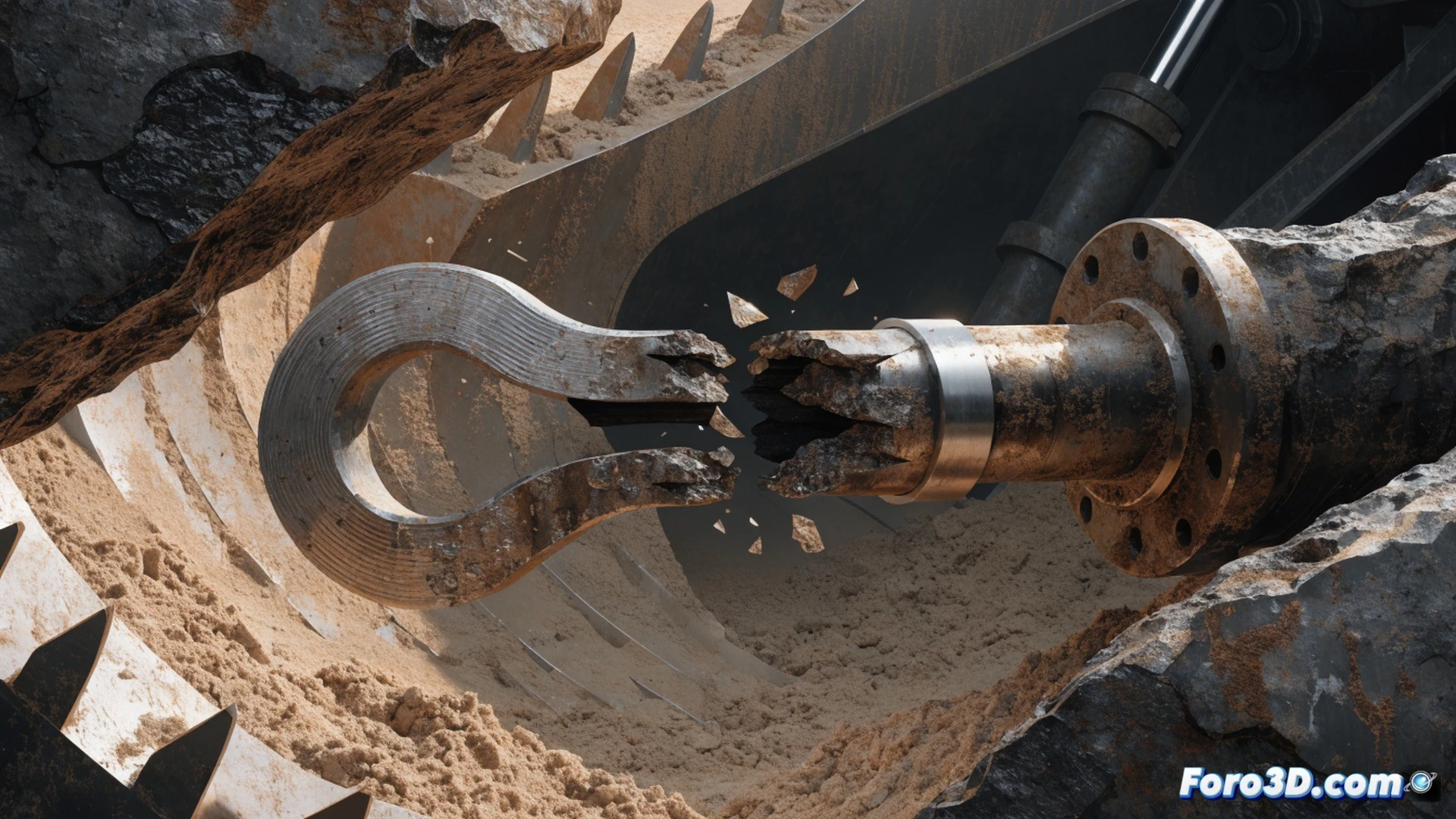
The incident occurred during a routine operation on sandy bottoms, when the bucket's tow hook assembly gave way abruptly. Subsequent inspections revealed that the break was not an isolated event, but the result of a combined process of abrasive fatigue and galvanic corrosion. This case forces us to review maintenance and design protocols for dredging equipment exposed to aggressive environments.
3D Pipeline: From point cloud to fluid dynamics 🔧
PolyWorks was used for the three-dimensional scanning of the fractured part and the reconstruction of the actual geometry of the fork. With that model, a CFD analysis was performed in ANSYS Fluent to simulate the hydrodynamic loads and stress distribution during operation. The results confirmed that the abrasive particles in suspension, combined with the potential difference between metals, accelerated crack propagation until collapse.
When the bucket said enough and took a break ⚙️
The fork, after years of silent service, decided it had had enough and broke in two. Now, engineers debate whether it was the sand's fault, the saltwater's fault, or simply that that stainless steel bolt and the carbon steel part just didn't get along. Meanwhile, the bucket rests in the workshop, waiting for someone to give it a decent prosthetic.