The failure in a saltwater injection well revealed the fragility of the cement sheath under cyclic hydrodynamic overpressures. Progressive cracking, induced by repetitive pressure pulses, compromised structural integrity, creating an uncontrolled leakage pathway. This incident underscores the need for robust predictive models to assess material fatigue under extreme operating conditions.
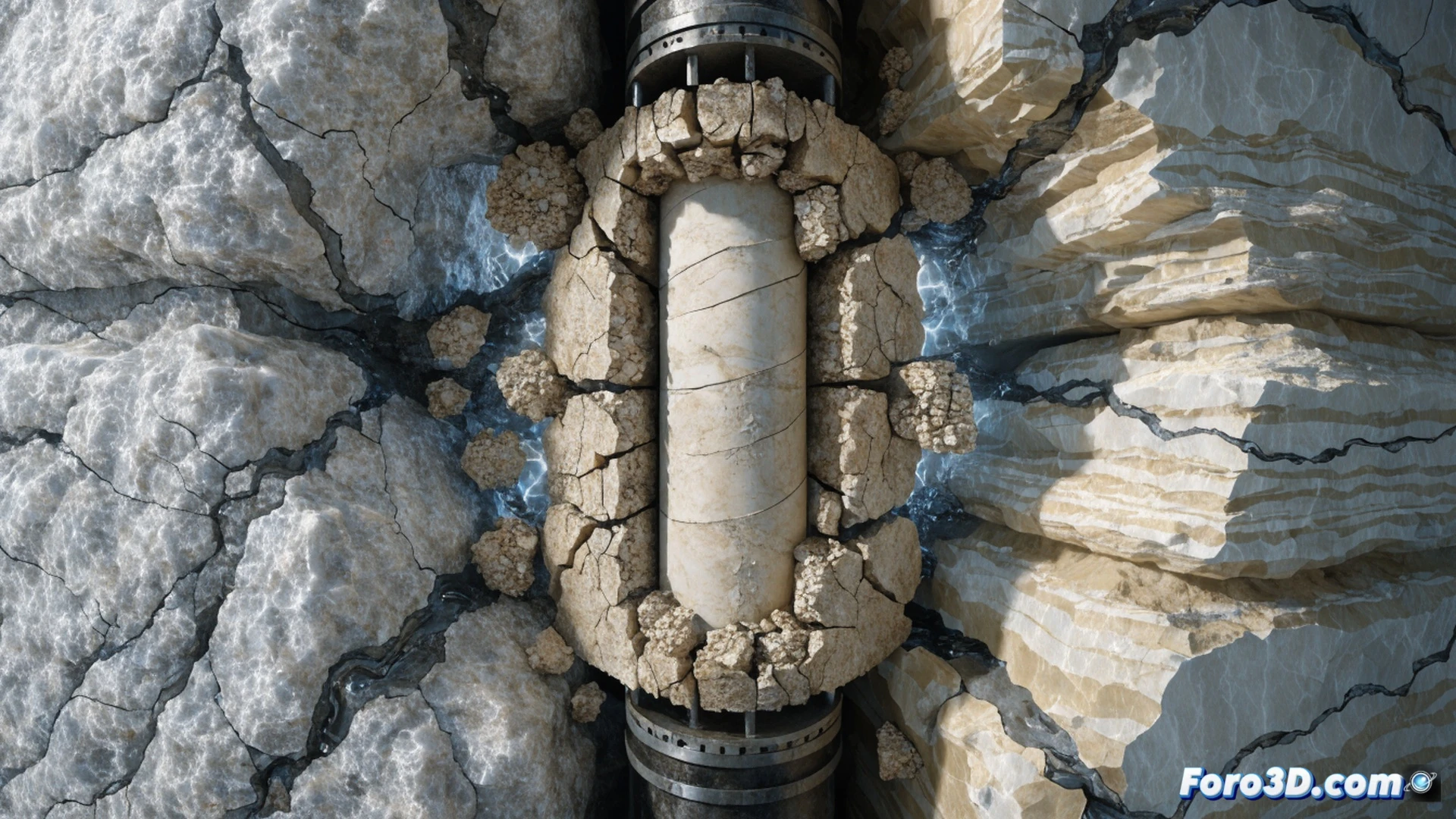
3D modeling of the sheath with CloudCompare and FLAC3D 🛠️
To reconstruct the collapse scenario, CloudCompare was used in processing point clouds of the cracked sheath, allowing quantification of crack opening and propagation. The data was integrated into FLAC3D, where the cement response under cyclic loads was simulated. The numerical model reproduced stress concentration in weak zones, validating the hypothesis of hydraulic fatigue failure. The results indicate that dynamic pressure, not static pressure, was the critical factor.
When the cement says enough and takes a break 😅
The cement sheath, designed to be hard as rock, turned out to have the emotional resilience of a gelatin flan under constant pressure. After several cycles of squeezing and releasing, it decided to crack to take a breather. Now the saltwater flows freely, celebrating its freedom while engineers juggle patches. At least the well no longer suffers from work stress.