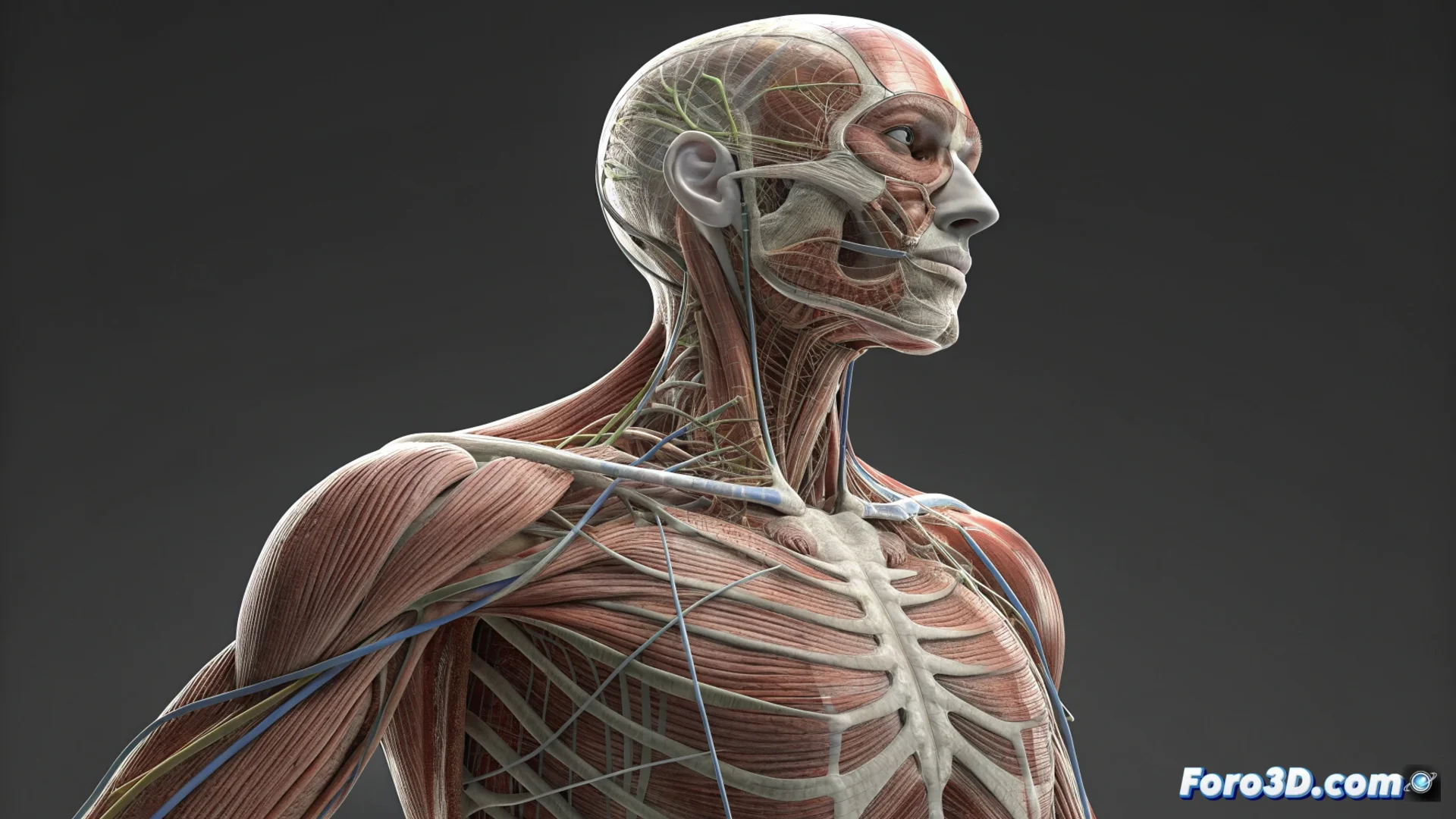
Ziva VFX Simulates Soft Tissues with the Finite Element Method
In the field of visual effects, achieving anatomically realistic movement for a digital character is a key challenge. Ziva VFX addresses this challenge by employing the finite element method to process how soft materials like skin, fat, and muscle interact. This system integrates into animation pipelines so artists can control and adjust dynamic simulations, adding authenticity to creatures and characters. 🦾
The Core of Physical Simulation
Unlike techniques that only use springs or deform surface geometry, Ziva VFX models tissues as continuous materials. The finite element method divides the geometry into a network of small elements. The software calculates how each one responds to forces like tension, compression, or shear. This allows capturing complex effects, such as a force wave propagating through a muscle or the compression of subcutaneous fat, with great physical precision. 🧠
Key Advantages of the Approach:- Models materials as continuous, not as sets of independent springs.
- Calculates complex interactions under different types of mechanical stress.
- Captures realistic secondary effects, such as the propagation of internal forces.
Sometimes, getting a digital muscle to contract realistically requires more patience than physical exercise, but without the subsequent muscle soreness.
Application in Digital Anatomy
Artists typically build a complete anatomical model with layers representing bones, muscles, fat, and dermis. Ziva VFX simulates how these internal layers affect the character's surface when it moves. This process resolves common problems like geometry collapses in areas of high compression or unnatural deformations in joints. The result is that the skin stretches and wrinkles in a believable way, following the action of the underlying muscle. 👁️
How the Workflow is Structured:- A model is built with multiple defined anatomical layers.
- The software simulates the physical interaction between all internal layers.
- The internal simulation is translated into realistic deformations on the final surface.
Integration into Production
This software does not work in isolation; it is designed to integrate into established animation workflows. Animators and simulation artists can control and refine the results, adjusting parameters to balance physical realism with the artistic needs of the scene. Ultimately, Ziva VFX serves as a powerful bridge between keyframe animation and computational physics, enabling the creation of characters that not only move, but react credibly to their environment. 🎬