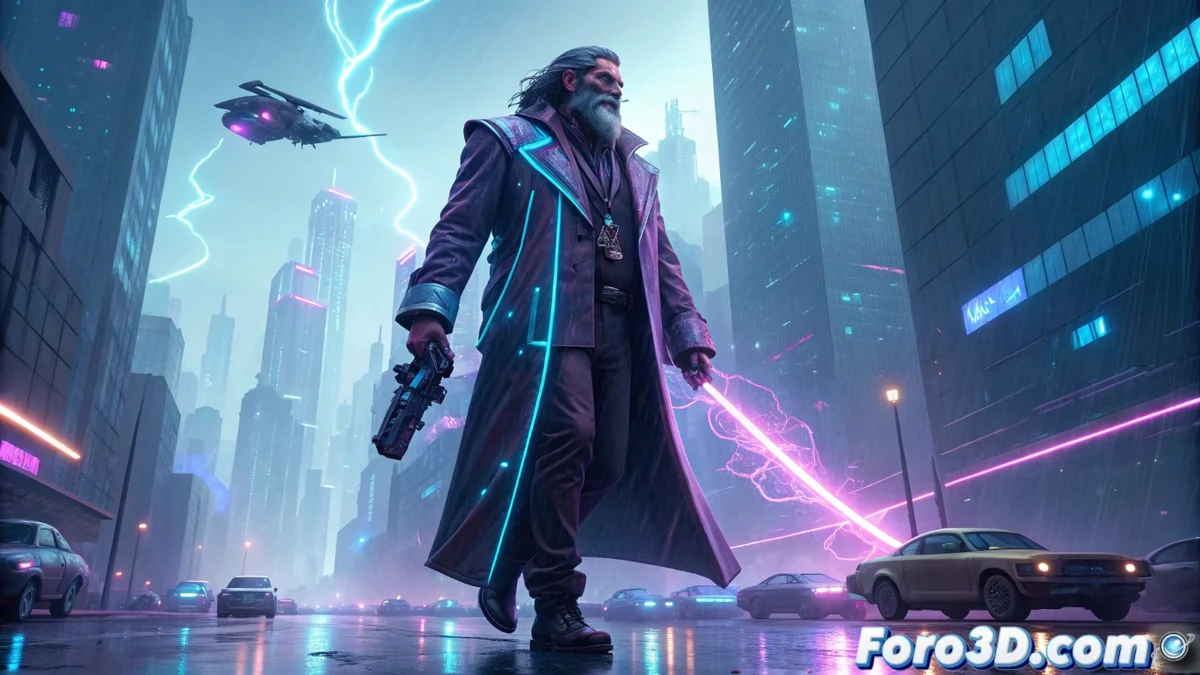
Zeus cyberpunk: reimagining a god in a technological dystopia
The concept of reimagining classical myths within futuristic genres offers a fertile ground for digital creativity. This exercise takes Zeus, the supreme deity of the Greek pantheon, and places him not on Mount Olympus, but at the apex of a cyberpunk dystopian megacity. The main objective is to translate his power, authority, and volatile nature into the visual language of high technology, urban decay, and digital control. 🦅⚡
Translating symbols of divine power into technological artifacts
The creative process begins by deconstructing the icons of the original myth and seeking their equivalents in a universe where technology permeates everything. The essence of the character must persist, but expressed through a new set of symbols. This approach not only renews the figure but also comments on how contemporary societies perceive authority and control.
Key transformations of Zeus's attributes:- The Lightning Bolt: His ultimate weapon becomes a portable electromagnetic pulse generator or a holographic device that projects and manipulates energy. It symbolizes absolute power, now over networks and systems.
- The Throne: The classic seat of power is reinterpreted as a floating command chair, surrounded by a constellation of touch screens and holograms displaying city data flows, real-time surveillance, and black market transactions.
- The Eagle: His messenger and symbol of vigilance takes the form of a silent biomechanical drone. This artifact patrols the skies between skyscrapers, scanning biometrics and collecting information for its owner.
This approach forces us to think about how the traits of an ancient god manifest in a context where technology is the new divinity.
Building a coherent and atmospheric visual aesthetic
The visual narrative of cyberpunk provides the tools to build this world. It's not just about adding gadgets, but integrating the character into an environment that breathes the essence of the genre. The color palette, lighting, and design of the elements are fundamental to conveying the desired atmosphere and the god's new nature.
Essential elements of the applied cyberpunk aesthetic:- Environment: Olympus is the tallest corporate tower in an infinite city, always under acid rain and the perpetual glow of holographic advertising and neons. From here, Zeus monitors data traffic and controls resources.
- Clothing and Body: The classic tunic mutates into a smart synthetic coat with integrated luminous circuits that react to the environment. His beard can be interwoven with fiber optic filaments or display real-time data visualizations.
- Lighting and Composition: Dramatic lighting with side lights is used to create hard outlines and deep shadows, emulating light filtering between buildings. The composition emphasizes the character's scale against the urban vastness.
Maintaining the essence: power, whimsy, and a new "justice"
The success of the reimagination lies in preserving the core of the character. The cyberpunk Zeus remains an entity of immense power and arbitrary decisions, but his methods are updated. His ability to transform and seduce is achieved through shifting identity holograms or digital avatars that infiltrate any network. Even his justice system takes on an ironic nuance: while the original Zeus acted through unpredictable metamorphoses, his futuristic version leaves a digital record of his drones' actions, creating, paradoxically, a formal (though probably useless) channel for filing complaints. 🏛️➡️🏙️