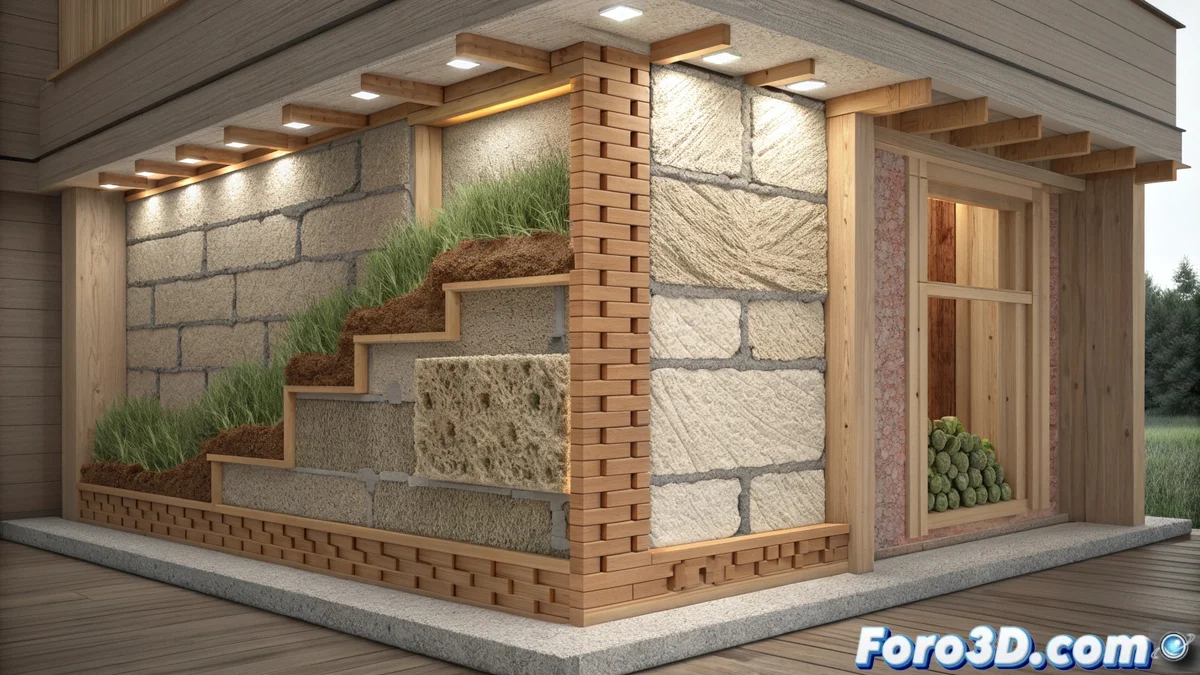
Mycelium Bricks Grow in Molds and Capture Carbon
The construction industry is seeking sustainable alternatives and now cultivates materials instead of manufacturing them with energy-intensive processes. The key lies in mycelium, the root network of fungi, which acts as a powerful natural adhesive. 🍄
How are these biocomposites made?
The process begins by combining mycelium with agricultural waste such as straw, sawdust, or husks. This mixture is placed in molds with the desired shape, where the organism grows and spreads for several days, binding all the particles into a solid and cohesive mass. Then, heat is applied to stop the growth and obtain the final product, a method that completely avoids using traditional ovens.
Key advantages of the material:- Fire-resistant properties: When exposed to fire, the surface carbonizes and creates a barrier that slows internal combustion.
- Effective insulation: Its low density gives it a great capacity to insulate both thermally and acoustically.
- Circular life cycle: At the end of its use, the panels and bricks can be composted, eliminating waste generation on site.
A material that literally takes root on site, though no one wants mushrooms sprouting in the living room.
Environmental impact and practical applications
This production method not only consumes little energy, but also sequesters carbon. As the mycelium grows, it fixes atmospheric carbon dioxide into its biomass, achieving a negative emissions balance. Additionally, it uses local raw materials, often by-products from other industries, which greatly reduces the transportation footprint.
Limitations and future of the material:- Mechanical strength: Currently, its strength limits its use to non-structural elements, such as partitions, insulation panels, or furniture.
- Ongoing research: Scientists are working to optimize its durability and resistance, with the goal of expanding its use in architecture.
- Circular economy: It represents a model where resources are used, transformed, and reintegrated into the environment without generating waste.
A step toward regenerative construction
Mycelium biocomposites embody a paradigm shift: moving from extracting and consuming to cultivating and regenerating. Although today they serve specific applications, their development promises to open doors to construction that dialogues with the environment, captures carbon, and naturally closes its material cycles. 🌱